
 Worksheets
Anatomy Chapter 07.1-07.8: The Muscular System
Total questions: 44
Worksheet time: 25mins
What type of muscle contraction occurs when the muscle tenses but does not shorten?
Isometric
Isotonic
Contraction
Relaxation

What type of contraction is occurring here?
Isostabilize
Isokinetic
Isotonic
Isometric
What is the name of the thin myofilaments in a muscle cell?
Actin
Myosin
Myoglobin
Titan
Contractions are generated by
Shortening of thick filaments
Shortening of thin filaments
Sliding of thin filaments past thick filaments
"Accordion-like" folding of thick and thin filaments

The actin is represented by which letter?
A
B
C
D
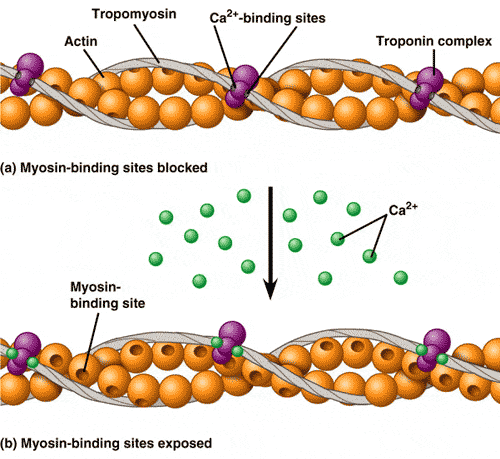
Calcium:
Causes ATP binding to actin
Increases the action potential along the sarcolemma
Binds to proteins on myosin
Triggers the binding of myosin to actin
What attaches the muscle to the bone?
Ligament
Aponeurosis
Epimysium
Tendon
What is a bundle of muscle fibers called?
Actin
Myosin
Fascicle
Sarcomere
When a muscle contracts, it _______.
gets longer
gets shorter
gets thinner
grows hair
This states that the muscle fibers shorten as the actin and myosin filaments pull on each other.
Threshold Stimulus Theory
Sliding Filament Theory
Neurotransmitter Theory
All or None Principle
Tropomyosin covers the actin and prevents the myosin head from attaching to the actin (rope or strand shape).
Tropomyosin
Myosin and actin
Calcium and Oxygen
Glycogen and hemoglobin

What is A pointing to?
Sarcomere
Z disk
A band
I band

What is B pointing to?
Sarcomere
Z disk
A band
I band

What is C pointing to?
H zone
Z disk
actin
I band

What is D pointing to?
H zone
Z disk
A band
I band

What is E pointing to?
H zone
Z disk
A band
I band

What is F pointing to?
H zone
Actin
A band
Sarcomere
The gap between the motor neuron and the muscle fiber it supplies at the neuromuscular junction is called:
H
Z
Synaptic cleft
Sarcomere
Tiny chains of contractile units between two Z disks, which are aligned end to end
H
Z
synaptic cleft
sarcomere
A neurotransmitter that stimulates skeletal muscles
Acetylcholine (ACh)
ATP
Cross bridges
Neuromuscular junction
The only energy source that can be used to directly power muscle activity
acetylcholine (ACh)
ATP
cross bridges
neuromuscular junction
Point where the axon terminals of a nerve cell and the sarcolemma of a skeletal muscle join
acetylcholine (Ach)
ATP
cross bridges
neuromuscular junction
The heads of the myosin myofilaments are called __ when they link the thick and the thin filament together.
acetylcholine (Ach)
ATP
cross bridges
neuromuscular junction
Plasma membrane of a muscle cell
Sarcolemma
Sarcoplasmic reticulum
Thick filament
Thin filament
Specialized smooth endoplasmic reticulum that surrounds each myofibril, stores calcium, and releases it on demand.
sarcolemma
sarcoplasmic reticulum
thick filament
thin filament
Myosin protein is found in which part of a muscle cell?
Sarcolemma
Sarcoplasmic reticulum
Thick filament
Thin filament
Actin is a contractile protein found in which structure?
sarcolemma
sarcoplasmic reticulum
thick filament
thin filament
What is the function of calcium during a skeletal muscle contraction?
Connecting to H zone
Connecting to troponin
Connecting to myofibril
Connecting to myosin
Which of the following refers to the muscle cell?
Myofibril
Myofilament
Fascicle
Muscle fiber
Which component is attached to the Z line?
myosin
actin
thick filament
troponin
What is released from the sarcoplasmic reticulum?
Inorganic phosphate
ADP
Calcium
ATP
Which pathway produces 95% of the energy for muscles?
Anaerobic Respiration
Glycolysis
Direct Phosphorylation
Aerobic Respiration

A single action potential causes a brief contraction followed by a relaxation in the muscle. This is called a single ___________________.
muscle twitch
latent period
contraction period
relaxation period
threshold stimulus

Identify A: Very brief delay between stimulus and contraction.
muscle twitch
latent period
contraction period
relaxation period
threshold stimulus
Identify B: Time when the muscle generates external tension. The force generated can overcome the load and cause movement.
muscle twitch
latent period
contraction period
relaxation period
threshold stimulus
Identify C: Time when tension declines to baseline. SR reabsorbs Ca2+, myosin releases actin, and tension decreases. Takes longer than contraction.
muscle twitch
latent period
contraction period
relaxation period
threshold stimulus

__________ _____________ occurs when a given set of cells is repeatedly stimulated without complete relaxation.
motor unit recruitment
wave summation
stimulus frequency
stimulus intensity

If repeated stimuli are given at a slower rate, then muscle fiber contractions grow stronger as they summate, but the relaxation between the contractions remains incomplete.
incomplete (or unfused) tetanus
complete (fused) tetanus

If repeated stimuli are applied at a fast rate, and no relaxation occurs between the stimuli, the muscle reaches maximum tension and a sustained contraction phase is obtained.
incomplete (or unfused) tetanus
complete (fused) tetanus
This type of muscle tissue is found only in the heart.
Skeletal
Cardiac
Smooth
This type of muscle tissue is found in the walls of hollow organs such as the stomach.
Skeletal
Cardiac
Smooth
Muscle tissue
Is tissue that functions in lining, covering, and glandular tissue
Is tissue involved in protecting, supporting, and binding together other body tissues
Is tissue that contracts and shortens to produce movement
Tissue that receives and conducts electrochemical impulses from one part of the body to another
Which type(s) of muscle tissue have visible striations?
Only Cardiac Muscle
Only Skeletal Muscle
Only Smooth Muscle
Skeletal and Cardiac Muscle

