
NEW
Font size
 Worksheets
Wind, Rain and Air Pressure
Total questions: 41
Worksheet time: 26mins

All rainfall is caused by...
freezing and cooling
air rising
clouds
air falling

How many types of rainfall are there?
1
2
3
4

When the ground heats up, air rises in warm currents and cools down creating...
Convectional rainfall
Frontal rainfall
Relief rainfall

Uh oh there's a mountain or a hill in the way!The wind has to push the warm air up! It cools there to form...
Convectional rainfall
Relief rainfall
Frontal rainfall

A warm and a cold air mass meet!
The warm one slides up over the cold one. It cools to form...
Convectional rainfall
Relief rainfall
Frontal rainfall

Which is most common in a tropical rainforest?
Clue: Air rises and cools rapidly
Convectional rainfall
Relief rainfall
Frontal rainfall

Relief rainfall is also called
frontal rainfall
convectional rainfall
orographic rainfall
very wet rainfall

The correct geographical term for rain is
precipitation
accumulation
condensation
transpiration

Which type of rainfall is seen in the image?
relief
frontal
convectional

True or False?
The image illustrates frontal rainfall.
False
True

Fact or Fiction?
The images illustrates convectional rainfall?
True
False

Which rainfall is most common in the UK?
Clue: Warm tropical air meets cold polar air over the UK!
Convectional rainfall
Relief rainfall
Frontal rainfall

Which is most common in a tropical rainforest?
Clue: Air rises and cools rapidly
Convectional rainfall
Relief rainfall
Frontal rainfall

In the west of the UK, warm air meets hills...
It creates...
Convectional rainfall
Relief rainfall
Frontal rainfall

What causes wind?
differences in air pressure
differences in gravity
difference in oxygen
differences in the thermosphere

What causes differences in air pressure?
even heating of the Earth
Even cooling of the earth
uneven heating of the earth
global warming

What is responsible for warming the Earth’s surface and creating wind?
The Moon
Earth's interior (inside)
Coriolis effect
The Sun

Which statement correctly defines wind?
Wind is the movement of air from areas of low pressure to areas of high pressure
Wind is the movement of air to a colder area in the atmosphere.
Wind is the movement of air from areas of high pressure to areas of low pressure.
Wind is the movement of air pushed around and bouncing off Earth's surface.


Air at the poles is colder and denser so it_______________.
rises
circulates
stagnates
sinks

Air is warmer and less dense at the equator because the equator receives more____________________.
wind
solar radiation
air pressure
condensation
In the Northern Hemisphere, winds traveling north appear to curve east because of the:
trade winds
convection currents
Coriolis effect
polar easterlies

The Coriolis effect is the curving of wind across Earth. What causes winds to curve?
Earth's revolution
Earth's magnetic field
Earth's rotation
Earth's gravitational pull


Which term best describes how the earth's atmosphere is heated?
Spirally
Unevenly
Circularly
Kinetically

What can you conclude about prevailing winds from their name?
They blow from west to east
They blow all the time
The air they contain is very warm
The air they contain is very cool

How are the winds in the northern hemisphere different from winds in the southern hemisphere?
Winds in the northern hemisphere are deflected right; winds in the southern hemisphere are deflected left
winds in the northern hemisphere are deflected south; winds in the southern hemisphere are deflected north
winds in the northern hemisphere are deflected eart; winds in the southern hemisphere are deflected west
winds in the northern hemisphere are deflected left; einds in the southern hemisphere are deflected right

if you wanted to find the jet steam, where would you go?
the area around the poles
the area around the equator
10 km above the earth's surface
1 km above the earth's surface

How do jet streams influence the weather?
by creating clouds
by increasing the moisture in the atmosphere
by moving weather from one area to another very quickly
by drying out the atmosphere

Cool air has __________ pressure.
low
high
medium
unknown

Toward what direction does a West wind blow.
east
south
north
west

It takes _________ energy to warm up a body of water than it does to warm up an equal area of land.
some
equal
less
more
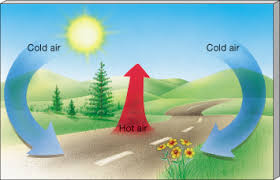
Warm air ____________ at the equator.
rises
sinks
mixes
goes down
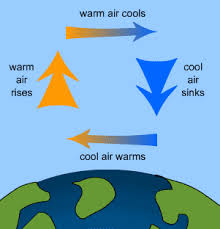
Cold air ___________ at the poles.
has a lot of moisture
gets warm
rises
sinks

The _____________ is the largest cell and extends from the equator to between 30 and 400 North and South.
Hadley Cell
Polar Cell
Ferrel Cell

In these latitudes the cooler air from the poles meets the warmer air from the tropics, causing air to rise.
Polar Cells
Ferrel Cells
Hadley Cells

The _________ cells are found between 60 and 700 North and South. These are typically colder and feature denser air.
Polar Cell
Hadley Cell
Ferrel Cell

Deserts are typically found:
In areas of high pressure
In areas of low pressure
On the windward sides of mountains
At high latitudes

Does this diagram show a warm front or a cold front?
Cold front
Warm front

Most coastal deserts are found on the ______ side of continents.
west
south
north
east

