
 Worksheets
Electrostatics: Electrification Methods
Total questions: 17
Worksheet time: 9mins
Name
Class
Date
1.
What is the name of the particle that is transferred?
a)
Proton
b)
Neutron
c)
Electron
d)
Positron
2.
When a balloon is rubbed on a sweater in what direction do the electrons move?
a)
From the sweater to the balloon
b)
From the balloon to the sweater
c)
They do not move
d)
They travel to the groud
3.
If two balloons have the same charge, what will happen if you place them close to each other?
a)
Nothing
b)
They will be attracted
c)
They will pop
d)
They will push each other away.
4.

What is the name of this device that is used to detect charges?
a)
beaker
b)
electroscope
c)
van de graff generator
d)
chargometer
5.
After you rub a balloon on your hair, what charge does your hair have?
a)
Positive
b)
Negative
c)
Neutral
6.
When a glass rod is rubbed with silk and the glass rod becomes positively charged, what happens to the electrons?
a)
they are removed from the rod
b)
they are added to the rod
7.
After a balloon is rubbed against wool, the two objects will ________ each other because they have ___________ charges
a)
attract; like
b)
attract, opposite
c)
repel; like
d)
repel; opposite
8.
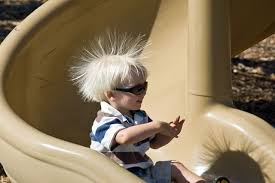
What method of static charging is shown in this picture
a)
Contact
b)
Friction
c)
Grounding
d)
Induction
9.

Which electrostatics phenomena is shown in this picture?
a)
Contact
b)
Friction
c)
Grounding
d)
Induction
10.
What is the end result of charging by friction?
a)
Both object have the same charge, so they will attract one another
b)
Both object have the same charge, so they will repel one another
c)
Both object have the opposite charge, so they will attract one another
d)
Both object have the opposite charge, so they will repel one another
11.
An atom loses an electron. What type of charge does it have now?
a)
positive
b)
negative
12.
Static electricity is:
a)
electricity flowing in a wire
b)
the buildup of electric charges on an object
c)
when protons move between objects
13.
Which is an example of static dischage?
a)
a motor
b)
lightning
c)
thunder
d)
insulators
14.
Static charges build up when
a)
protons move within an object
b)
electrons move within an object
c)
neutrons move within an object
d)
the nucleus moves within an object
15.
Which of these is NOT a way to create a static charge?
a)
Friction
b)
Induction
c)
Electroaction
d)
Conduction
16.
Is it possible to CREATE electrons?
a)
Yes, that's what static electricity is.
b)
No, you can move them, but they are never created or distroyed.
c)
Sometimes, it depends on the voltage.
d)
Sometimes, it depends on the element.
17.
"Static" comes from the Greek word meaning:
a)
stay
b)
discharge
c)
electricity
d)
noise
100 %

