

wayground logo

Free Printable Worksheets

Font size

S
M
L
XL
Worksheets

LT 5.7 - Impulse-Momentum Theorem

Total questions: 19

Worksheet time: 11mins
Name
Class
Date
1.
Softer landings tend to
a)
increase impact force
b)
increase force
c)
increase collision time
d)
increase change in momentum
2.
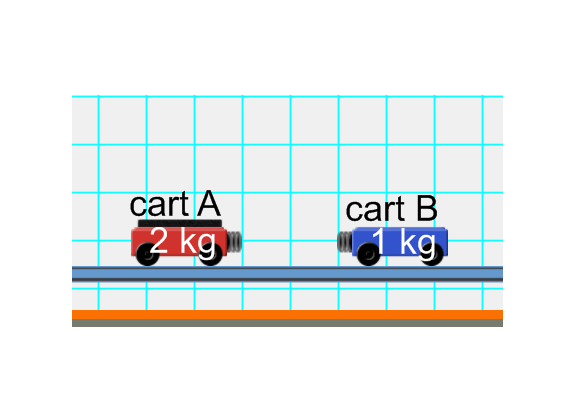
Cart A is pulled with a 2 Newton force for 2 seconds, and Cart B is pulled with a 1 Newton force for 3 seconds.  Which cart experiences the greatest impulse?
a)
Cart B
b)
Cart A
c)
they are the same
3.
The impulse-momentum theorem states that
a)
the impulse on an object is equal to the change in momentum it causes 
b)
the force on a moving object is equal to the magnitude of the impulse.
c)
the impulse on an object is greater than the change in momentum it causes 
d)
the impulse on an object is less than the change in momentum it causes
4.
Which takes more force  to catch, a bowling ball or a ping pong ball?
a)
bowling ball because it has more momentum
b)
ping pong ball because it has more momentum
c)
both require the same amount of force when catching
d)
bowling ball because it has less momentum
5.

A boy kicks a football with a force of 20 N, the time the force acts for is 0.3 s. Calculate the impulse on the ball.

a)

1 N⋅s

b)

6 N⋅s

c)

33.3 N⋅s

6.
How can a tennis ball and a bowling ball have the same momentum?
a)
have the same speed
b)
have different speeds
c)
one is moving backwards
d)
they can't
7.

The units for Impulse are

a)

N/s

b)

N·s

c)

N

d)

m/s

8.

Which variable is impulse?

a)

J

b)

F

c)

m

d)

v

9.

m Δ\Delta  v is equal to...

a)

the impulse

b)

the force times the time

c)

The change in momentum

d)

the velocity

10.

To calculate impulse

a)

divide mass and velocity

b)

multiply the force and the change in time

c)

multiply momentum and mass

d)

divide mass and acceleration

11.

These data show force is

a)

increasing

b)

decreasing

c)

constant

12.

These data show time is

a)

increasing

b)

decreasing

c)

constant

13.

These data show impulse is

a)

increasing

b)

decreasing

c)

constant

14.

These data show the change in momentum is

a)

increasing

b)

decreasing

c)

constant

15.

These data show the mass is

a)

increasing

b)

decreasing

c)

constant

16.

These data show the change in velocity is

a)

increasing

b)

decreasing

c)

constant

17.

These data show there is an inverse relationship between

a)

mass

b)

impulse

c)

force

d)

Δt\Delta t

e)

Δv\Delta v

18.

Impulse is equal to

a)

force *  \Delta t  

b)

 \Delta p 

c)

mass * \Delta v  

19.

On a scale of 1-4, how well do you feel you understand the impulse-momentum theorem?

a)

1 - not at all

b)

2 - okay but I need some help

c)

3 - I may make some small mistakes

d)

4 - I can explain this to someone else
