

Wayground logo

Free Printable Worksheets

Font size

S
M
L
XL
Worksheets

Grade 8 Mid-Year Review

Total questions: 100

Worksheet time: 2hrs 31mins

Name
Class
Date
1.
Growth of American industry is most closely associated with
a)
a large labor supply
b)
an abundance of natural resources
c)
construction of new railroads
d)
all of the above
2.
Reporters, journalists, photographers, and authors who used the media to raise concerns about the negative effects of industrialization were known as
a)
muckrakers
b)
suffragists
c)
immigrants
d)
abolitionists
3.
A period of time when social, economic and political problems caused by rapid industrialization were exposed and in some cases reformed
a)
Industrialization
b)
Progressive Era
c)
Reconstruction
d)
Prohibition
4.
Prohibition began with the 
a)
15th Amendment
b)
17th Amendment
c)
18th Amendment
d)
21st Amendment
5.
Suffragists included
a)
Alice Paul
b)
Susan B Anthony
c)
Elizabeth Cady Stanton
d)
All of the above
6.
Amendment that gave women the right to vote
a)
15th
b)
17th
c)
18th
d)
19th
7.
Upton Sinclair's The Jungle is credited with exposing the unsanitary conditions in the food industry and helping to pass the
a)
Sherman Anti-Trust Act
b)
18th Amendment
c)
Pure Food and Drug Act
d)
Equal Rights Amendment
8.
Who wrote about and exposed the corrupt monopolistic business practices of Standard Oil?
a)
Ida Tarbell
b)
Lewis Hines 
c)
Jacob Riis
d)
Upton Sinclair
9.
When was the Progressive Era?
a)
Antebellum
b)
1865-1877
c)
1900-1920
d)
1933-1945
10.
What anti monopoly law made all"combinations, contracts, and conspiracies" that restrained free trade illegal (1890)?
a)
Interstate Commerce Act
b)
Sherman Antitrust Act
c)
Clayton Antitrust Act
d)
Keller-Cefauver Act
11.
Who was the person who founded the settlement house (Hull House) for the Assimilation and Americanization of the immigrant poor?
a)
Elixabeth Cady Stanton
b)
Jane Addams
c)
Susan B. Anthony
d)
Belle Starr
12.
Which Progressive President used Big Stick Diplomacy and was known as a Trust buster?
a)
Teddy Roosevelt
b)
Taft
c)
Woodrow Wilson
d)
Luke Skywalker
13.
17th Amendment-
a)
Banned sale, distribution and manufacture of alcohol
b)
required direct election of US Senators
c)
established the Income Tax
d)
Gave women suffrage rights
14.
What was an important effect of the influx of people from the country to the cities in the late nineteenth century?
a)
a sharp increase in college enrollment
b)
crowded slums and unsanitary conditions
c)
decline in economic growth
d)
 a large amount of unused farmland
15.
Who was the president during WWI
a)
Herbert Hoover
b)
Abraham Lincoln
c)
Robert Taft
d)
Woodrow Wilson
16.
What was the spark that led to WWI?
a)
Pearl Harbor
b)
assassination
c)
fascism 
d)
the stock market crash
17.
Which one of these countries was not on the Allied Powers? 
a)
Serbia
b)
Germany
c)
France
d)
Great Britain 
18.
What does nationalism mean?  
a)
Means you do not want to get involved in affairs 
b)
Means a stronger country over powers a weaker country
c)
Means strong love and devotion to ones country
d)
Means you love many nations 
19.
This was signed to end World War One. 
a)
Treaty of Spain
b)
Treaty of Germany 
c)
Treaty of Versailles 
d)
Treaty of Paris 
20.

This was created to try to PREVENT any future wars after WWI.

a)

NATO

b)

United Nations

c)

League of Nations

d)

Treaty of Versailles

21.
This is a county that was on the Central Powers side. 
a)
France 
b)
Belgium 
c)
Great Britain 
d)
Austria- Hungary
22.
Which country declared war on Serbia to begin WWI? 
a)
Austria-Hungary
b)
Russia 
c)
France 
d)
Germany
23.
This word means an agreement between countries to protect one another. 
a)
secede
b)
alliance 
c)
abolish
d)
segregate
24.
Which of the following was NOT a cause of WWI?
a)
Communism
b)
Nationalism
c)
Imperialism
d)
Militarism
25.

Who was blamed for WWI?

a)

Serbia

b)

France

c)

Russia

d)

Germany

26.
Who was responsible for triggering the war through an assassination? 
a)
Franz Ferdinand
b)
Gavrilo Princip
c)
Kaiser Wilhelm
d)
Woodrow Wilson
27.

Which was most influential in the US joining WWI?

a)

Attacks in Serbia

b)

unrestricted submarine warfare

c)

pity for those who were suffering in Europe

d)

to gain world power

28.

Conscription or drafting men between the ages of 21-30 began in WWI due to this law.

a)

Sedition Act

b)

Propaganda Act

c)

Selective Service Act

d)

Treaty of Versailles

29.
What is a German submarine?
a)
subway
b)
uboat
c)
blitzkrieg
d)
dreadnought 
30.

Europe is divided into which two alliances?

a)

Triple Entente (Allied Powers) & Triple Alliance (Central Powers)

b)

Warsaw Pact & NATO

c)

Axis Powers & Allied Powers

d)

Roundheads & Cavilers

31.

Who is assassinated in 1914 to start WWI?

a)

Archduke Ferdinand

b)

Kaiser Wilhelm II

c)

Sultan Mehmed V

d)

Prince Henry of Wales

32.

What treaty is signed to end WWI?

a)

Treaty of Versailles

b)

Treaty of Paris

c)

Geneva Convention

d)

Paris Peace Accords

33.

Which country takes the blame of WWI and has to pay reparations (war debt)?

a)

Germany

b)

Austria-Hungary

c)

Russia

d)

Ottoman Empire

34.

Which country leaves WWI in 1917?

a)

Russia

b)

United States

c)

Austria-Hungary

d)

Britain

35.

Posters were used as a part of the war machine. What does this World War I poster represent?

a)

Imperialism

b)

Prohibition

c)

Neutrality

d)

Propaganda

36.

Why did the U.S. Senate refuse to ratify (accept) the Treaty of Versailles?

a)

It was not a meeting in a neutral ground

b)

The treaty forced the U.S to pay to much for repairs

c)

It contained material (the League of Nations) that could draw the U.S into future foreign conflicts

d)

President Wilson was to ill to go back and sign the treaty

37.

How was the U.S. affiliated with the Allied Powers before even entering the war?

a)

The assassination of Archduke Franz Ferdinand

b)

Economical ties with Britain, including loans to finance WWI

c)

The presence of U.S. merchant ships in the seas

d)

Due to the fact that Britain is the "mother country"

38.

How did women serve during WWI & support from home?

a)

Segregated troops

b)

Nurse Corps, Non- combat roles, working in factories

c)

Were not allowed to serve their country.

d)

Full military rank and pay

39.

Why was the Selective Service Act passed?

a)

To defend the United States?

b)

To attack communists in Russia

c)

To raise the size of the American army so it could join the Allies

d)

None of the above

40.

What is the acronym used to describe the causes that led to WWI

a)

MEAN

b)

NASA

c)

MAIN

d)

WIB

41.

What country does this soldier represent?

a)

United States

b)

Belgium

c)

Germany

d)

France

42.

At the beginning of the war the US...

a)

remained neutral

b)

declared support for the Allied Powers

c)

declared support for the Central Powers

d)

immediately sent troops overseas to fight

43.

This political cartoon demonstrates which "cause" of the war?

a)

Militarism

b)

Alliances

c)

Imperialism

d)

Nationalism

44.

What countries started WWI?

a)

Germany and France

b)

France and Russia

c)

Austria-Hungary and Serbia

d)

Austria-Hungary and Britain

45.

True/False: The US joined the League of Nations?

a)

True

b)

False

46.

In hopes of avoiding fighting a two front war, the Germans enacted the at the start of the war.

a)

Schlieffen Plan

b)

Kaiser Plan

c)

Hungarian Offensive

d)

Zeppelin Attack

47.

All of the following are parts of the trench system except...

a)

communication trench

b)

front line

c)

protective trench

d)

support trench

48.

When did WWI end?

a)

11/11/1911

b)

11/11/1918

c)

6/25/1914

d)

4/25/1917

49.

General John "Black Jack" Pershing was the leader of the American Expeditionary Forces (AEF) who fought in what region of the world?

a)

Along the Western Front

b)

In Southeast Europe

c)

Along the Italian Penninsula

d)

In the Ottoman Empire

50.

What was the Federal Government's policy toward Native American Indians in the late 1800's?

a)

To give all Native Americans the right to vote

b)

To preserve tribal cultures and traditions.

c)

To destroy tribal bonds and weaken their cultural values.

d)

To ignore the Native Americans and let them live anywhere they wanted.

51.

Most Native Americans living in the western states were forced off their land and on to

a)

U.S. Army bases

b)

ships

c)

foreign soil

d)

reservations

52.

The change shown in the photograph below is a direct result of

a)

The boy becoming the chief of his tribe

b)

The boy attending a boarding school on a reservation

c)

The boy wanting to impress others in his tribe by showing off the latest fashions of the 1900's

d)

The boy posing for the cover of a French fashion magazine

53.

Isolationism is

a)

interfering in foreign affairs

b)

giving aid to foreign nations

c)

not joining an alliance and staying out of foreign affairs

d)

joining world peace keeping organizations

54.

The U.S. annexing Hawaii, Midway Island and the Philippines is an example of

a)

pacifism

b)

nativism

c)

isolationism

d)

imperialism

55.

The headline above is an example of

a)

xenophobia

b)

nativism

c)

expansionism

d)

yellow journalism

56.

What event caused the USA to enter into a war against Spain?

a)

a Spanish invasion of Hawaii

b)

the sinking of the USS Maine

c)

the Battle of Manila Bay

d)

President McKinley was assassinated in Buffalo, NY

57.

A major reason the United States wanted to build the Panama Canal was to

a)

improve United States relations with Australia

b)

increase trade with England

c)

protect United States citizens living in South America

d)

shorten the sea route between the Atlantic and Pacific coast

58.

To improve trading opportunities in China for the United States, the United States supported the

a)

Dawes Act

b)

Open Door Policy

c)

Monroe Doctrine

d)

Marshall Plan

59.
Most immigrants on the East Coast were processed where?
a)
Washington, D.C.
b)
Ellis Island
c)
Angel Island
d)
Baltimore
60.
What is the term for the mixture of people of different cultures and races together into Americans?
a)
Mixing Bowl
b)
Angel Food Cake
c)
Fish Tank
d)
Melting Pot
61.
19th century Chinese immigrants are known for what?
a)
Work in building the Transcontinental Railroad
b)
Work in New York factories
c)
Contributions to the steel industry
d)
Contributions to John D. Rockefeller
62.
What processing station did Immigrants go through on the WEST coast?
a)
Ellis Island
b)
Angel Island
c)
Devil Island
d)
Alcatraz
63.
During the period from 1880 to 1910, why did the majority of immigrants to the United States settle in urban areas in the North?
a)
The Populists were successful in preventing immigrants from buying farmland.
b)
Rapid industrialization had created many job opportunities.
c)
Labor unions gave financial help to immigrants willing to work in the factories.
d)
Most immigrants had lived in cities in their native countries.
64.
Which of the following caused the most prejudice against new immigrants in the United States during the late nineteenth century?
a)
Americans believed that immigrants were transient and would hurt the communities when they moved on again.
b)
The United States had tense relations with many of the nations from which the immigrants came.
c)
Heavy immigration caused overcrowding in rural areas and a rise in the price of cropland.
d)
Americans feared that immigrants would refuse to assimilate into American culture.
65.
War, poverty, and discrimination are all examples of.......
a)
Pull Factors
b)
Push Factors
c)
Jump Factors
d)
Falling Factors
66.
Economic opportunities, religious freedom, and political and social equality are all examples of...
a)
Push Factors
b)
Pull Factors
c)
Falling Factors
d)
Jump Factors
67.
Which idea led to a rise in anti-immigrant groups and a demand for immigration restrictions?
a)
Melting Pot
b)
Birds of Passage
c)
Nativism
d)
All of the above
68.
What is a tenement?
a)
A new form of transportation
b)
Poorly built, overcrowded apartment buildings
c)
The end of immigration
d)
A revolutionary war in Africa
69.
What was the Chinese Exclusion Act?
a)
Letting Chinese in America with open arms
b)
Banning Chinese people from immigrating to the United States for 10 years
c)
The Europeans taking over China
d)
Italians Immigrating to China
70.

This event launched the United States into the "War on Terror"

a)

Oklahoma City Bombing '95

b)

World Trade Center bombing '93

c)

The War in Iraq

d)

The coordinated attacks on September 11, 2001

71.

What are the two "types" of terrorism

a)

Violent and peaceful

b)

Domestic and Foreign

c)

Domestic and Patriotic

d)

Sharia Law and Fundamentalist

72.

Choose the best definition of terrorism:

a)

the use of violence and threats to intimidate and achieve personal & political goals

b)

the complex and organized attempt to overthrow one's own government

c)

Violent acts committed against the US

d)

threatening, intimidating, creating fear in one's own nation

73.

Identify the leader of Al-Qaeda

a)

Saddam Hussein

b)

Osama bin Laden

c)

Mahatma Ghandi

d)

Confucius

74.

Al-Qaeda had strong allies and training facilities in what country:

a)

Afghanistan

b)

Azerbaijan

c)

India

d)

Egypt

75.

The United States sent troops to fight the "War on Terror" to the following countries:

a)

Afghanistan and Pakistan

b)

Azerbaijan and Afghanistan

c)

Iraq and Afghanistan

d)

Kuwait and Iran

76.

What US President vowed to reduce the number of troops in the Middle East

a)

Obama

b)

Bush

c)

Clinton

77.

What new technology was employed by the US during the "War on Terror"

a)

WMDs

b)

Drones

c)

Grenade launchers

d)

GPS

78.

Which event occurred on Black Tuesday?

a)

many factories closed

b)

many banks closed

c)

many people lost their homes

d)

the stock market crashed

79.

What was the "New Deal" of the 1930s?

a)

a government program that gave free land to homesteaders

b)

a government program that helped women get the vote

c)

a government program that spread civil rights throughout the country

d)

a government program designed to help people during the depression
80.
President Franklin Roosevelt asked Congress to pass a series of acts called the New Deal. Which is one way the New Deal helped people during the Great Depression?
a)
It gave all people the right to vote. 
b)
It created programs to put people back to work.    
c)
It let all new immigrants become American citizens. 
d)
It let people travel around the country freely. 
81.
The Great Depression that began in 1929 hit farmers especially hard. Farmers had not been doing well in the 1920s and several years of severe drought turned the land into a "dust bowl." What was an immediate result of this?
a)
Many farmers decided to grow crops that did not use as much water. 
b)
The government built large dams in the West for irrigation. 
c)
Many farmers and their families lost their farms and moved west. 
d)
The government helped farmers by buying their land and equipment. 
82.
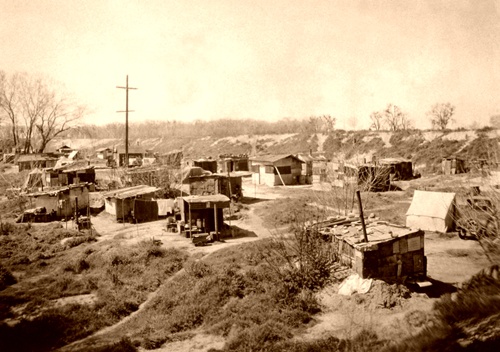
What was the main reason for the emergence of “Hoovervilles” like the one shown in the photograph?
a)
Many Americans had lost jobs during the Great Depression.
b)
Thousands of homes had been destroyed by the effects of the Dust Bowl.
c)
Housing projects could not keep up with the demand for homes needed by the poor.
d)
Preparations for World War I had created a shortage of building materials.
83.
The Civilian Conservation Corps (CCC) and the Works Progress Administration (WPA) were both New Deal programs developed to address the problem of
a)
excessive stock market speculation
b)
high unemployment
c)
increased use of credit
d)
limited income of senior citizens
84.
A drought in the Great Plains that affected farmers greatly.
a)
Drought
b)
Dust Bowl
c)
Angel's Grave
d)
Texas Cattle Storm
85.

This person was blamed for not helping struggling Americans during the beginning of the Depression.

a)

Franklin D Roosevelt

b)

Harry Truman

c)

Calvin Coolidge

d)

Herbert Hoover

86.

Which event eventually ended the Great Depression?

a)

The New Deal

b)

Creation of the TVA

c)

World War 2

d)

The publication of Gone With the Wind

87.

The Harlem Renaissance was a movement of African American artists who

a)

Worked in the South

b)

Calling for segregation

c)

Urged African Americans to leave the country

d)

Exploring their heritage and encouraging African Americans to be prideful of black culture.

88.

A “return to normalcy” after World War I meant….

a)

Increased US involvement in Europe

b)

No longer selling alcohol in the United States

c)

Going back to life as it had been before the war

d)

Limiting immigration

89.

Henry Ford produced a more affordable car primarily because his company….

a)

Paid workers lower wages than his competitors.

b)

Used foreign-made parts.

c)

Developed a faster and less expensive method of production called the assembly line.

d)

Offered a variety of options to buyers

90.

During the 1920s, controversies concerning national Prohibition and the behavior of “flappers” were all signs of disagreement over…

a)

The return to normalcy

b)

Changing culture and lifestyles

c)

Causes of the Great Depression

d)

The benefits of new technology

91.

The Great Migration of African Americans to the North during the 1920s was mainly the result of…

a)

Political corruption

b)

Nativism

c)

Racism and discrimination of African Americans in the South

d)

Success of military desegregation

92.

The ____________________________ banned alcohol.

a)

18th Amendment

b)

19th Amendment

c)

20th Amendment

d)

21st Amendment

93.

Young women in the 1920s who declared their independence from traditional values were known as __________________________.

a)

Fads

b)

Actresses

c)

Flappers

d)

Beyonce

94.

Nativists believed that native-born Americans

a)

Should not drink alcohol

b)

Are superior to immigrants and foreigners

c)

Should have better working conditions

d)

Are a lost generation

95.

Nativism influenced the outcome of which 1920s court case?

a)

Brown v. Board of Education

b)

Roe v. Wade

c)

Sacco and Vanzetti

d)

Plessy v. Ferguson

96.

The Lend-Lease Act was...

a)

The US loaned weapons to allied nations

b)

Germany loaned weapons to Italy

c)

Russia banned weapon sales to Germany

d)

Great Britain halted trade with Germany

97.

What was the name of the operation where Hitler invaded Russia?

a)

Operation Kristallnacht

b)

Operation Barbarossa

c)

Operation Flying Nazis

d)

Operation Snow Plow

98.

Which of the following defines Blitzkrieg?

a)

"Lightning warfare"

b)

"Living space"

c)

"Russian invasion force"

d)

"Anti-semetism"

99.

Which event brought the US into WWII?

a)

Pearl Harbor

b)

The invasion of Poland

c)

The Appeasement Politics

d)

The invasion of Czechoslovakia

100.
What event marked the official start of WWII in 1939?
a)
Gemany's invasion of Poland
b)
The Soviet Union signing a nonaggression pact with Germany
c)
The Japanese attack on the US at Pearl Harbor
d)
The signing of the Treaty of Versailles
