
 Worksheets
3rd Grade Fusion Unit 5 Review
Total questions: 104
Worksheet time: 52mins

What is this landform?
Ocean
Valley
Mountain
River

What is this landform?
Ocean
Mountain
Valley
Plain

What is this landform?
Ocean
Mountain
Valley
Plain


True or False, A house is a landform
True
False

Mound of earth with a rounded top; smaller than a mountain.
mountain
hill
valley

A large area of flat land or gently rolling land.
plain
valley
hill

Low land between hills or mountains.
bay
trench
valley

What is the one of the largest body of water?
Sea
Lake
River
Ocean

What is a valley?
A long stream of water
Lower land between hills or mountains
A large, flat land area
Piece of land surrounded by water

What is a canyon?
a dig cliff
a deep, narrow valley with high, steep sides
a big duvet in the ground
Which landform is a Plateau ?


This landform is an opening in the earth where hot rock and lava can burst into the air.
a blowhole
a geyser
a river
a volcano
It's the breaking up and moving of weathered rocks from one place to another
erosion
soil
magma

It's a large mass of slow-moving ice
lava
soil
glacier

Which of the following landforms is the result of a river carving out land by erosion?
A. Canyon
B. Sand dune
C. Hill
D. Mountain


The process of breaking up rocks on Earth's surface is called...
sediment
erosion
weathering
deposition

What process causes sediments or rocks to move and "takes" them to a new location
weathering
erosion
deposition

Waves dropping sand on the beach
Weathering
Erosion
Deposition

When water gets into cracks, freezing, and breaks the rocks or pavement apart
Weathering
Erosion
Deposition

A triangle-shaped (deposit) landform at the mouth of a river as it empties into a body of water:
weather
delta
landform

Which layer of the Earth is made of iron and some nickel?
crust
mantle
core

Which physical layer is the thinnest?
crust
mantle
core

Which layer of the core is solid?
inner
outer


A place on Earth’s surface that is higher than the land around it. It has a peak. It is called _____.
a valley
a cavern
an island
a mountain
A student is making a model of a volcano. What should she label the substance that erupts from the top of the volcano?
Lava
Water
Helium
Wet sand

These are lowland area between higher areas such as mountains. Sometimes rivers can wear away land to form valleys. What is this describing?
Island
Plateau
Valley
Volcano

A student is drawing a landform that was carved out by a river many years ago. Which landform is he illustrating?
Island
Canyon
Volcano
Mountain

The land feature in the picture has steep sides. It is formed by moving water in rivers. What is this landform called?
canyon
cavern
mountain
volcano

What is the correct layers of the earth starting with the surface?
crust, outer core, inner core, mantle
mantle, outer core, inner core ,crust
crust, mantle, outer core, inner core
outer core, inner core , crust, mantle

Which layer of Earth is liquid metal?
Outer Core
Mantle
Inner Core
Asthenosphere

A canyon can be described as _____.
low land between small hills
a deep valley with steep sides
land with steep sides and a flat top
land with steep side and a pointed top

Which is the hottest layer and has the most pressure on it?
Crust
Mantle
Outer Core
Inner core

I am an opening in Earth's surface from which lava flows.
mountain
valley
volcano
island

What do we call the landforms that are flat?
Mountains
Hills
Valleys
Plains

What landform is between two mountains and sometimes has a river run through it?
Hill
Valley
Mountain
Plain

What describes a mountain?
Salt water surrounded by land.
Rounded, gentle rise in the land.
Steep, pointed rise in the land.
Large area of relatively flat land.

What describes a valley?
Flat low land surrounded by mountains.
Rounded, gentle rise in the land.
Steep, pointed rise in the land.
Large area of relatively flat land.

What describes a plain?
Salt water surrounded by land.
Rounded, gentle rise in the land.
Steep, pointed rise in the land.
Large area of relatively flat land.

What describes a hill?
Salt water surrounded by land.
Rounded, gentle rise in the land.
Steep, pointed rise in the land.
Large area of relatively flat land.

This layer is directly below the crust.
Crust
Mantle
Outer Core
Inner Core

This layer is directly below the mantle.
Crust
Mantle
Outer Core
Inner Core

This layer is the innermost layer of the Earth.
Crust
Mantle
Outer Core
Inner Core

This layer is the thinnest layer and is made of solid rock.
Crust
Mantle
Outer Core
Inner Core

This layer is completely made up of liquid metal.
Crust
Mantle
Outer Core
Inner Core

This layer is a solid ball of metal.
Crust
Mantle
Outer Core
Inner Core

This layer includes all dry land and the Ocean floor.
Crust
Mantle
Outer Core
Inner Core

This layer contains a small amount of metal.
Crust
Mantle
Outer Core
Inner Core

This layer surrounds the inner core.
Crust
Mantle
Outer Core
Inner Core

This layer is the hottest layer of the Earth.
Crust
Mantle
Outer Core
Inner Core


This layer is the outermost (TOP) layer of the Earth.
Crust
Mantle
Outer Core
Inner Core

Rocks being broken into smaller pieces.
Weathering
Deposition
Erosion
Flood
Volcanic Eruption

Weathered material dropped somewhere new.
Weathering
Deposition
Erosion
Flood

Loose material being carried away by wind or water.
Gravity
Volcanic Eruption
Erosion
Weathering

A lot of water quickly covers dry land.
Weathering
Flood
Erosion
Landslide
Fill in the blank.
Weathering is a ____________ process that changes Earth's surface.
Slow
Rapid
Fill in the blank.
Deposition happens ____________ erosion.
After
Before
Fill in the blank.
Erosion occurs ____________ weathering.
Before
After

Sand in the wind is dropped in piles to form dunes. This is an example of:
Landslide
Deposition
Flood
Erosion

Rocks being broken apart is an example of:
Landslide
Erosion
Volcanic Eruption
Weathering

A lot of water leads to rivers and streams overflowing. This is an example of:
Landslide
Weathering
Flood
Deposition

Soil being carried away from its original location is an example of:
Erosion
Flood
Weathering
Deposition

Is a flood caused by nature or humans?
Nature
Humans

Is an earthquake caused by nature or humans?
Nature
Humans
Is farming caused by nature or humans?
Nature
Humans
Are volcanic eruptions caused by nature or humans?
Nature
Humans

Which factor causes weathering in this picture ?
ice
wind
water

Which factor causes weathering in this picture ?
ice
wind
water
Which change takes a long time?


drought
flooding
weathering

erosion
drought
earthquake


Identify this fast change:
Dune
Stream
Volcano
Island
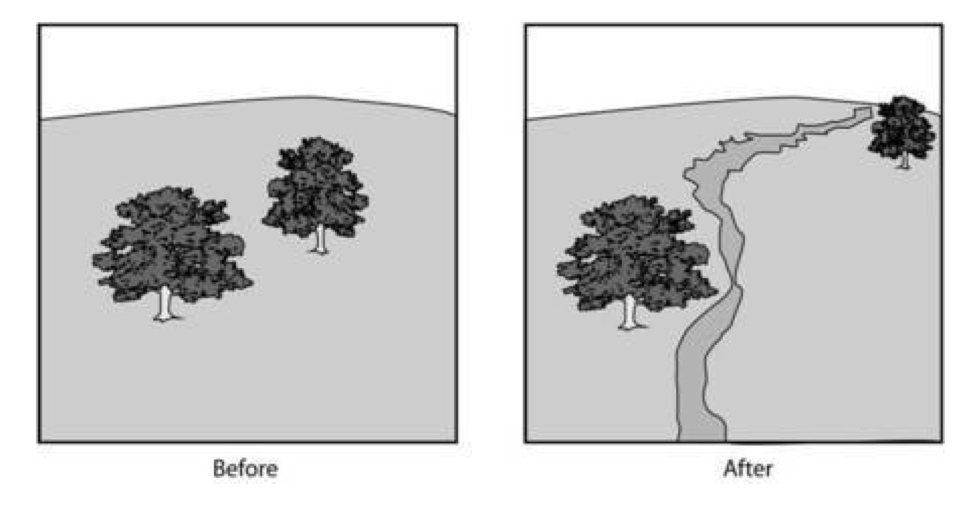
Which of the following most likely caused the change to the Earth's surface illustrated?
landslide
thunderstorm
sinkhole
earthquake
Which would be an example of a fast change to the Earth’s surface?
A mountain's top cracking open due to volcanic eruptions.
A valley getting deeper as a river runs through it.
A plain forming cracks when hot weather makes it dry.
A hill rising as the wind piles up loose sand.

The rock layers pictures here have split and been shifted. What most likely caused this change?
river
landslide
earthquake
volcano
Something that happens quickly to Earth's surface to make it different--
Earth's surface
Fast change
A river forming
A mountain forming

Sometimes, places of the Earth shake so much that the land rises and falls. Which of the following is the name for this shaking?
Crumbling
Earthquake
Landslide
Vibrating

A landform that is rough and jagged, it is much higher than surrounding land.
Plateau
Hill
Valley
Mountain

Which layer of the Earth has a solid ball of metals in the center?
Mantle
Inner Core
Outer Core
Crust
The breaking down of rocks into smaller pieces is called....
Weathering
Erosion
Landslide
Landform
When there is a flood, in which way can the Earth's surface be changing?
Warming
Weathering
Erosion
Landslide
_______, _______, and __________ can carry soil away
select all apply
Wind
Water
mountain
Glaciers

