
NEW
Font size
 Worksheets
Earthquakes, volcanoes & plate tectonics
Total questions: 35
Worksheet time: 46mins
Non-explosive, gently sloping volcano made of flat layers of lava
Cinder cone
Shield
Composite
Transform
Theory that Earth's crust is divided into plates & the plates move around on the mantle
Seafloor spreading
Plate tectonics
Continental drift
Earthquakes
Theory that magma rises to surface at mid-ocean ridge & cools to form new seafloor
Continental drift
Plate tectonics
Volcanoes
Seafloor spreading
Boundary between two plates moving toward each other
Transform fault boundary
Divergent boundary
Convergent boundary
Strike-slip fault
Shaking of the ground caused by sudden movement of large blocks of rocks along a fault
Earthquake
Volcano
Tsunami
Surface waves
In an earthquake, the point underground where the rocks first begin to move
Epicenter
Normal fault
Focus
Reverse fault
These waves move along Earth's surface & cause the most damage
Surface waves
Primary waves
Secondary waves
D waves
The point on Earth's surface directly above the focus of an earthquake
Juan de fuca plate
Focus
Seismic wave
Epicenter
Fastest seismic waves, first to reach a location after an earthquake, also called P waves
Secondary waves
Seismic waves
Primary waves
Surface waves
Small, steep-sided volcanoes made of loosely packed layers of tephra, very explosive eruptions
Cinder cone volcano
Shield volcano
Composite volcano
Mauna Loa volcano
Boundary between 2 plates that are sliding past one another
Transform fault boundary
Convergent boundary
Divergent boundary
Reverse fault

When a two continental plates push against each other it causes what to be formed ?
Mountains
Trenches
When a two plates move away from each other at a divergent boundary it causes sea floor to do what ?
Sea floor spreading
Sea floor shrinking
When a two plates slide past each other at a transform boundary is causes an
Earthquake
Sea floor shrinking
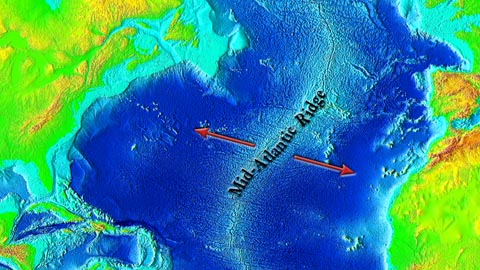
Where are most volcanoes located?
at divergent boundaries, transform boundaries, and hot spots
at convergent boundaries, divergent boundaries, and hot spots
at convergent boundaries, hot spots, and transform boundries
at divergent boundaries, convergent boundaries, and transform boundaries

This is a diagram of a soil triangle. Farmers can use this chart to identify the type of soil found on their land and determine the likelihood of erosion and other important factors. What type of soil does a farmer have if the coil contains 40% sand, 40% silt, and 20% clay?
clay
loam
silty loam
sandy loam
What would be most effective in minimizing the potential damage caused by an earthquake?
installing sirens in areas prone to earthquakes
building structures that withstand ground vibrations
increasing the amount of concrete during road building
requiring the recycling of metal and wood products
Bedrock that is closer to oceanic ridges is younger in age than bedrock that is farther away. What can best be concluded from this information?
The shape of Earth's lithosphere is continually changing.
The moment of continental plates is caused by volcanic eruptions
The oceans are becoming deeper and warmer as more rocks are produced.
The rocks on the ocean floor are producing tectonic plates that are converging


These rocks are often foliated, meaning they have layers.
Sedimantary
Sediment
Metamorphic
Igneous

