
 Worksheets
Titrations
Total questions: 23
Worksheet time: 35mins
Name
Class
Date
1.
acid + base ₋>
a)
salt + hydrogen
b)
salt + water
c)
salt + carbon dioxide + water
d)
salt
2.
HCl + NaOH →
a)
NaH + ClOH
b)
NaCl + H2
c)
NaCl + H2O
d)
NaCl + Cl2
3.
What is the endpoint of a titration
a)
Where the amount of acid and base are balanced according to the equation
b)
Where there is no base
c)
At the end
4.
I am titrating 1M HCl with 1M NaOH. I have 25mL of HCl. How much NaOH will I need?
a)
2.5mL
b)
5mL
c)
25mL
d)
50mL
5.

what is the reading on this burette?
a)
4.40mL
b)
3.50mL
c)
3.60mL
d)
4.50mL
6.
I have 25mL of 1M HCl which neutralises 20mL of NaOH. What is the concentration of the NaOH?
a)
0.8 M
b)
1 M
c)
1.25 M
7.
Identify the products of the chemical equation
3 LiOH + H3PO4 →
3 LiOH + H3PO4 →
a)
Li3PO4 + 3 H2O
b)
LiPO4 + 3 H2O
c)
Li(PO4)3 + 3 H2O
d)
BOY + La + N2
8.
What acid and what base would you choose to prepare the salt potassium chlorate?
a)
KOH and HClO3
b)
KOH and HClO2
c)
HK and OHClO3
d)
HK and OHClO2
9.
A 50.0 mL sample of Ca(OH)2 is neutralized by 300.0 mL of HCl solution with a pH of 1.3. Calculate the molarity of the Ca(OH)2 solution.
a)
1.0 M
b)
0.50 M
c)
0.15 M
d)
0.30 M
10.
How many moles of Ca(OH)2 are needed to neutralize three moles of HCl?
a)
8
b)
1.5
c)
6
d)
3
11.
For the acid-base titration combination of NaOH with 0.79 mol HCl, find the number of moles of NaOH that would be the chemically equivalent amount of HCl.
a)
0.79 mol
b)
1.6 mol
c)
0.38 mol
d)
3.2 mol
12.
If phenolphthalein turns bright pink, it indicates
a)
an acid
b)
a base
c)
a neutral
13.
What does pH measure?
a)
Amount of Oxygen Ions
b)
Amount of Hydrogen Ions
c)
The amount of salt in a solution
d)
The density
14.
Which of the following is a conjugate acid/base pair?
a)
HCl/OCl-
b)
H2SO4/SO42-
c)
NH4+/NH3
d)
H3O+/OH-
15.

I have 25cm3 of 1M HCl which neutralises 20cm3 of NaOH. What is the concentration of the NaOH?
a)
0.8 M
b)
1 M
c)
1.25 M
16.
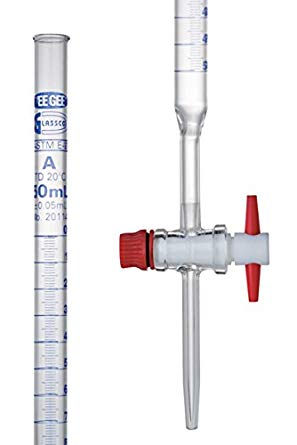
What is this piece of apparatus called
a)
Pipette
b)
Burette
c)
Janette
d)
Cuvette
17.
What is the main purpose of acid-base titrations?
a)
To test if reactants react.
b)
To calculate the concentration of unknown acid or base.
c)
To test quality of reactants.
18.
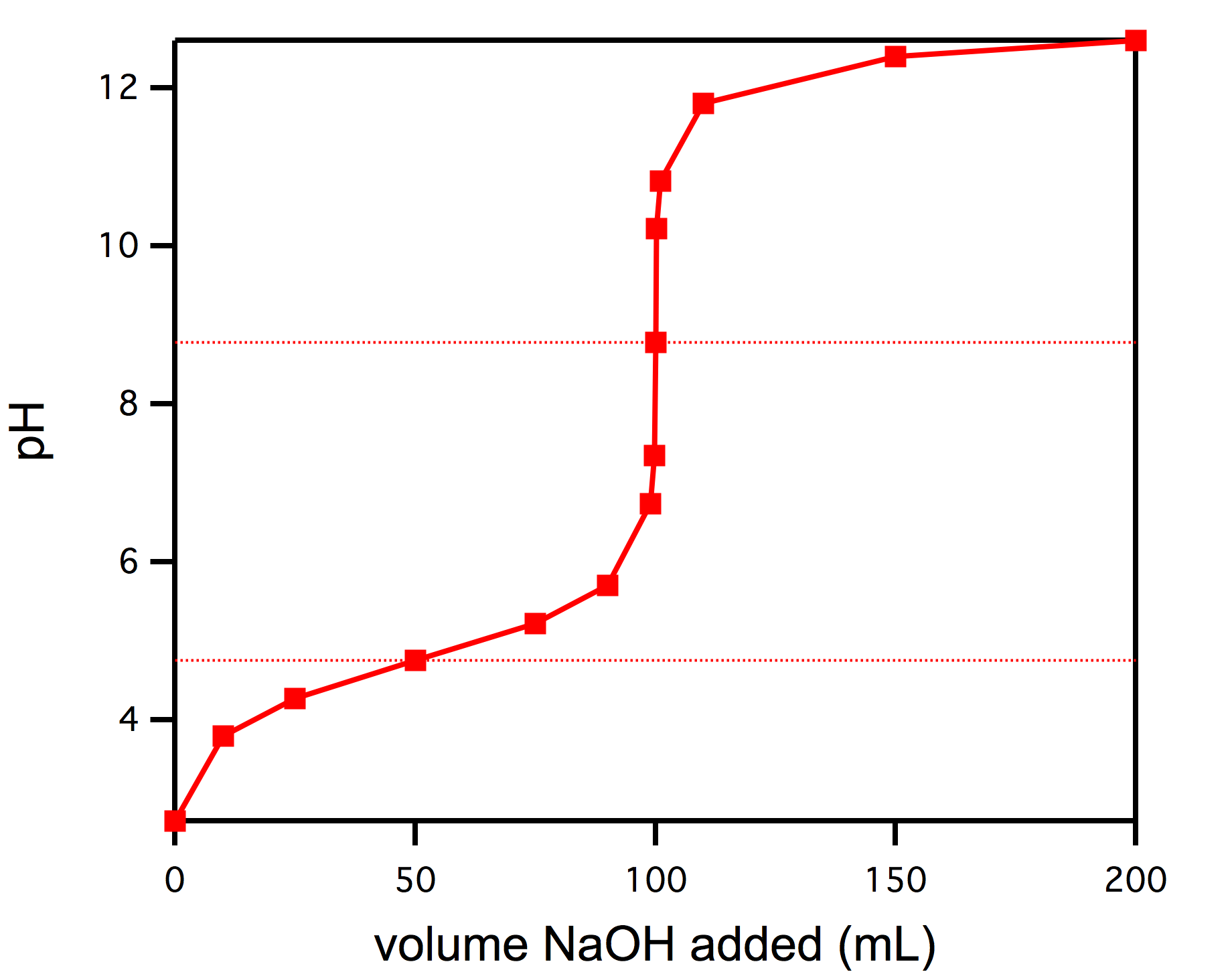
What is the pH at the equivalence point.
a)
The pH is approximately 5
b)
The pH is approximately 6
c)
The pH is approximately 8
d)
The pH is approximately 9
19.
Strong acids are those which
a)
have an equilibrium lying far to the left.
b)
yield a weak conjugate base when reacting with water.
c)
have a conjugate base which is stronger base than water.
d)
readily remove the H+ ions from water.
20.
What is the [H+] of a solution if the pH = 5.60?
a)
1.25 x 10⁻³ M
b)
1.25 x 10⁻⁶ M
c)
2.51 x 10⁻³ M
d)
2.51 x 10⁻⁶ M
21.

From the list of indicators shown, choose one that is suitable for this reaction.
a)
Phenolphthalein
b)
Bromophenol Blue
c)
Bromocresol Green
d)
Any indicator can be used and an accurate result will be obtained.
22.
How will I ensure I get an accurate final end point?
a)
Be slow and careful
b)
Repeat until you have 3 very similar titre
c)
Rinse the Burette
d)
Always use the same Pipette filler
23.
A standardised solution of NaOH is left overnight and then used to titrate an unknown solution . This would ________________ the concentration of the unknown
a)
underestimate
b)
overestimate
c)
not make any difference
d)
be dangerous
100 %

