Wayground logo

Free Printable Worksheets

Font size

S
M
L
XL
Worksheets

Jawuan's Quiz (Score 50% or above for a 100%)

Total questions: 36

Worksheet time: 48mins

Name
Class
Date
1.

Matthew has six cubes of different materials. Each cube has a mass of 10 grams (g). Matthew sorts the cubes into two groups using one physical property.


Which physical property did Matthew most likely use to sort the cubes into two groups?

a)

Electrical conductivity

b)

Density

c)

Melting point

d)

Magnetism

2.

Interactions between layers of Earth cause convection currents to move crustal plates. The diagram below shows four layers of Earth.


In which layer of Earth are the convection currents that directly result in tectonic plate motion found?

a)

1

b)

2

c)

3

d)

4

3.

The points labeled on the chart below represent the approximate size of Earth, the Milky Way, the Moon, and the Sun. The approximate size of the Solar System is also shown.


Which point on the chart best represents the approximate size of the Sun?

a)

W

b)

X

c)

Y

d)

Z

4.

The diagram below represents a cell of a green plant. plant cell Solar energy is used to produce energy-rich compounds in which structure?

a)

A

b)

B

c)

C

d)

D

5.
All of the trees next to a stream are chopped down, leaving only rocks and soil. A paved parking lot is built next to the stream. What might cause the water in the stream to be cloudy following the next rain?
a)
increased groundwater under the area
b)
decreased abrasion from the pavement
c)
increased erosion along the edges of the stream
d)
increased erosion from the pavement being weathered
6.
A sedimentary rock unit was exposed to heat and pressure deep within Earth. The rock changed to metamorphic rock. Over a long time, it was exposed at Earth’s surface. How did this metamorphic rock unit reach Earth’s surface? 
a)
Deposition acted on the rock unit, causing it to be exposed at the surface over time.
b)
Magma brought it up to Earth’s surface, where it flowed from a volcanic vent as lava.
c)
Weathering and erosion of the rock above it caused the metamorphic rock to uplift and become exposed.
d)
Weathering of the metamorphic rock brought pieces up to Earth’s surface.
7.

In which direction will the box move?

a)

A. in the direction arrow P is pointing

b)

B. in the direction arrow Q is pointing

c)

C. in the direction arrow R is pointing

d)

D. in the direction arrow S is pointing

8.

According to the Law of Conservation of Energy, which statement regarding this track is TRUE?

a)

The cart at position 3 will have more kinetic energy than at position 1

b)

The cart will be travelling slower at position 4 than at position 2

c)

The cart will have more potential energy at position 2 than at position 4

d)

The kinetic energy of the track is equal at all points

9.
Thomas performed an experiment to measure the temperature of water as he heated it on a hotplate. At the end of his experiment, he plotted the results as shown in the graph.  Which of the following physical properties of water did Thomas measure?
a)
melting point and boiling point 
b)
volume and thermal conductivity 
c)
solubility and electrical conductivity 
d)
density and physical states of matter 
10.

Having attached or unattached earlobes is an inherited trait. The figure shown is of an attached earlobe and the alleles responsible for this trait. Which statement correctly describes the genotype and phenotype?

a)

The genotype is the attached earlobe and the phenotype is (e).

b)

The genotype is (e) and the phenotype is attached earlobe.

c)

The genotype is the attached earlobe and the phenotype is (ee).

d)

The genotype is (ee) and the phenotype is attached earlobe.

11.

Which of these statements is correct according to the diagram?

a)

Each offspring has 25% probability of inheriting the alleles (PP).

b)

Each offspring has 25% probability of inheriting the alleles (Pp).

c)

Each offspring has equal probability of inheriting the alleles (PP and Pp).

d)

Each offspring is more likely to inherit (pp) than any other combination of alleles.

12.

The gene for curled ears is (C) is dominate over the gene for straight ears (c). This image shows a cat with curled ears (Cc) and a cat with straight ears (cc). What percentage of offspring are expected to have curled ears as a result of a cross between the cats shown?

a)

100%

b)

75%

c)

50%

d)

25%

13.

Hydrogen sulfide has a pH of 4.5, water has pH of 7.0, and sodium hydroxide has a pH of 12.0 which of these compounds is an acid?

a)

Hydrogen sulfide

b)

Water

c)

Sodium hydroxide

d)

Cannot be determined

14.

A student is given two different objects, a marble and a cube, that appear to be made of the same substance. The student did some measurements of the objects and recorded the measurements in the table. Using the student's measurements, determine if the two objects are indeed made of the same substance. The formula for density is D = M / V.

a)

No. The objects are different substances because their masses are different.

b)

No. The objects are different substances because their densities are different.

c)

No. The objects are different substances because their volumes are different.

d)

Yes. The objects are the same substance because they have the same density.

15.

Lithium (Li), sodium ( Na), Potassium (K), Rubidium (Rb), Cesium (Cs), and Francium (Fr) are in the same column in the periodic table? Why are these elements in the same column in the periodic table?

a)

They have the same properties.

b)

They have atoms of the same size.

c)

They have the same number of protons.

d)

They have the same number of neutrons.
16.
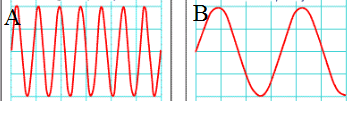
Which wave has a greater frequency?
a)
A
b)
B
17.
The graph below compares the density, in grams per cubic centimeter (g/cm3 ), of four different substances.
Based on information from the graph, which of the following best compares the physical properties of two of the substances?
a)
F.Substance X has less mass than substance Y has
b)
G.Substance W has less volume than substance X has.
c)
H.Substance Y would have less mass than substance Z would have if they had the same volume.
d)
I.Substance Z would have less mass than substance W would have if they had the same volume.
18.
Students in Ms. Alvarez’s eighth grade science class are investigating how temperature, in degrees Celsius (˚C), affects the solubility of a compound in 100 milliliters (mL) of water. Ms. Alvarez provides the students with a graph that shows the solubility of a certain compound, as shown below. She then tells the students that she will demonstrate how many grams (g) of the compound will dissolve in 100 mL of water at40˚C.Based on the information in the graph, which of the following is the best prediction of how many grams of the compound will dissolve at40˚C?
a)
F.40 g
b)
G.65 g
c)
H.85 g
d)
I.100 g
19.
Mr. Roberts drives his car away from his house at a constant speed. Which of the following graphs best shows the relationship between the distance traveled and the time spent driving?
a)
F
b)
G
c)
H
d)
I
20.

Green algae, slime molds, and protozoa are classified together in the kingdom protista. Which of the following is one characteristic of all members of this kingdom?

a)

They are all viruses

b)

they all spread diseases

c)

they are all single celled

d)

their cells all have a nucleus

21.
Which energy conversion is taking place when you put gasoline in a car?
a)
thermal -> electrical
b)
mechanical -> electrical
c)
chemical -> mechanical
d)
mechanical -> electromagnetic
22.
When a pendulum swings, at which point is kinetic energy highest?
a)
1
b)
2
c)
3
d)
4
23.

What are the chances of heterozygous genotypes in offspring?

a)

50%

b)

25%

c)

1 in 4

d)

75%

24.
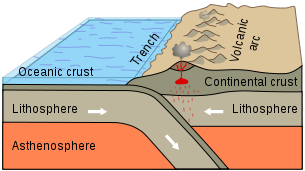
Subduction zones occur on Earth where dense oceanic crust dives under more buoyant continental crust. These boundaries are characterized by a deep ocean trench next to a high continental mountain range, large numbers of earthquakes and volcanoes. All of this is further evidence for the
a)
big bang theory.
b)
theory of plate tectonics.
c)
origin of the species.
d)
theory of natural selection.
25.

The diagrams shows a stack of rock layers. Layer T contains a well-know index fossils that is 120 million years old. Layer R contains a different index fossil that is 100 million years old. Based on this information and the principle of superposition, how old is Layer M?

a)

either 20 million or 220 milllion years old

b)

between 100 million and 120 million years old

c)

younger than 100 milion years

d)

older than 120 million years

26.
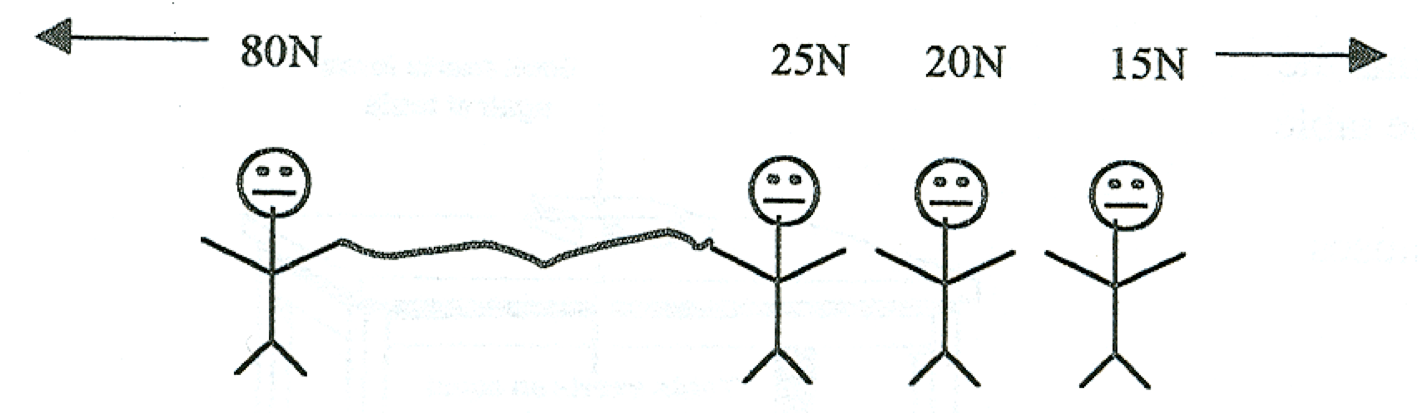
Who wins the tug of war with what net force?
a)
The person on the left with 20 N
b)
The person on the left with 80 N
c)
The people on the right with 20 N
d)
The people on the right with 100 N
27.

Ms. De made a pitcher of lemonade. Which diagram BEST represents the liquid water molecules?

a)
b)
c)
d)
28.

An atomic model of sulfuric acid (H2SO4) is shown. How many different elements have combined to form this compound of sulfuric acid?

a)

2

b)

3

c)

6

d)

7

29.
What is an example of a wave with a long wavelength and low frequency?
a)
Gamma rays
b)
Infrared
c)
Radio
d)
Visible light
30.

Asexual Reproduction requires...

a)

One Parent only.

b)

Two Parents.

31.
Which diagram shows the formation of a land breeze?
a)
diagram Y
b)
diagram X
c)
neither 
d)
both
32.
What kind of breeze is this & what time of day/night would it form?
a)
Land breeze - daytime
b)
Land breeze - nighttime
c)
Sea breeze - daytime
d)
Sea breeze - nighttime
33.
Kari likes to play marbles, and she wants to find out if the density of a marble has any effect on how far the marble rolls. To begin, she selects ten different marbles of various sizes from her collection. She measures the first marble on a balance and finds that its mass is 13.8 grams (g). Then she takes a 100-milliliter (mL) graduated cylinder and fills it to the 50-mL mark. After she places the marble in the graduated cylinder, the water level reads 56 mL. What is the density of this marble, in grams per milliliter (g/mL)?
a)
0. 25 g/mL 
b)
0. 43 g/mL 
c)
2. 3    g/mL 
d)
 4. 1    g/mL 
34.
The graph shows changes in a population of rabbits over a 15-year period.
What is the most likely conclusion that can be supported by the data in the graph?
a)
Between Year 1 and Year 5, food resources for rabbits decreased.
b)
Between Year 5 and Year 10, the number of rabbit predators increased.
c)
Environmental conditions were favorable for rabbits at Year 10.
d)
Rabbit reproduction rates declined after Year 15.
35.
All objects below have the same mass. Gravitational force would be greatest between which pair of objects?
a)
A
b)
B
c)
C
d)
D
36.
A student placed an ice cube in a beaker. Then the student placed the beaker in a room that was  72 F. Which model best shows the arrangement of the molecules in the ice cube after 30 minutes?
a)
A
b)
C
c)
B
d)
D