wayground logo

Free Printable Worksheets

NEW

Font size

S
M
L
XL
Worksheets

Laws of Motion and Gravity

Total questions: 73

Worksheet time: 58mins
Name
Class
Date
1.
What is a PUSH or PULL of an object?
a)
Motion
b)
Force
c)
Friction
d)
Gravity
2.
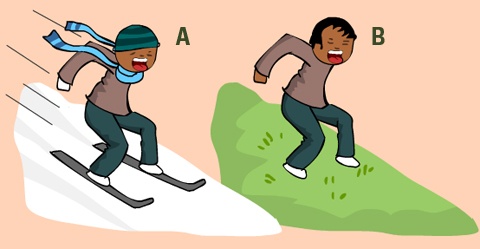
Why is it harder for the boy in Image B to get down the hill?
a)
Motion
b)
Friction
c)
Work
d)
Displacement
3.
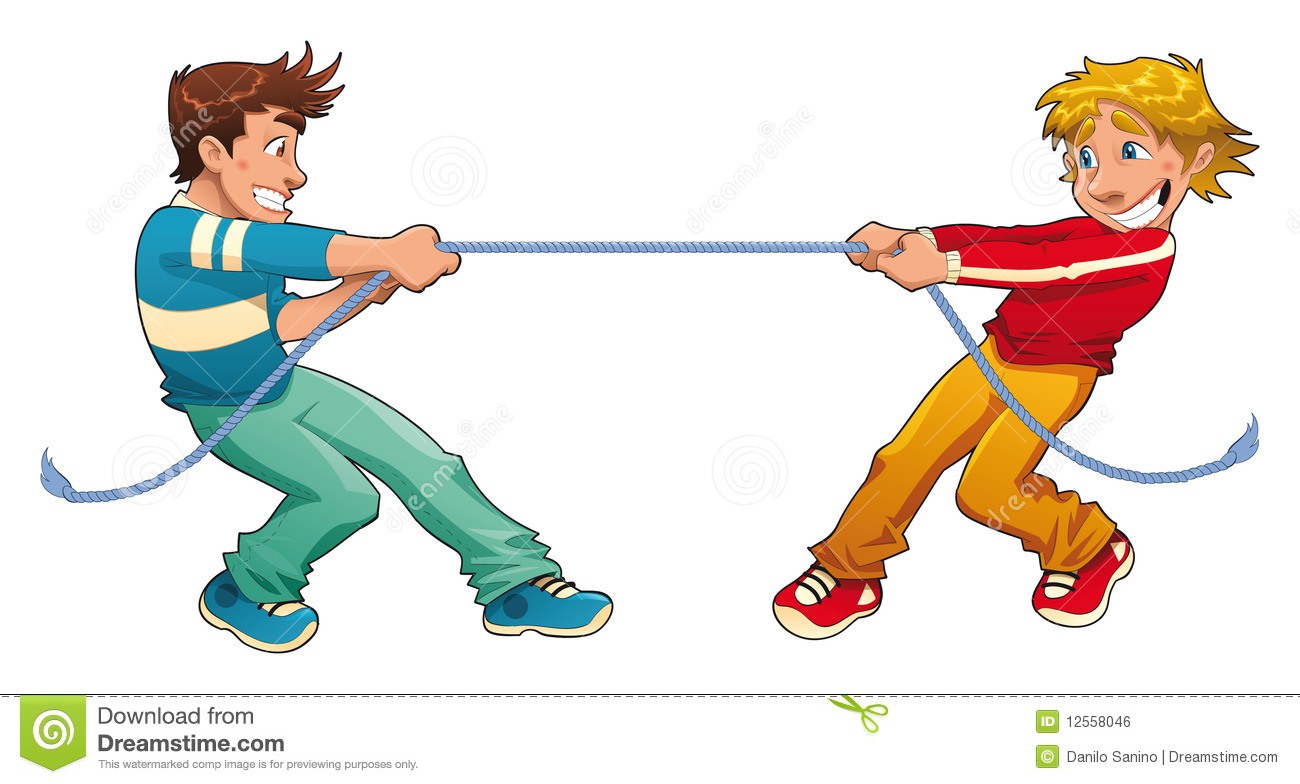
If these boys are pulling with the same amount of force.  What will happen?
a)
The boy in blue will win.
b)
They will not move at all.
c)
The boy in red will win.
d)
Both will fall down.
4.
At which point is potential energy greatest
a)
W
b)
X
c)
Y
d)
Z
5.
It takes more force to accelerate the iron man on the left than the iron man on the right because the iron man on the left has more mass. This best describes
a)
Newton's first law, the law of inertia
b)
Newton's second law, the law of acceleration
c)
Newton's third law, the law of action reaction 
d)
The law of universal gravitation
6.
The formula 
? = mass x acceleration
or 
? = m x a 
is used to find 
a)
Force
b)
Velocity
c)
Momentum
d)
Gravity
7.
For every action, there is an equal and opposite reaction.
a)
Newton's
1st
Law of Motion
b)
Newton's
2nd
Law of Motion
c)
Newton's
3rd
Law of Motion
8.
An automobile you are riding in suddenly stops, but you continue to go forward.
a)
Newton's
1st
Law of Motion
b)
Newton's
2nd
Law of Motion
c)
Newton's
3rd
Law of Motion
9.
a)
1st
b)
2nd
c)
3rd
10.
One object has twice as much mass as another object. The first object also has also twice as much...
a)
velocity
b)
gravitational acceleration
c)
inertia
d)
all of these
11.
What is the attractive force that exists between all objects that have mass?
a)
Weight
b)
Mass 
c)
Gravity
d)
Viscosity
12.
If an object is stationary (not moving) the forces acting upon it are _____________
a)
unbalanced
b)
weak
c)
balanced
d)
Hulk Smash!
13.
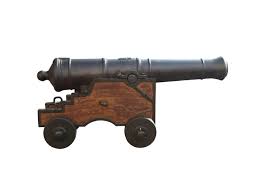
When a cannon fires a cannonball we observe Newton's third law. Which force is the reaction force?
a)
The cannon moving forward
b)
The cannonball moving forward
c)
The cannon moving backward
d)
The cannonball moving backward
14.
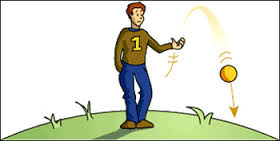
What Newtons law does this picture represent
a)
Newtons 2nd law 
b)
Law of gravity 
c)
Newtons 1st law
d)
Newtons 5th law
15.
When you push a boat off from the dock, you are demonstrating Newton's 3rd Law of Motion. It simply states that for every action there is an equal and opposite _______________?
a)
Motion
b)
Change
c)
Reaction
d)
Push
16.
What do each of the letters correctly represent?
a)
Funny, Monkeys, Arrive
b)
Force, Mass, Acceleration
c)
Free, Mass, Access
d)
Force, Magnesium, Arsenic
17.
Which is always a contact force?
a)
electric
b)
friction
c)
magnetic
d)
gravity
18.

When the force on a car is doubled, the acceleration is doubled.

a)

Newton's

1st

Law of Motion

b)

Newton's

2nd

Law of Motion

c)

Newton's

3rd

Law of Motion

19.

A magician pulls a table cloth from under a table of dishes.

a)

Newton's

1st

Law of Motion

b)

Newton's

2nd

Law of Motion

c)

Newton's

3rd

Law of Motion

20.

A skater pushes another skater forward, but the one pushing moves backwards.

a)

Newton's

1st

Law of Motion

b)

Newton's

2nd

Law of Motion

c)

Newton's

3rd

Law of Motion

21.

The harder you hit a baseball, the faster it accelerates.

a)

Newton's

1st

Law of Motion

b)

Newton's

2nd

Law of Motion

c)

Newton's

3rd

Law of Motion

22.

You push against a wall and the wall is pushing back on you.

a)

Newton's

1st

Law of Motion

b)

Newton's

2nd

Law of Motion

c)

Newton's

3rd

Law of Motion

23.

As the fuel in a rocket ignites, the force of gas expansion and explosion pushes out the back of the rocket and pushes the rocket forward.

a)

Newton's

1st

Law of Motion

b)

Newton's

2nd

Law of Motion

c)

Newton's

3rd

Law of Motion

24.

As the fuel in a rocket ignites, the force of gas expansion and explosion pushes out the back of the rocket and pushes the rocket forward.

a)

Newton's

1st

Law of Motion

b)

Newton's

2nd

Law of Motion

c)

Newton's

3rd

Law of Motion

d)

Law of Gravity

25.
45 m/s2 is the... 
a)
Mass
b)
Force 
c)
Acceleration
d)
weight
26.
If a force of 26 N is exerted on two balls, one with a mass of 0.52 kg and the other with a mass of 0.78 kg, which ball will have the greater acceleration?  (F=ma)
a)
The one with a mass of .78 kg will have the greatest acceleration.
b)
The one with a mass of .52 kg will have the greatest acceleration.
c)
They will both accelerate at the same rate.
27.
A 20 kg bike accelerates at 10 m/s2.  what was the force?
a)
25 Newtons
b)
20 Newtons
c)
200 Newtons
d)
10 Newtons
28.
Unit of mass
a)
m/s 2
b)
m/s
c)
newtons
d)
kg
29.
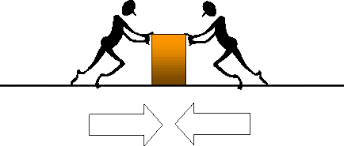
A student pushes a box to right with a force of 10N while a young boy pushes the box to the left with a force of 8N. What is the sum of all forces on the box? 
a)
18N left
b)
18N right
c)
2N right
d)
2N left
30.
If net force acting on object is 0, then the force is considered to be..
a)
Balanced
b)
Unbalanced
c)
Equal in Direction
d)
Distance/Time
31.
A car speeding up, a dog slowing down and person turning around the block are examples of..
a)
Balanced Forces
b)
Unbalanced Forces
32.
What is Newton's First Law known as? The Law of
a)
Friction
b)
Mass
c)
Inertia
d)
Gravity
33.
Which type of force(s) will cause a change in an object's motion?
a)
gravity
b)
zero net force
c)
balanced forces
d)
unbalanced forces
34.
What is Newton's First Law
a)
F=ma
b)
Every action has an equal and opposite reaction
c)
An object at rest stays at rest, an object in motion stays in motion. 
d)
Friction 
35.
A bike accelerates at 10 m/s2 when a force of 50N is applied.  What is the mass of the bike and its rider?
a)
25 kg
b)
200 kg
c)
20 kg
d)
5 kg
36.

A brick and a pencil are dropped at the same time from the same height. Which one would hit the ground first?

a)

brick

b)

pencil

c)

both would hit at the same time

37.

When will the forces of gravity between two objects be the GREATEST?

a)

when the masses of both objects are small and the objects are far apart

b)

when the masses of both objects are large and the objects are close together

c)

when the masses of both objects are small and the objects are close together

d)

when the masses of both objects are large and the objects are far apart

38.

Which statement about gravity is true?

a)

gravity causes objects to pull towards one another

b)

gravity causes objects to push away from each other

c)

gravity only takes place between planets

d)

the moon doesn't have any gravity

39.
What is the SI unit used to measure force? 
a)
pounds 
b)
grams 
c)
newtons 
d)
kg/ m2
40.
Any object with mass is surrounded by a gravitational field.
a)
True
b)
Sometimes
c)
False
d)
Never
41.
The force of gravity acting on an object is the object's ______.
a)
mass
b)
matter
c)
weight 
d)
terminal velocity 
42.
Which of the following will not change in different gravitational fields?
a)
weight
b)
force
c)
mass
d)
pounds
43.
A person would weigh more on Jupiter than on the Earth because . . .
a)
Jupiter has more mass, and therefore more gravity
b)
Jupiter has less mass, and therefore more gravity
c)
Jupiter has more mass, and therefore less gravity
d)
Jupiter has less mass and therefore less gravity
44.
Which model has greater gravitational attraction (if any)
a)
Model A
b)
Model B
c)
Both Model A and Model B (same gravity)
45.
Any object with mass has gravity.
a)
True
b)
Sometimes
c)
False
d)
Never
46.
As distance between two objects increase the pull of gravity 
a)
Increases
b)
Decreases
c)
Stays the same
47.
As mass increases, what happens to gravitational force?
a)
increases
b)
decreases
c)
stays the same
d)
i don't know
48.
If Earth's mass was cut in half, what would happen to your mass?
a)
increase because gravitational force increases
b)
decrease because gravitational force decreases
c)
decrease because gravitational force increases
d)
nothing, mass is not affected by gravitational force
49.
Which of the following never changes no matter where in the universe?
a)
weight
b)
force
c)
mass
d)
pounds
50.
What is the SI unit used to measure force? 
a)
pounds 
b)
grams 
c)
newtons 
d)
friction
51.
The amount of matter in an object is 
a)
pressure
b)
weight
c)
mass
d)
force
52.
A person would weigh less on on the Moon than on the Earth because . . .
a)
Moon has more mass, and therefore more gravity
b)
Moon has less mass, and therefore more gravity
c)
Moon has more mass, and therefore less gravity
d)
Moon has less mass and therefore less gravity
53.
The farther apart two objects are, the __ their gravity.
a)
weaker
b)
stronger
c)
more equal
54.
What does this tool measure?
a)
weight
b)
meters
c)
mass
d)
force
55.

The energy of an object that is due to the objects motion.

a)

Mechanical Energy

b)

Potential Energy

c)

Kinetic Energy

d)

Energy

56.

A law that states that energy cannot be created or destroyed but can change from one form to another.

a)

Law of Gravity

b)

First Law of Motion

c)

Law of Conservation of Energy

d)

Second Law of Motion

57.

The distance traveled divided by the time interval during which the motion occurred.

a)

Motion

b)

Movement

c)

Distance

d)

Speed

58.

The energy an object has due to its position.

a)

Energy

b)

Mechanical Energy

c)

Kinetic Energy

d)

Potential Energy

59.

The speed of an object in a particular direction.

a)

Motion

b)

Speed

c)

Velocity

d)

Acceleration

60.

The rate at which velocity changes over time. (Either in speed, direction or both.)

a)

Velocity

b)

Motion

c)

Speed

d)

Acceleration

61.

This force pulls objects to Earth's center due to Earth's large mass.

a)

Air resistance

b)

Force

c)

Gravity

d)

Friction

62.
As mass decreases, gravitational force does what?
a)
Increases
b)
Decreases 
c)
Remains the same
d)
Changes
63.
What is the rate of gravitational acceleration?
a)
9.8 m/s
b)
8.9 m/s
c)
9.8 m/s2
d)
8.9 m/s2
64.
The heavier objects fall to the ground more quickly than lighter objects
a)
True
b)
False
65.
The measure of the change in velocity is:
a)
Acceleration
b)
Time changing
c)
Distance changing
d)
Speed changing
66.
What is the velocity of an object that has been falling freely in a vacuum for 2 seconds?
a)
9.8 m/s down
b)
10.1 m/s down
c)
19.6 m/s down
d)
39.2 m/s down
67.
Objects with different masses have different gravitational force acting on them
a)
True
b)
False
68.
In a vacuum, a rock and a feather will have a gravitational acceleration rate:
a)
both are 9.8m/s2
b)
the rock's is greater
c)
the feather's is greater
d)
Both are 0 m/s2
69.
All objects accelerate at the same rate due to gravity, unless air resistance affects one object more than another
a)
False
b)
True
70.

A ball drops from a very tall building in Dubai. The ball strikes the sidewalk 10 seconds later. What is the velocity of the ball when it hits the sidewalk?

a)

98 m/s2

b)

98 m/s

c)

9.8 m/s

d)

78.8 m/s2

71.

Which of the following is the fastest speed?

a)

20 Kilometers per Second

b)

20 Kilometers per Hour

c)

20 Miles per Hour

d)

20 Centimeters per Minutes

72.

Escape velocity is the speed needed to ________________________

a)

get out of a planets atmosphere

b)

get beyond the pull of gravity

c)

be in orbit

d)

reach the speed of light

73.

If a train goes 60 kilometers in 3 hours then its speed is _________km/h

a)

180

b)

6

c)

5

d)

20