
 Worksheets
Sun's path
Total questions: 19
Worksheet time: 19mins
Name
Class
Date
1.
Why do we experience the changing of the season on the earth?
a)
distance from the sun
b)
rotation of the earth
c)
change in solar output
d)
tilt of the earth's axix
2.
What season is when the north pole is tilted toward the sun?
a)
summer
b)
winter
c)
fall
d)
spring
3.
When is the winter solstice?
a)
December
b)
June
c)
March
d)
September
4.
What is the longest day of the year?
a)
winter solstice
b)
summer solstice
c)
fall equinox
d)
spring equinox
5.
When are the equinoxes?
a)
June & December
b)
July & January
c)
April & October
d)
March & September
6.
Because of the direction that the Earth rotates on it's axis, what direction does the sun rise every day?
a)
north
b)
south
c)
east
d)
west
7.
If in the southern hemisphere is winter, what is the northern hemisphere?
a)
Shimoneta
b)
Winter
c)
Autumn
d)
Summer
8.
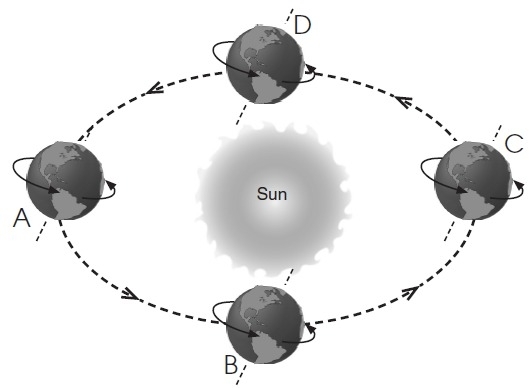
At position A, which hemisphere would have summer?
a)
Northern hemisphere
b)
Southern hemisphere
9.
Very cold climates occur at Earth’s North and South Poles because the polar regions
a)
are usually farthest from the Sun
b)
absorb the greatest amount of insolation
c)
receive the most hours of daylight
d)
receive low-angle insolation
10.
On which day of the year would the intensity of insolation at Kingston, New York, most likely be greatest?
a)
March 21
b)
June 21
c)
September 21
d)
December 21
11.
Locations in the Northern Hemisphere are warmest in summer because sunlight in summer is
a)
least intense and of shortest duration
b)
least intense and of longest duration
c)
most intense and of shortest duration
d)
most intense and of longest duration
12.
In New York State, the risk of sunburn is greatest between 11 a.m. and 3 p.m. on summer days because
a)
The air temperature is hot
b)
The angle of insolation is high
c)
Earth's surface reflects most of the sunlight
d)
The Sun is closest to the Earth
13.
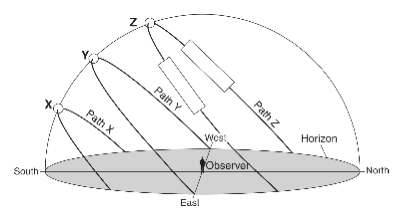
State the day represented by Sun's Path Z.
a)
September 23
b)
December 21
c)
March 20
d)
June 21
14.
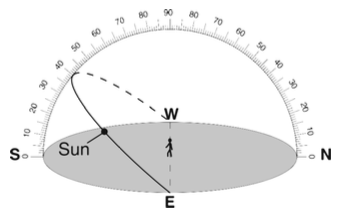
What time of the day is represented by the location of the Sun on the diagram?
a)
6 AM
b)
9 AM
c)
12 PM
d)
6 PM
15.
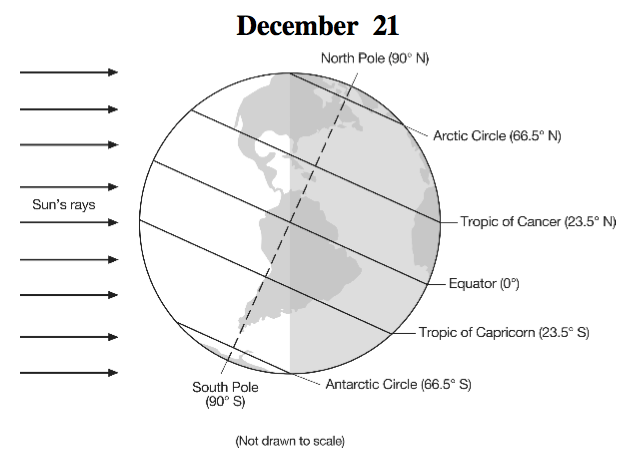
What Latitude experiences direct Sun Rays on December 21st?
a)
23.5°N
b)
0° (Equator)
c)
23.5° S
d)
66.5° S
16.
The term equinox means....
a)
equal amount of day light and equal amount of night
b)
Equal amount of winter and summer
c)
Equal amounts of hot dogs for everyone
d)
The longest day of the year
17.
Earth's axis is tilted at -
a)
23.5 degrees
b)
33.5 degrees
c)
28 degrees
d)
90 degrees
18.
The Earth's _______ is an imaginary line that goes from the North Pole to the South Pole.
a)
vernal equinox
b)
axis
c)
solar eclipse
d)
solar flare
19.

Why do globes lean sideways?
a)
To allow them to spin easier.
b)
To demonstrate the tilt of Earth's axis.
c)
To demonstrate the effects of gravity.
d)
To demonstrate day and night.
100 %

