
NEW
Font size
S
M
L
XL
 Worksheets
POM and Bonding
Total questions: 27
Worksheet time: 44mins
Name
Class
Date
1.
What type of bond forms when 2 or more electrons are SHARED?
a)
Covalent bond
b)
Incomplete bond
c)
Ionic bond
d)
Metallic bond
2.
What type of bond forms between two or more atoms that are charged (+/-)?
a)
Covalent bond
b)
Incomplete bond
c)
Ionic bond
d)
Metallic bond
3.
Which of the following is an example of an IONIC COMPOUND?
a)
NaCl
b)
H2O
c)
CO2
d)
NO
4.
Which of the following is an example of a COVALENT COMPOUND?
a)
H2S
b)
KI
c)
CaCl2
d)
MgO
5.
Ionic bonds are between _______ and ________.
a)
nonmetals and nonmetals
b)
metals and metals
c)
metals and nonmetals
d)
none
6.
How does a positively charged ion form?
a)
An atom loses an electron
b)
An atom gains an electron
c)
An atom gains a proton
d)
An ionic compound dissolves
7.
In covalent bonding, electrons are
a)
shared
b)
transferred
c)
wiped out
8.
Covalent bonds tend to happen between two
a)
metals
b)
nonmetals
c)
metal and nonmetal
9.
Outer shell electrons are called
a)
outer electrons
b)
valence electrons
c)
negatives
10.
Atoms want
a)
A full outer shell of electrons
b)
One electron short of a full shell
c)
kit kats
11.

The compound formed between lithium and chlorine is _________.
a)
ionic
b)
covalent
12.
Which of the following has a full valence shell?
a)
Oxygen
b)
Neon
c)
Barium
d)
Carbon
13.
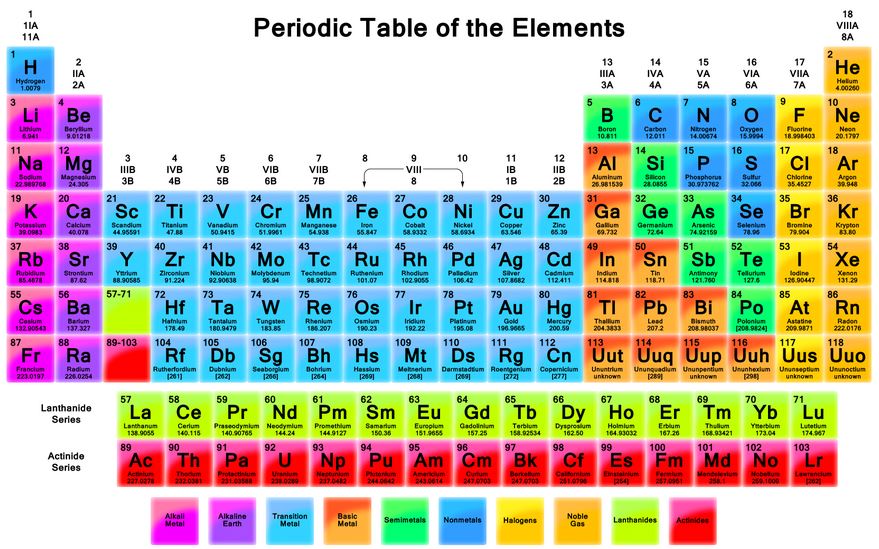
Elements on the LEFT side of the periodic table will most likely form:
a)
Positive ions
b)
Negative ions
c)
Neutral Ions
d)
None of these
14.
An ionic bond forms when atoms ___________ electrons.
a)
gain
b)
share
c)
increase
d)
transfer
15.
Chemical bonds form when atoms
a)
combined nuclei
b)
give up neutrons
c)
gain protons
d)
share or transfer electrons
16.
Bonds that form between two metals are called ______________ bonds.
a)
ionic
b)
covalent
c)
metallic
d)
pervasive
17.
If an atom loses two electrons what charge will it have?
a)
+ 2
b)
- 2
c)
+1
d)
-1
18.
If an atom gains one electron what charge will it have?
a)
-2
b)
-1
c)
+1
19.
Are the atoms more stable when they are bonded together or when they are apart?
a)
Bonded Together
b)
Apart
20.
What is a cation's charge?
a)
positive
b)
negative
c)
neutral
d)
depends on the element
21.
What is an anion's charge?
a)
positive
b)
negative
c)
neutral
d)
depends on the element's charge
22.
H2O2← ?
This number tells the number of atoms present.
This number tells the number of atoms present.
a)
coefficient
b)
molecule
c)
subscript
d)
atom
23.

What does this image represent?
a)
Atom
b)
Element
c)
Molecule
d)
Marshmallows
24.
How many carbon atoms (C) are in a CO2 molecule?
a)
1
b)
2
c)
3
d)
0
25.
How many elements are in C6H12O6?
a)
1
b)
2
c)
3
d)
4
26.
Element or compound?
H2O
H2O
a)
element
b)
compound
27.
Which is the correct formula for:
three hydrogen (H)
one sulfur (S)
four oxygen (O)
three hydrogen (H)
one sulfur (S)
four oxygen (O)
a)
H3SO4
b)
HSO4
c)
H4S3O
d)
H2O
Reset

