wayground logo

Free Printable Worksheets

NEW

Font size

S
M
L
XL
Worksheets

Ecosystems Quiz - Open Note

Total questions: 25

Worksheet time: 19mins

Name
Class
Date
1.

What is an ecosystem?

a)

The pattern of weather that affects a particular area.

b)

The life cycle of a plant from seed to flower.

c)

All living things in a particular environment like a forest or a desert.

d)

A community of living of non-living things that interact with their environment.

2.

In most ecosystems, the producers are________________

a)

green plants

b)

fungi

c)

animals

d)

humans

3.

The study of ecosystems and the interactions that occur among organisms in a geographic area is ____________

a)

environment

b)

population

c)

ecology

d)

species

4.

Abiotic means

a)

toxic

b)

nonliving

c)

antibiotic

d)

desert

5.

What is an example of an abiotic element that may change an area?

a)

introducing a new type of grass to the prairie

b)

water flooding a prairie

c)

two birds species competing for the nest habitat

d)

uncontrollable mold growth on trees

6.

The five levels of organization in the environment, from the first to the fifth level are_________________

a)

organism, population, biosphere, ecosystem, community

b)

organisms, population, biotic elements, abiotic elements

c)

organism, population, community, ecosystem, biosphere

d)

organism, population, biosphere, community, ecosystem

7.

Which option is the best definition for Ecosystem

a)

Living and nonliving things working together.

b)

Only the living things in a forrest

c)

How living things change other living things.

d)

The cause and effect of living things

8.
An organism that gets food by eating other organisms? 
a)
producer 
b)
consumer
c)
herbivore 
d)
decomposer 
9.
Decomposers get their food by __________.
a)
making it themselves
b)
eating live organisms
c)
using dead organisms
d)
eating themselves
10.
Why is a racoon classified as an omnivore?
a)
A racoon eats only animals.
b)
A racoon eats only plants.
c)
A racoon makes its own food.
d)
A racoon eats plants and animals.
11.
Producers get their energy from the ______.
a)
water
b)
Sun
c)
eating animals
d)
eating plants
12.
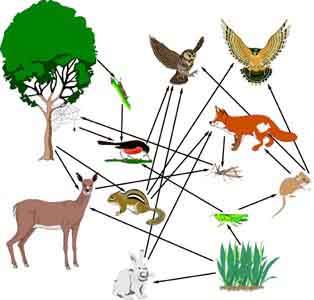
What does a food web represent?
a)
All connections of energy flow throughout all organisms in a habitat.
b)
The specific ways that mutualism is carried out.
c)
A single pathway or energy flow between organisms. 
d)
How carnivores get their food. 
13.
 Which biome is more likely to survive a change in the environment?
a)
High (rich) biodiversity
b)
Low (poor) biodiversity
14.

Biodiversity is important to keep an area (biome) healthy. In this example "Food Web A" is sustainable. Why is sustainability important for an ecosystem in "Food Web A".

a)

If one organism is removed the food web can still operate (work) with little or no negative effect.

b)

If an organism is removed the food web will collapse and will affect the environment.

15.
a)

A

b)

B

c)

C

d)

D

16.
All the members of one species that live within an area of an ecosystem is a?
a)
population
b)
community
c)
niche
17.
All of the different populations that live in a specific area.
a)
community
b)
habitat
c)
ecosystem
d)
village
18.
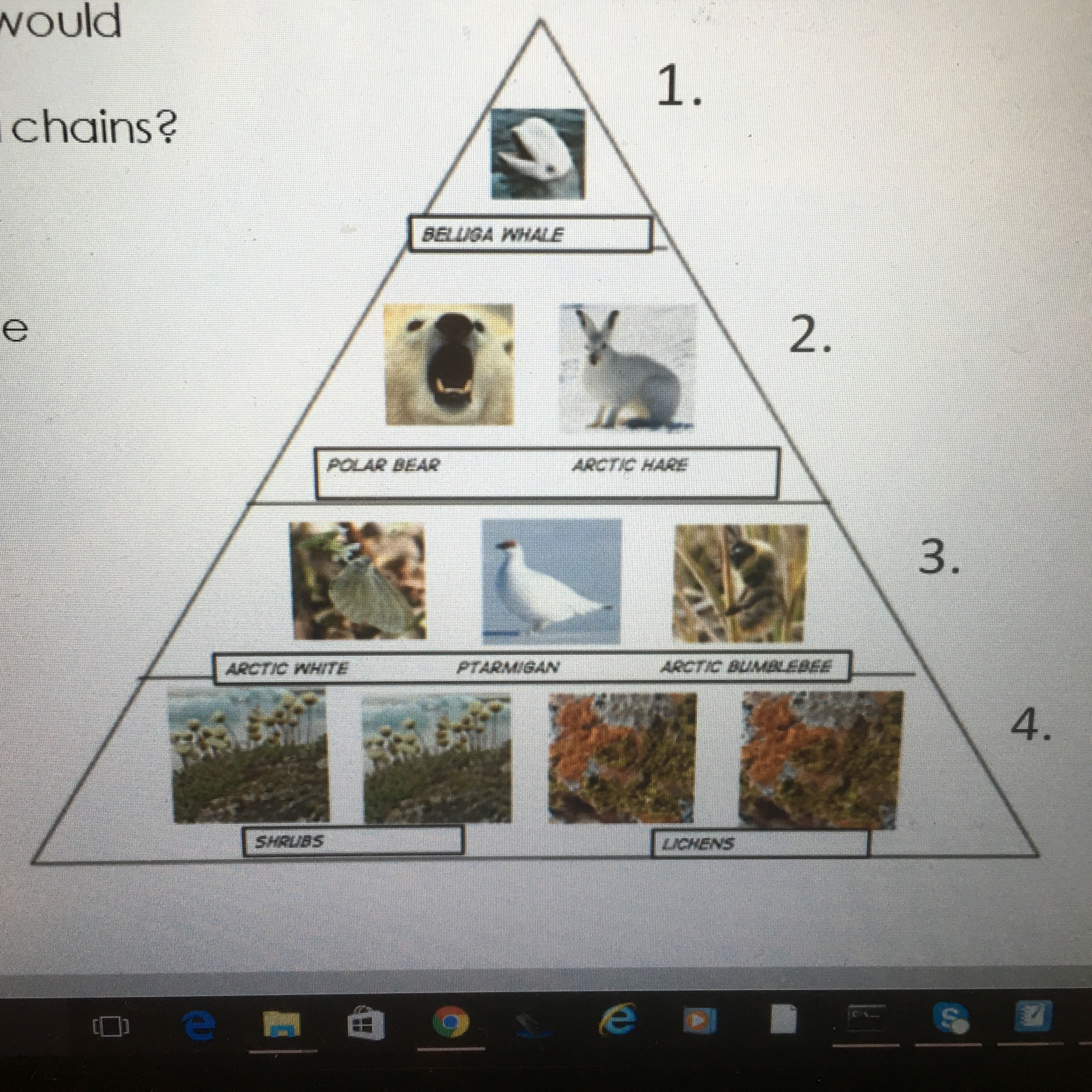
Which group are the producers? 
a)
1 and 2
b)
3 and 4
c)
4
d)
3
19.
Makes its own food
a)
autotroph
b)
heterotroph
c)
herbivore
d)
biomass
20.

What does an energy pyramid show?

a)

Energy flow in a community

b)

Longest lifespans

c)

The stronger animal the higher it is on the pyramid

21.

Process through which plants make their own food

a)

Photosynthesis

b)

Autotroph

c)

Biomass

d)

Trophic

22.
Which are located at the very BOTTOM of an energy pyramid? 
a)
producers
b)
consumers - Level 1
c)
consumers - Level 2
d)
decomposers
23.
If there is 1000 Kcal available in the producers in trophic level 1, how much energy is available in the herbivores in trophic level 2?
a)
10 Kcal
b)
1 Kcal
c)
100 Kcal
d)
1000 Kcal
24.
A food web consists of?
a)
Many overlapping food chains in an ecosystem.
b)
A series of events in which one organism eats another and obtains energy.
c)
Amount of energy that moves from one feeding level to another.
d)
Many types of insects that are stuck.
25.
True or False. In this Food Web Pyramid the consumers on each level only get about 10 percent of energy that the plants have stored.
a)
True
b)
False