
 Worksheets
Nuclear Chemistry
Total questions: 14
Worksheet time: 26mins
Name
Class
Date
1.
Which process produces alpha particles?
a)
Alpha decay
b)
Beta decay
c)
Gamma decay
d)
Nuclear fusion
2.
Which process produces beta particles?
a)
Alpha decay
b)
Beta decay
c)
Gamma decay
d)
Nuclear fusion
3.
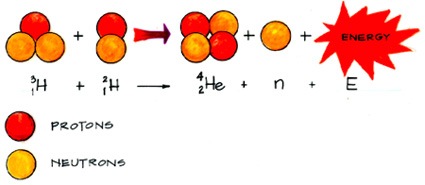
Which process involves the joining of small nuclei?
a)
Beta decay
b)
Alpha decay
c)
Nuclear fission
d)
Nuclear fusion
4.

Which process involves the splitting of large nuclei?
a)
Beta decay
b)
Alpha decay
c)
Nuclear fission
d)
Nuclear fusion
5.
The time taken for half of an amount of radioactive atoms to decay.
a)
Nuclear fusion
b)
Full-life
c)
Dead time
d)
Half-life
6.
The nuclear process occurring at a nuclear power plant.
a)
Nuclear fusion
b)
Nuclear fission
c)
Combustion
d)
Multiplication
7.

Arrange in order of increasing ability to penetrate matter.
a)
Beta, gamma, alpha
b)
Alpha, gamma, beta
c)
Gamma, beta, alpha
d)
Alpha, beta, gamma
8.

Classify this process.
a)
Nuclear fission
b)
Nuclear fusion
c)
Alpha decay
d)
Beta decay
9.
Which type of radiation has the greatest penetrating power?
a)
Alpha
b)
Beta
c)
Gamma
d)
Microwaves
10.
What happens to the atomic number during alpha decay?
a)
The atomic number decreases by 4
b)
The atomic number increases by 1
c)
The atomic number decreases by 2.
d)
The atomic number stays the same.
11.
The technetium-99 isotope has a half-life of 6.0 hours. If 100.0 mg were injected into a patient how much remains after 18 hours?
a)
33.0 mg
b)
12.5 mg
c)
.33 mg
d)
15.8 mg
12.
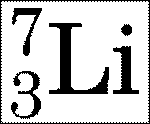
How many protons are in this atom?
a)
3
b)
4
c)
6
d)
10
13.

The diagram above represents what type of reaction?
a)
Fusion
b)
Alpha Radiation
c)
Fission
d)
Gamma Radiation
14.

The diagram above represents what type of reaction?
a)
Beta Radiation
b)
Fission
c)
Gamma Radiation
d)
Fusion
100 %

