wayground logo

Free Printable Worksheets

NEW

Font size

S
M
L
XL
Worksheets

Kepler's Laws

Total questions: 50

Worksheet time: 26mins
Name
Class
Date
1.
Planets orbit the Sun in a shape called a(n)
a)
circle
b)
ellipse
c)
focus
d)
perihelion
2.
An ellipse is drawn around two points called
a)
aphelion
b)
perihelion
c)
foci
d)
axis
3.
When a planet orbits the Sun, one of the foci of the elliptical orbit is 
a)
the axis
b)
the perihelion
c)
the center
d)
the Sun
4.
The place where a planet is closest to the Sun as it orbits the Sun is called the
a)
perihelion
b)
aphelion
5.
The place where a planet is farthest away from the Sun in its orbit around the Sun is called the
a)
aphelion
b)
perihelion
6.
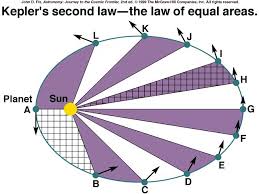
Where is the planet moving faster
a)
Position A to B
b)
Position B to C
c)
Position H to I
d)
Position I to J
7.
What is true about the area between points A, B and the Sun, and the area between points H, I and the Sun?
a)
The area between A, B and the Sun is the largest.
b)
The area between H, I and the Sun is the largest
c)
Both areas are equal in size
d)
There is not enough information to determine the areas
8.
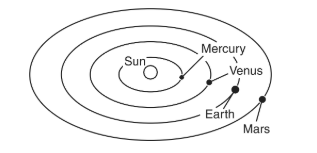
What is the smallest terrestrial planet?
a)
Mars
b)
Venus
c)
Mercury 
d)
Earth
9.
Earth and the other planets closest to the Sun are made mostly of _______
a)
gas
b)
metal
c)
water
d)
rock
10.
Kepler's 2nd Law deals with 
a)
the shape of the planets' orbits
b)
the speed/area the planet travels 
c)
the length of time it takes the planet to orbit the sun
11.
The "Law of Harmonies" is which of Kepler's Laws?
a)
1st
b)
2nd
c)
3rd
d)
4th
12.
A planet moves __________ when it is farthest from the sun.
a)
faster
b)
slower
13.
Kepler's first law states that the orbits of the planets are oval in shape or 
a)
ellipses
b)
perfect circles
14.
The farther away a planet is from the sun, the _______ it takes it to orbit the sun once. 
a)
longer
b)
shorter
15.
The path a planet travels around the sun is called its 
a)
orbit
b)
ellipse
c)
barycenter
d)
precession
16.
When do planets move the fastest?
a)
Close to the sun
b)
Far away from the sun
17.
Which term describes when the Earth spins on its axis.
a)
Rotation
b)
Revolution
c)
Kepler's Laws
d)
Precession
18.
Which term describes the time it takes for Earth to complete one circle around the sun.
a)
Rotation
b)
Revolution
c)
Kepler's 1st Law
d)
Barycenter
19.
Earth's orbit follows an elliptical path.
a)
Kepler's 1st law
b)
Kepler's 2nd law
c)
Kepler's 3rd law
d)
Nutation
20.
When Earth orbits around the sun, it slows down when it is close to the sun. It speeds up its orbit when it is further from the sun. This is because the sun's gravity is stronger when you are closer to it.
a)
Kepler's 1st law
b)
Kepler's 2nd law
c)
Kepler's 3rd law
d)
Nutation
21.
What did Kepler discover about planets and their orbital speed?
a)
Planets closest to the Sun will orbit with the fastest orbital speed.
b)
Planets with the greatest mass will orbit the Sun with the fastest orbital speed.
c)
Planets furthest from the Sun will orbit with the fastest orbital speed.
d)
Planets with the least mass will orbit the Sun with the fastest orbital speed.
22.
Which is NOT one of Kepler's laws?
a)
Planets travel in an ellipse
b)
Planets closest to the sun travel faster
c)
The farther a planet is from the sun, the longer it takes to orbit
d)
Planets revolve around the Earth
23.

The diagram below shows a moon revolving around a planet in an elliptical orbit. At which position is the moon traveling fastest?

a)

location 1

b)

location 2

c)

location 3

d)

location 4

24.

According to the Heliocentric Model of the Universe, _____________ is at the center of our Solar System with the planets revolving around it.

a)

Earth

b)

The Sun

c)

Jupiter

d)

Helios

25.

The diagram below shows a moon revolving around a planet in an elliptical orbit. At which position is the moon traveling slowest?

a)

location 1

b)

location 2

c)

location 3

d)

location 4

26.

According to the data in the chart, the farther a planet is from the sun

a)

the longer it takes for it to complete one revolution.

b)

the longer it takes for it to complete one rotation.

c)

the less dense it is.

d)

the smaller it is.

27.

Which planet will take the least amount of time to revolve around the Sun?

a)

Mercury

b)

Venus

c)

Earth

d)

Mars

28.

Which planet will take the most amount of time to revolve around the Sun?

a)

Mercury

b)

Venus

c)

Earth

d)

Mars

29.

Which statement best describes Kepler’s 2nd Law of Planetary Motion?​

a)

Planets revolve around the sun over equal areas in equal time intervals.

b)

Planetary orbits are in the shape of an ellipse.

c)

A planet’s orbital period is proportionate to its distance from the sun.

30.

What unit to we usually use to to measure a planet's orbital period?

a)

light year

b)

year

c)

day

d)

astronomical unit

31.

Kepler's 3rd law tell us that __ would be dependent on __.

a)

orbital period ; distance

b)

distance ; orbital period

32.
What is Kepler's 1st Law?
a)
Law of Orbits
b)
Law of Areas
c)
Law of Periods
33.
What is Kepler's 2nd Law?
a)
Law of Orbits
b)
Law of Areas
c)
Law of Periods
34.
What is Kepler's 3rd Law?
a)
Law of Orbits
b)
Law of Areas
c)
Law of Periods
35.
Which of Kepler's Laws is illustrated here?
a)
1st Law
b)
2nd Law
c)
3rd Law
36.
Which of Kepler's Laws is illustrated here?
a)
1st Law
b)
2nd Law
c)
3rd Law
37.
Which of Kepler's Laws is illustrated here?
a)
1st Law
b)
2nd Law
c)
3rd Law
38.
Why do the seasons change?
a)
Because of the axial tilt of the Earth.
b)
Because of how close or far the Earth is from the sun.
c)
Because of where the Earth is located in its orbit.
d)
Because sometimes Earth is facing the sun and other times it is facing away.
39.
How long does it take the Earth to rotate once?
a)
24 hours (1 day)
b)
365.25 days (1 year)
c)
100 days
d)
100 years
40.
How long does it take the Earth to revolve once?
a)
24 hours (1 day)
b)
365.25 days (1 year)
c)
100 days
d)
100 years
41.
As a planet moves closer to the sun in its orbit, its orbital velocity (speed):
a)
Increases
b)
Decreases
c)
Stays the same
42.
As a planet moves farther from the sun in its orbit, its orbital velocity (speed):
a)
Increases
b)
Decreases
c)
Stays the same
43.
What causes a planet's speed to change as it approaches the sun?
a)
The sun's gravity causes the planet to travel faster.
b)
The sun's gravity causes the planet to travel slower.
c)
The planet's rotation causes it to speed up.
d)
The planet's rotation causes it to slow down.
44.

The diagram below shows a moon revolving around a planet in an elliptical orbit. If the moon in the above picture is moving clockwise, at position 1 the moon is ______________.

a)

speeding up

b)

slowing down

45.

The diagram below shows a moon revolving around a planet in an elliptical orbit. If the moon in the above picture is moving clockwise, at position 3 the moon is ______________.

a)

speeding up

b)

slowing down

46.

Kepler's third law is represented by the following equation:

a)
b)
c)
d)
47.

Kepler's third law can be applied to any two bodies as long as they are orbiting around a single common body.

a)

True

b)

False

48.
According to Kepler's 3rd law, the square of the time it takes for an object to orbit, T, is directly related to the cube of the distance, r, between the object and what it is orbiting.            
a)
 T3 = k*r2
b)
T2 = k*r3
c)
T3 = k/r2
d)
T2 = k/r3
49.
According to Kepler's 3rd law, the square of the time it takes for an object to orbit, T, is directly related to the cube of the distance, r, between the object and what it is orbiting.    
What this means is that if a satellite moves away from what it is orbiting,
a)
the larger the constant k is.
b)
the smaller the constant k is.
c)
the longer the orbital period is.
d)
the shorter the orbital period is.
50.
The speed at which any planet moves through space is constantly changing. In a perfectly circular orbit, the orbital radius of the planet would be constant and therefore so would be its observed angular velocity. In elliptical orbits, the velocity varies. In elliptical orbits, the orbital radius of the satellite will vary and therefore so will its velocity. The planet travels "faster" when closer to the Sun, then "slower"  at a more distant radius.   According to Newton's 2nd Law, what is the underlying force behind this change in velocity?
a)
Friction
b)
Gravity
c)
Mass
d)
Projectile motion