
 Worksheets
Dichotomous key
Total questions: 17
Worksheet time: 4hrs 15mins

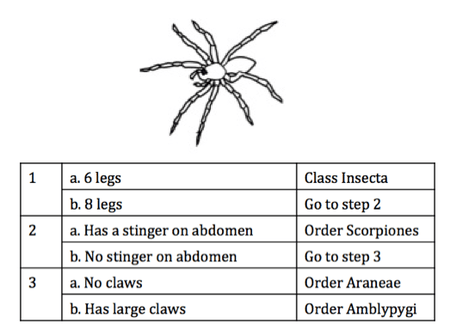

arachnids and insects?
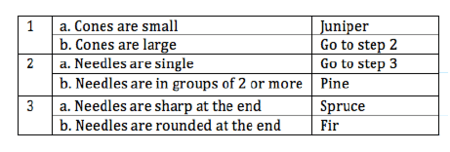
following observations of the plant’s characteristics would be useful in determining its identity with a dichotomous key?

A student discovers an arachnid without a segmented abdomen, and legs longer than its body. The student uses the dichotomous key below to identify it. Which arachnid has the student found?
Whip Scorpion
Wind Scorpion
Daddy long legs
Scorpion

Which of the following is an accurate description of the fiddler crab?
3 Paris of walking legs on both sides
Two propodus
3 Chelipeds
A pair of eyes
A student discovers an arachnid with a segmented abdomen, long legs, and a tail with no stinger.
The student uses the dichotomous key below to identify it.
1. a) Abdomen segmented.............go to 2
b) Abdomen not segmented ......go to 4
2. a) Abdomen with tail....................go to 3
b) Abdomen without tail...............go to 5
3. a) Tail with stinger..........................Scorpion
b) Tail without stinger.....................Whip scorpion
4. a) Legs longer than body.............Daddy Long Legs
b) Legs not longer than body……….Wind scorpion
5. a) Covered with spines .......................Mite
b) Few spines.....................................Tick
Whip Scorpion
Daddy Long Legs
Mite
Tick

To what order does a two pairs of wings, rigid and leathery and mouth for sucking belong to?
Diptera
Lepidoptera
Heteroptera
Coleoptera
Which of the following characteristics will most likely be helpful in identifying a butterfly using a dichotomous key?
It migrates north in the summer
It has long tail
It likes only certain plants
Its wings beat very fast in hot weather

Which letter in the picture has two pairs of wings?
M
K
F
L

Which leaf is shown in the drawing?
Magnolia
Redbud
Sweetgum
None of the above

Which of the paired statements could be used to tell the difference between the two insects using a dichotomous key?
Has 6 legs
Has 8 legs
Large hind legs
Small hind legs
2 pairs of spots on wing cover
3 pairs of spots on wing cover
Antennae absent
Antennae present
Which of the following characteristics would be useful in determining the identify of a tree in a dichotomous key?
It provides shade
It has a nest
It has several birds in it
Its leaves are long and narrow

Which shark is the picture of?
Cow Shark
Great White Shark
Hammerhead Shark
Saw Shark

