
NEW
Font size
 Worksheets
Science Form 3_Chap 4.2 Reactivity Series of Metals
Total questions: 30
Worksheet time: 18mins
The position of a metal in the reactivity series of metals depends on the reactivity of the metal when reacting with ....
Carbon
Hydrogen
Oxygen
Sulphur
Aluminium is more reactive than ....
Calcium and Zinc
Sodium and Gold
Magnesium and Copper
Lead and Iron

Based on the following diagram, what is the function of potassium manganate (VII) crystals in this experiment?
To supply oxygen
To avoid the metals to mix with each other
To release heat
To give out water vapour
Complete the word equation below.
Magnesium + oxygen --> .....
Magnesium
Magnesium oxide
Oxides
Magnesium oxide + water

The diagram shows a setup apparatus for an experiment. What is the aim of the experiment?
To determine the position of carbon in the reactivity series of metals
To determine the position of hydrogen in the reactivity series of metals
To observe the reactivity of metals with carbon dioxide
To observe the reactivity of metals with water
What is the observation when aluminium oxide react with carbon?
The mixture burns vigorously
The mixture glows dimly
The combustion is extinguish
No change
When aluminium oxide react with carbon, there is no change that will occur. What is your inference for this observation?
Carbon cannot remove the oxygen from the aluminium oxide
Carbon is less reactive than aluminium
Aluminium is more reactive than carbon
All of the above
Complete the word equation below.
Zinc oxide + carbon --> ..........
Zinc + carbon
Zinc oxide + carbon
Zinc + carbon dioxide
No change

Based on the diagram, what is the function of anhydrous calcium chloride in the experiment?
To absorb water vapour so that dry hydrogen will be produced
To supply hydrogen gas
To separate the metals
To release heat for combustion
Hydrogen is more reactive than the following metals except .....
Lead
Copper
Aluminium
Mercury
Choose the correct sequence.
.............. , ............ , .........
----------------------------------->
Reactivity towards oxygen increases
Silver , Copper , Tin
Iron , Lead , Mercury
Magnesium , Aluminium , Calcium
Iron , Carbon , Lead
The reactivity series of metals is applied in the ............. of the metals from their ore.
Melting
Extraction
Freezing
Crystalization
Metal oxides that more reactive than carbon can be extracted through ......
Electrolysis
Fractional distillation
Evaporation
Photosynthesis
What are the two non-metals that are include in the reactivity series of metals?
Hydrogen and iron
Oxygen and lead
Tin and carbon
Carbon and hydrogen
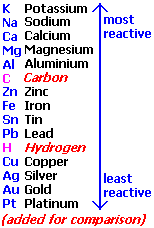
Metal A is more reactive than Metal B. The following displacement reaction takes place.
Metal A + Metal B in compound ---> Metal B + Metal A in compound.
True or False.
True
False
Reactivity of metal towards oxygen increases down the reactivity series of metal diagram
True
False
In a vigorous reaction between a more reactive metal such as magnesium and oxygen, a bright flame is observed
True
False
In a less vigorous reaction between a less reactive metal such as iron and oxygen, only a glow or slow change in colour is observed
True
False
If carbon can remove oxygen from a metal oxide, it means carbon is ___________ reactive than the metal.
more
less
During reaction between hydrogen and iron(III) oxide, observation as below is obtained:
Iron(III) oxide burns brightly. Reddish brown powder turns shiny grey.
What does this mean?
Iron(III) oxide is produced. Hydrogen oxidised iron to iron(III) oxide.
Iron is produced. Hydrogen reduces iron(III) oxide to iron.
Hydrogen does not reduce iron(III) oxide.
Iron(III) oxide does not reduce hydrogen.
The most reactive metal in the reactivity series of metals is ______________.
Calcium
Potassium
Magnesium
Aluminium

Magnesium chloride + Sodium → ?
Sodium chloride + Magnesium
Magnesium chloride + Sodium (No change)
Sodium magnesium + Chlorine
Magnesium sodium chloride
Which metal produces MOST vigorous reaction when reacts with oxygen?
Iron
Magnesium
Potassium
Sodium
The carbon is located between ___________________ in reactivity series of metals.
Zinc and hydrogen
Zinc and Iron
Magnesium and Aluminium
Aluminium and Zinc
The hydrogen is located between ___________________ in reactivity series of metals.
Calcium and magnesium
Zinc and Iron
Aluminium and Zinc
Tin and Lead

