
 Worksheets
Science 14 Chapter 3 Quiz
Total questions: 29
Worksheet time: 2hrs 25mins
A mixtures is a combination of two or more____________ in which no new kinds of matter are formed.
subtances
parts
leaves
pebbles

Which of the pictures represents a mixture?
A
B
C
What is the definition of a solvent?
The substance that is dissolved.
The substance in which the solute is dissolved.
Unable to be dissolved.
The substance that is being dissolved in a solution is called the--
suspension
solute
solvent
mixture
Lemonade - Water, lemon juice, and sugar
Identify the solute
water
lemon juice
sugar and lemon juice
Kool-Aid - Powder, sugar, and water
Identify the solvent
water
powder
sugar
powder and sugar

Why is water known as universal solvent?
It is found anywhere.
It gives life to living things.
It covers the greater part of the earth.
It dissolves almost all the substances on Earth.

Type of mixture that has the SAME COMPOSITION in every part.
Homogenous
Heterogeneous

Type of mixture that DOESN'T HAVE the same composition in every part.
Homogeneous
Heterogeneous

Stefanie wants to dissolve a sugar cube into water. Which of the following will speed up the dissolving rate of the sugar cube? (Choose all that are correct!)
Using warm water instead of cold water
Add more than 1 cube at a time
Crushing the cube into small pieces
Adding the cubes to the cup and then pouring on the water
Stirring the water after adding the cubes
You can make a solute dissolve more quickly in a solvent by
adding more solute.
adding ice.
heating the solvent.
removing some solvent.
A solution that contains all of the solute it can hold at a given temperature is
diluted.
saturated.
supersaturated.
unsaturated.
Which will dissolve faster, crushed table salt or a cube of table salt?
crushed table salt
a cube of table salt
You can make a solution more concentrated by adding __________.
solute
solvent
water
and subtracting numbers

Which of the following are true statements about the picture? (Choose all that are correct!)
A is the most concentrated
G is the most diluted
C is more diluted than E
D is more diluted than E and more concentrated than C
B is more diluted than A and more concentrated than C

At 60 degrees Celsius, how much NaNO3 can be dissolved in 100g of water?
120 g
105 g
140 g
90 g

According to the graph, which substance is not much affected in solubility as the temperature rises?
NaNO3
KNO3
NaCl
Na2SO3
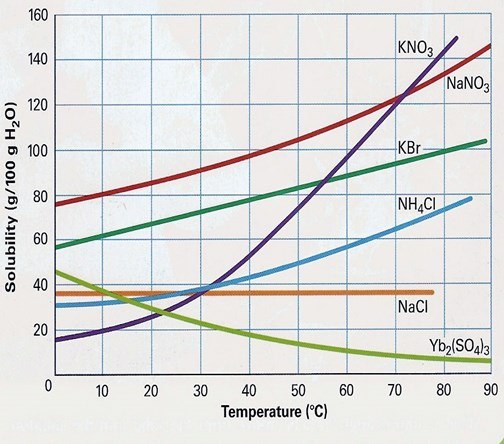
At 30'C, which substance has the lowest solubility?
KNO3
KBr
NaCl
Yb2(SO4)3
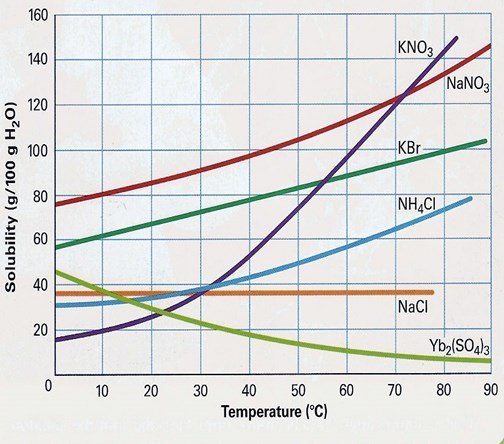
At which temperature do KBr and KNO3 have the same solubility?
60
55
50
Never
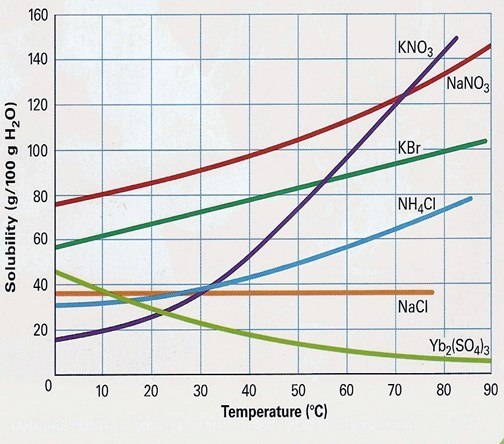
The solubility of Yb2(SO4)3 ________________ with added temperature.
increases
decreases
remains the same
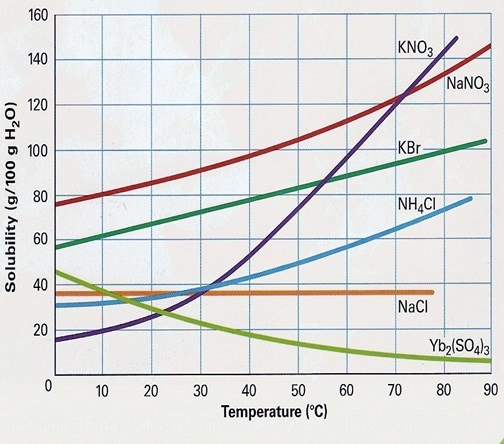
Identify how many grams of KNO3 is required to make a saturated solution at 40'C.
50 g
45 g
60 g
33 g

