wayground logo

Free Printable Worksheets

Font size

S
M
L
XL
Worksheets

Year 7 Particles

Total questions: 25

Worksheet time: 25mins

Name
Class
Date
1.

Name the 3 states of matter.

a)

solid

b)

liquid

c)

gas

d)

all of them

2.

Name the term used to describe the change in state from liquid to gas.

a)

evaporation

b)

condensation

c)

boiling

d)

freezing

3.

Name the term used to describe the change in state from gas to liquid.

a)

evaporation

b)

condensation

c)

diffusion

d)

freezing

4.

Name the term used to describe the change in state from liquid to solid.

a)

evaporation

b)

condensation

c)

freezing

d)

boiling

5.

Name the process by which particles move from a high concentration to a low concentration (i.e. how smell travels around a room).

a)

condensation

b)

osmosis

c)

diffusion

d)

active transport

6.

In which state of matter are the particles closest together?

a)

solid

b)

liquid

c)

gas

7.

In which state of matter are the chemical bonds (also known as forces of attraction) the strongest?

a)

solid

b)

liquid

c)

gas

8.

In which state of matter are the chemical bonds (also known as forces of attraction) the strongest?

a)

solid

b)

liquid

c)

gas

9.

In which state of matter are the particles touching but can move past one another?

a)

solid

b)

liquid

c)

gas

10.

Which states of matter have a fixed volume?

a)

solid

b)

liquid

c)

gas

11.

Which state of matter is easily compressed?

a)

solid

b)

liquid

c)

gas

12.

True or False


Particles in liquids have chemical bonds between them?

a)

true

b)

false

13.

Which state of matter is most dense?

a)

solid

b)

liquid

c)

gas

14.

Which state of matter is least dense?

a)

solid

b)

liquid

c)

gas

15.

Name the term used to describe a solid changing to a liquid (e.g. ice to water).

a)

freezing

b)

melting

c)

condensing

d)

boiling

16.

True or False:


A pure substance consists of more than one type of particle.

a)

true

b)

false

17.
How do gases behave in a container?
a)
Cluster together
b)
form a solid
c)
They take the shape of their container
d)
leak out 
18.
Which states allow easy flow of particles
a)
Gas and Solid
b)
Gas and Liquid
c)
Solid and Liquid
d)
Gas only
19.
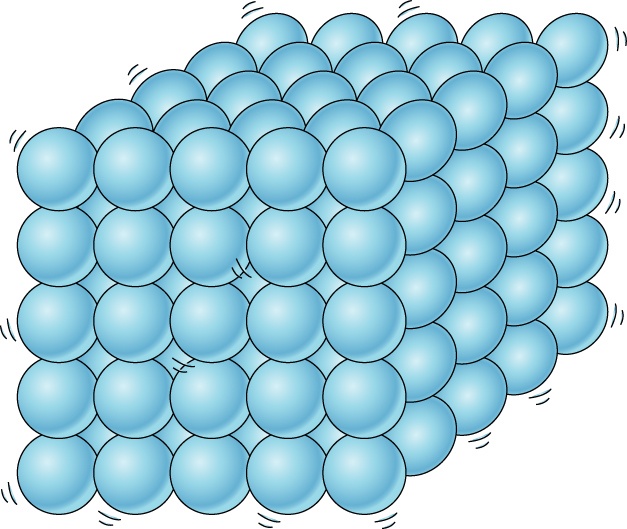
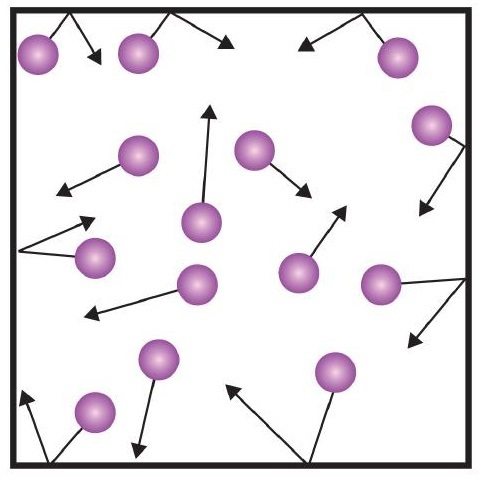
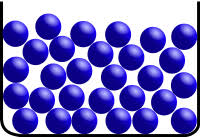
Which description best matches this particle model?
a)
Closely packed and can't move a lot. 
b)
Particles are close together but can move a little. 
c)
Particles have lots of energy and can move around. 
20.
Which description best matches this particle model?
a)
Closely packed and can't move a lot. 
b)
Particles are close together but can move a little. 
c)
Particles have lots of energy and can move around. 
21.
Which description best matches this particle model?
a)
Closely packed and can't move a lot. 
b)
Particles are close together but can move a little. 
c)
Particles have lots of energy and can move around. 
22.
Which of the following occurs when a liquid becomes a gas?
a)
the particles slow down
b)
the particles beak away from one another
c)
the particles move closer together
23.
How do the particles of matter move as the matter changes state in the diagram?
a)
The particles released energy and move as matter changed state?
b)
The particles released energy and moved more quickly.
c)
The particles gained energy and moved more slowly.
d)
The particles gained energy and moved more quickly.
24.
Particles (molecules) in a ______________________ have more energy than the other states of matter.
a)
gas
b)
solid
c)
liquid
25.
At higher temperatures
a)
particles in an object have less energy
b)
particles in an object move faster
c)
a gas contracts