
 Worksheets
IGCSE Force
Total questions: 20
Worksheet time: 25mins

A car moves along a level road.
The diagram shows all of the horizontal forces acting on the car.
Which statement is correct?
The car is slowing down.
The car is speeding up.
The car is moving at a constant speed.
The car is moving backwards.
Which force and distance produce the smallest moment about a pivot?
a 6.0 N force at a perpendicular distance of 4.0m from the pivot
a 7.0 N force at a perpendicular distance of 6.0 m from the pivot.
a 10 N force at a perpendicular distance of 4.0 m from the pivot
a 12 N force at a perpendicular distance of 3.0 m from the pivot.
A resultant force of 4.0N acts on an object of mass 0.50 kg for 3.0 seconds.
What is the change in velocity caused by this force?
4.0 m / s
6.0 m / s
12 m / s
24 m / s

The diagram shows a tug-of-war between team X and team Y. The arrows show the forces exerted by the teams on the rope.
What is the size of the resultant force on the rope and in which direction does the resultant force act?
size of resultant force = 75 N; direction of resultant force = to the left
size of resultant force = 75 N; direction of resultant force = to the right.
size of resultant force = 725 N; direction of resultant force = to the left
size of resultant force = 725 N; direction of resultant force = to the right.
Which property of an object cannot be changed by a force?
mass
motion
shape
size

An unstretched spring obeys Hooke’s law and has a length of 10 cm. A load with a mass of 2.0 kg is hung from it, and its length becomes 14 cm.
The load is now increased to 6.0 kg, and the new length of the spring is Y. The limit of proportionality is not reached.
What is Y?
22 cm
26 cm
30 cm
42 cm

A spring is suspended from a stand. Loads are added and the extensions are measured.
Which graph shows the result of plotting extension against load?


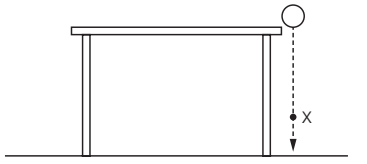
A ball is dropped from a table-top. Air resistance may be ignored.
Which row describes the velocity and the acceleration of the ball at point X
acceleration = constant; velocity = constant
acceleration = constant; velocity = increasing
acceleration = increasing; velocity = constant
acceleration = increasing; velocity = increasing
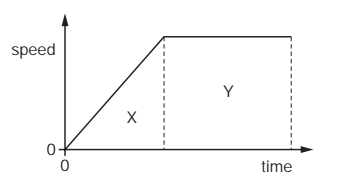
The diagram shows the speed-time graph for a car.
Which area represents the distance travelled while the car is accelerating?
X
X + Y
Y
Y - X

A wooden bar is pivoted at its centre so that it can rotate freely. Two equal forces F are applied to the bar.
In which diagram is the turning effect greatest?


A hole is drilled in a square tile. The diagram shows the tile hanging freely on a nail.
Where is the centre of mass of the tile?
A
B
C
D

A balloon and a mass are attached to a rod that is pivoted at P.
The balloon is filled with helium, a gas less dense than air, so that it applies an upward force on the rod.
The rod is horizontal and stationary.
Which action causes the rod to rotate clockwise?
Move both the balloon and mass 10 cm to the left.
Move both the balloon and mass 10 cm to the right.
Move both the balloon and mass to the 25 cm mark
Move the balloon to the 20 cm mark and the mass to the 30 cm mark.
Link between moment, force and (perdindicular) distance (to pivot)
moment = force x distance
moment = force / distance
moment = distance / force
moment = force / moment
momentum = forks x distant ants

A ball of mass 0.50 kg falls and hits the floor at 10 m / s.
It rebounds at speed 8.0 m / s, as shown.
The collision between the ball and the floor lasts for 0.50 s.
What is the average force acting on the ball during the collision?
2.0 N upwards
2.0 N downwards
18 N upwards
18 N downwards

A gas molecule strikes the wall of a container. The molecule rebounds with the same speed.
What happens to the kinetic energy and what happens to the momentum of the molecule?
Kinetic energy changes; momentum changes
Kinetic energy changes; momentum stays the same.
Kinetic energy stays the same; momentum changes
Kinetic energy stays the same; momentum stays the same.

A tennis ball of mass 0.060 kg travels horizontally at a speed of 25 m/s. The ball hits a tennis racket and rebounds
horizontally at a speed of 40 m/s.
The ball is in contact with the racket for 50 ms.
What force does the racket exert on the ball?
0.018 N
0.078 N
18 N
78 N

