
 Worksheets
8 EMS - Factors of Production
Total questions: 35
Worksheet time: 19mins
All of the economic inputs that are required to produce goods and services are called:
Factors of production
Supply
Demand
Capital goods
The physical effort of people to produce goods or services describes which factor of production?
Land
Capital
Labour
Entrepreneurship
The ideas and emotional drive a person has to produce something that other people will want to buy describes which factor of production?
Capital
Labour
Entrepreneurship
Land
Land includes...
The "gifts of nature" or natural resources not created by human effort.
the tools, equipment, and factories used in production of goods and services
people with all their efforts and abilities
individuals who start a new business or bring a product to market.
Capital refers to...
The "gifts of nature" or natural resources not created by human effort.
people with all their efforts and abilities
the tools, equipment, and factories used in production of goods and services
individuals who start a new business or bring a product to market.
Labour refers to...
people with all their efforts and abilities
individuals who start a new business or bring a product to market.
the tools, equipment, and factories used in production of goods and services.
The "gifts of nature" or natural resources not created by human effort.
Entrepreneurs are...
people with all their efforts and abilities
individuals who start a new business or bring a product to market.
The "gifts of nature" or natural resources not created by human effort.
the tools, equipment, and factories used in production of goods and services
A herd of cattle is an example of ...
Land
Labour
Entrepreneur
Capital
Forests are examples of...
Land
Labour
Entrepreneurs
Capital
A bulldozer is an example of...
Land
Labour
Entrepreneurs
Capital
A steel factory is an example of
Land
Labour
Entrepreneurs
Capital
Bill Gates is an example of...
Land (seriously though, come on)
Labour
An Entrepreneur
Capital
Cashiers at McDonalds are examples of ….
Land
Labour
Entrepreneurs
Capital
The following items (accountant's computer, carpenter's drill, and a tailor's sewing machine) are all examples of which factor of production?
Capital
Entrepreneurship
Land
Labour
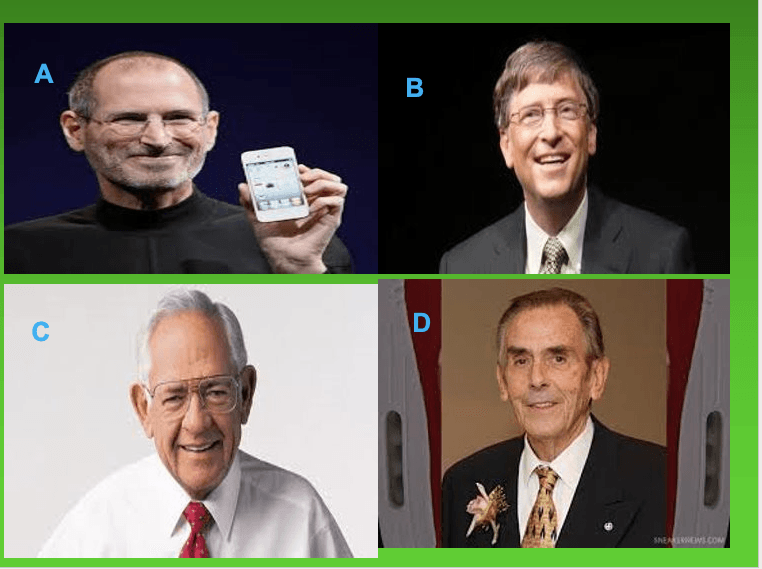
Steve Jobs the founder of Apple is holding up an iPhone. What is another name for someone who starts a business?
Capital
Entrepreneur
Land
Labour
This factor involves money, equipment, and tools and any items to produce goods and services?
Capital
Entrepreneur
Land
Labour
The enterprising spirit that allows an individual to spot gaps in the market and take risks (including starting a business):
Entrepreneurship
Capital
Land
Labour
All natural resources that go into the production of a good or service:
Capital
Entrepreneurship
Land
Labour

Iron Ore
Land
Labour
Physical capital
Human capital
Entrepreneurship
The people who decide to buy products or services
Producers
Consumers
Economist
Entrepreneurs
Which of the following is an example of a blue-collar worker?
Heath is a waiter at Spur.
Sandra works at UPS and lifts heavy boxes.
Brenda works as a secretary for an office executive.
Saul owns his own catering company.
Which of the following is a fixed cost for a business?
Monthly rent for a restaurant.
New tyres for a car dealership.
Wages for workers at the factory.
Petrol for a pizza delivery shop.
Of the following, who would most likely earn the highest salary?
A skilled white-collar worker
An unskilled blue-collar worker
Someone who is hired to work on a farm
Someone who has a high school certificate
Wages and raw materials are examples of variable costs.
True
False
An office executive with ABSA Bank is considered a blue-collar worker.
True
False

Which factor of production is a person who owns their own McDonald's franchise?
Land
Labour
Capital
Entrepreneurship
A profit is:
Man made things that help make a good or service
The money left over after paying off operating costs
Gifts of nature
The amount of money it takes to run a business
Revenue is:
The amount of money it takes to run a business
profit
The amount of money you make from selling goods and services
Gifts of nature
When people can't have everything they want due to limited resources, this is:
Scarcity
Entrepreneur
Profit
Consumer
A person who buys goods and services are called:
Producers
Entrepreneurs
Consumers
Businesses
A person who sells goods and services are called:
Consumers
Producers
Profit
Operating costs
When you want to buy groceries using the money in your account, instead of using cash, you could use:
Debit card
Credit card
Cash

Which factor of production would you consider a cow?
Land
Labour
Capital
Entrepreneur


