wayground logo

Free Printable Worksheets

NEW

Font size

S
M
L
XL
Worksheets

Genetics and Punnett Squares

Total questions: 38

Worksheet time: 52mins

Name
Class
Date
1.

What is a GENOTYPE?

a)

the genetic make-up of an organism

b)

the physical trait of an organism

c)

mitosis

d)

meiosis

2.

The physical appearance of a trait is known as the-

a)

genotype

b)

phenotype

c)

Homozygous

d)

intelligence

3.

In plants, tall (T) is dominant to short (t).


Draw a punnett square and perform the following cross: Tt x Tt


What is the probability of producing a short plant?

a)

0%

b)

25%

c)

50%

d)

75%

4.
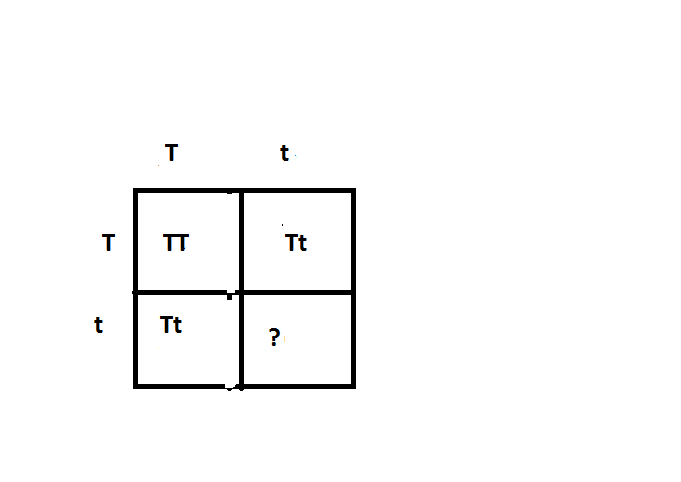
What allele combination should go in the missing box?
a)
AA
b)
Aa
c)
aa
d)
none of these
5.

A homozygous brown mouse BB is crossed with a heterozygous brown mouse Bb (tan is the recessive color).


Perform a punnett square cross and determine the phenotype & %.

a)

100 % tan

b)

100 % brown

c)

50 % brown and 50% tan

d)

75 % brown and 25 % tan

6.

What genotype would go in box 1?

a)

BB

b)

Bb

c)

bb

d)

Bb

7.

What are the possible genotypes for this cross? And what percentage of each is produced?

a)

TT = 25% Tt= 50% tt=25%

b)

all tall

c)

TT= 75% tt = 25%

d)

Tt = 100%

8.
Dominant alleles are represented by a:
a)
Male gene
b)
lowercase letter
c)
recessive trait
d)
capital letter
9.

Complex molecule that carries genetic information that defines an organism's traits. It is stored in the nucleus.

a)

Protein

b)

DNA

c)

RNA

d)

Glucose nucleic acid (GNA)

10.

In a heterozygous genotype, the ___________ allele takes hides the recessive allele in the phenotype.

a)

recessive

b)

dominant

c)

lower case letter

d)

both

11.
What you see, or the physical appearance.
a)
Genotype
b)
Phenotype
c)
Homozygous
d)
Heterozygous
12.

T - tall and t = short

In the punnett square below, what belongs in the missing square

a)

tt

b)

Tt

c)

Bb

d)

TT

13.

Which of the following would be a phenotype?

a)

Aa

b)

red hair

c)

heterozygous

d)

DNA

14.

How many alleles are in the genotype for a simple trait?

a)

1

b)

2

c)

3

d)

4

15.

How many alleles (letters) does a child get from EACH parent for each trait?

a)

1

b)

2

c)

3

d)

4

16.

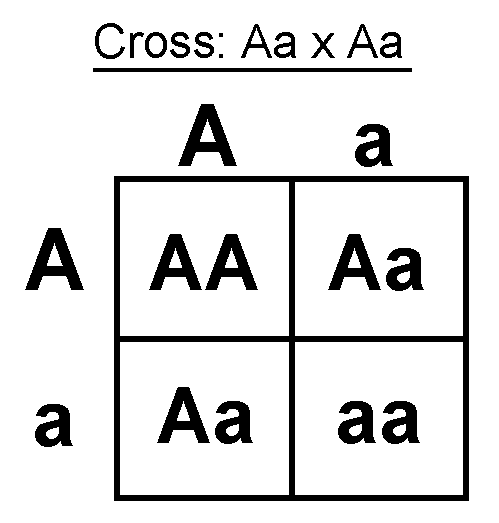
What is the percentages of the genotypes for the offspring? Use the cross Aa x Aa

a)

50 % Aa and 50% AA

b)

25 % Aa and 75% AA

c)

75 % aa and 25% AA

d)

0% aa and 100% AA

e)

25% AA and 50% Aa and 25% aa

17.

B = brown fur b = white fur

In the punnett square, what is the genotype of the missing parent?

a)

BB

b)

Bb

c)

bb

d)

cannot be determined with the punnett square

18.
What is a punnett square?
a)
graph used to predict the possible genotypes of offspring in a given cross
b)
a graph used to predict the possible birth rate of offspring.
c)
a graph used to predict the possible behavioral characteristics an offspring could have
d)
None of the above
19.
In a punnet square where are the parent alleles written?
a)
Top and inside the boxes
b)
Only on the left and right side of the boxes. 
c)
outside of the boxes (top and left side)
d)
All on the top side of the boxes
20.
What is the dominant trait?
a)
yellow pea seeds
b)
green pea seeds
c)
there is no dominant seed
d)
Jolly green giant
21.

What is the probability of heterozygous Bb offspring?

a)

25%

b)

50%

c)

0%

d)

100%

22.
What allele combination should go in the missing box?
a)
AA
b)
Aa
c)
aa
d)
none of these
23.
T - tall and t = short
In the punnett square below, what belongs in the missing square
a)
tt
b)
Tt
c)
Bb
d)
TT
24.
Physical characteristics that are passed down from parents to offspring during sexual reproduction. 
a)
Phenotype
b)
Traits
c)
Genes
d)
Heredity
25.
The passing of traits from parent to offspring. 
a)
Heredity
b)
Traits
c)
Genetics
d)
Genes
26.
The study of how traits are inherited through the interactions of genes. 
a)
Genetics
b)
Heredity
c)
Genes
d)
Traits
27.
A segment of DNA found on a chromosome that determines the inheritance of a particular trait. 
a)
Genes
b)
Genetics
c)
Heredity
d)
Traits
28.
Structures found in the nucleus of a cell that contain DNA. 
a)
Genes
b)
Chromosomes
c)
Allele
d)
Traits
29.
If B = brown hair and b = blonde hair, what is the probability of brown hair?
a)
25%
b)
50%
c)
0%
d)
75%
30.

What are the 4 chemicals used in DNA?

a)

A, B, C, D

b)

L, M, N, O

c)

A, T, C, G

d)

H, E, L, P

31.
What are the possible genotypes for this cross?
a)
TT = 25% Tt= 50% tt=25%
b)
all tall
c)
TT= 75% tt = 25%
d)
Tt = 100%
32.
What are genes?
a)
Something you wear.
b)
Segments of DNA that carry traits for offspring.
c)
The powerhouse of cells.
d)
None of the above.
33.

What are the parents' genotypes?

a)

Homozygous BB for brown eyes

b)

Heterozygous Bb for brown eyes

c)

Homozygous bb for blue eyes

34.
What is the phenotype for the recessive trait?
a)
brown eyes
b)
green eyes
c)
blue eyes
35.

What genotype would go in box 2? And is it Homozygous or Heterozygous?

a)

BB Heterozygous

b)

Bb Heterozygous

c)

bb Homozygous

d)

Bb Homozygous

36.
How many boxes would say BB?
a)
1
b)
2
c)
4
d)
0
37.
T4 - The genotypic ratio here is
a)
25% blue eye 75 % brown eye 
b)
BB = 25% Bb = 50% bb = 25%
c)
BB= 50 % bb = 50%
d)
All brown eye
38.
T4 - What genotype would go in box 4?
a)
BB
b)
Bb
c)
bb