
 Worksheets
Types of Experiments
Total questions: 48
Worksheet time: 1hrs 21mins
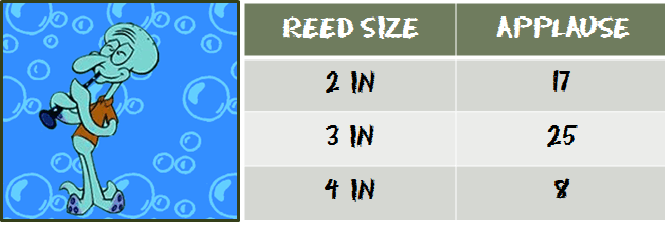
What was the dependent variable?
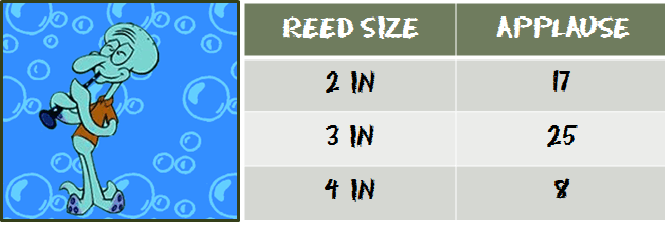
What was controlled?
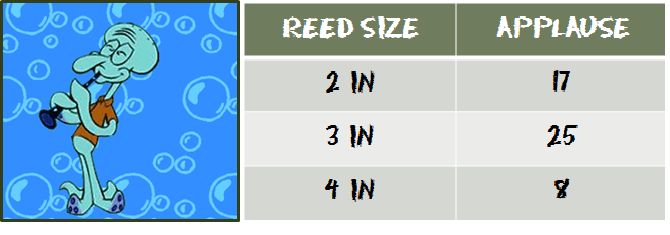
What was the independent variable?
A student wants to test how different amounts of UV light affect the growth of the bacteria, Staphylococcus aureus. She wants to grow the bacteria in petri dishes for her experiment. Which of the following variables should NOT be held constant in this experiment?
amount of UV light bacteria is exposed to
amount of time to grow bacteria
location of petri dishes while growing bacteria
type of bacteria (Staphylococcus aureus)
A student performed an experiment that tested how many days it takes different types of grass seed to grow to a height of two inches. Four types of grass seed were tested, and the student recorded the number of days for each type to grow. Use this information to answer the next question.
What should be held constant in this experiment?
amount of sunlight, amount of water, and type of soil
amount of sunlight
amount of water and type of soil
amount of water
A student is studying the effect of sunlight on plants. The student developed this hypothesis: Plants need light to make food and to grow properly. To conduct a controlled experiment, which method should she use?
Choose two identical plants; put one in the dark and one near sunlight; use the same amount of water; water both regularly
Choose a healthy plant; put it in a dark place; use clean water; water the plant regularly.
Choose two identical plants; put each in the dark for 12 hours and then light for 12 hours; use the same amount of water; water both regularly.
Choose three identical plants; put one in the dark, one near sunlight, and one in the shade, water only the plant in light.
What is the independent variable in the following hypothesis?
HYPOTHESIS: If I spend more time studying, then my grades in science will improve.
Time spent studying
Improvement in grades
Playing soft music in the background
Location for studying science
Ellin is conducting a scientific investigation in which she measures a certain type of plant's growth in response to different amounts of fertilizer. What is the independent variable?
Amount of fertilizer
Plant growth
Type of plant
Temperature of the fertilizer
Adam conducted a science experiment on the effect of different environments on plant growth. He put one plant in the closet and the other plant in the window at his house. He measured the growth of each plant weekly for six weeks. He then created a graph after he reviewed his data. What is the dependent variable of Adam's experiment?
Total Growth of Plant
Plant Environment
The Effect of Different Environments
Measurement over Six Weeks
A student performed an experiment that tested how many days it takes different types of grass seed to grow to a height of two inches. Four types of grass seed were tested, and the student recorded the number of days for each type to grow.
What is the independent variable in this experiment?
type of grass seed
two inches
number of days
sunlight
A student is investigating how compost can increase the size of vegetables grown in the garden. To test this, two separate gardens will be grown that are almost identical. The only difference will be that one plot will use regular soil and the other will use compost enriched soil. What is the dependent variable in this investigation?
compost enriched soil
quality and size of vegetables
two garden plots
water supply
What is the independent variable in the following hypothesis?
"If the salinity of freshwater is increased, then the growth rate of harmful algae decreases."
salinity of freshwater
decreases
algae
growth rate
Identify the independent variable in the following hypothesis. "If the amount of rainfall increases, then the occurrence of plant disease decreases."
rainfall
disease
decrease
plants
Students are testing the James River for dissolved-oxygen levels. They test in the Blue Ridge Mountains, at the river's source, and in Richmond Virginia, a highly populated area. What is the independent variable in this experiment?
the location of the test sights
the time of year for gathering samples
the method for testing dissolved oxygen
the time of day for gathering samples
John and Emily were experimenting with the effects of road salt on plant growth. To do this, they watered plants daily with the same amount of salt water. They could BEST improve their experiment by ___.
watering half the plants with pure water and half with salt water
adding food color to see how far the salt penetrates the plants
cooling the salt water before watering the plants
increasing the amount of salt added to the water each day
Ellin is conducting a scientific investigation in which she measures a certain type of plant's growth in response to different amounts of fertilizer. What is the dependent variable?
Plant growth
Amount of fertilizer
Type of plants
Temperature of the fertilizer
James is conducting an experiment to test the effect of insecticides on frogs. What is the control group in his experiment?
The frogs that were NOT exposed to the insecticides.
The frogs that were exposed to 15 mL of insecticide.
The frogs that were exposed to 30 mL of insecticide.
The frogs that did not survive the experiment.
Jackie performs an experiment on how the type of music played in a room can affect plant growth. In her experiment, the independent variable is the ___.
type of music
height of plant
type of plant
color of flower
Alicia is testing the effectiveness of different brands of antibacterial hand sanitizers. What is the independent variable in Alicia's experiment?
The different brands of hand sanitizers
The amount of hand sanitizer used
The amount of time the sanitizer is left on the hands
The time of day the experiment is conducted
Jeremiah is measuring the growth of two indoor plants. He wants to find out if there is a difference in plant growth based on the amount of sunlight that each plant receives. All of the following are variables in this experiment EXCEPT ___.
color of pot
growth
sunlight
plants
Glenda is designing an experiment for her science fair project on the amount of water that will grow the tallest plant. She wants to find out which amount of water will grow the tallest plant - 100mL, 200mL, or 300mL per week. What is the independent variable in this experiment?
Amount of water
Type of plant
Plant height
Color of the pot
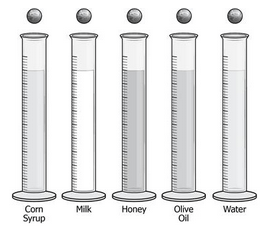
A student is conducting an experiment on the movement of a marble through five different substances. The student knows that is takes an average of 0.9 seconds for a marble to move through 80 mL of water. What is the control in the experiment?
Water
Corn Syrup
Milk
Olive Oil
How could this experiment be improved?
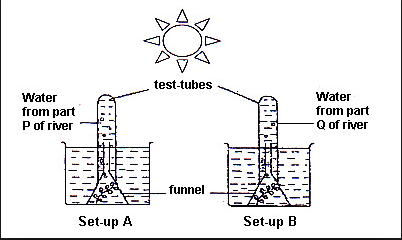
A restaurant chef conducts an experiment in which several small potatoes of the same size are boiled for various amounts of time from 1 minute up to 15 minutes. Which of the following statements could be an aim of the experiment?
The best time to cook a potato is ten minutes.
After boiling for two minutes, a potato is still too hard to eat.
To determine the time taken to perfectly cook a potato.
Place a potato in a saucepan and cover with water.
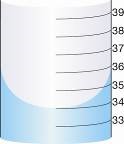
Which of the following measurements is correct for the volume of liquid in the measuring cylinder?
34 mL
35 mL
36 mL
There is not enough information to decide.
Evan ran a series of experiments testing how high different balls bounced. Which of the following is not a good conclusion for his experiments?
Balls bounced higher on concrete than on grass.
Tennis balls bounced higher than squash balls.
Balls bounce higher when dropped from greater heights.
The experiment was lots of fun and I learnt a lot about balls.
Maddie measured how far an elastic band stretched when 50g masses (metal weights) were hung from it. Which of the following is the variable that she is changing (the independent variable)?
How far an elastic band stretches.
The brand of elastic band.
The number of masses hung from the elastic band
The thickness of the elastic band.
Joe noticed that when he washed dishes he sometimes made lots of froth and at other times made almost none. He designed an experiment where he put 1 drop of detergent in the sink and turned the tap on high until the sink was half full. He then repeated the experiment with 2 drops of detergent, then 3 then 4. Identify his dependent variable.
the amount of bubbles
the number of drops of detergent
the brand of the detergent
the temperature of the water

