wayground logo

Free Printable Worksheets

NEW

Font size

S
M
L
XL
Worksheets

Science Form 2_Chap 7.1 Electricity

Total questions: 35

Worksheet time: 22mins

Name
Class
Date
1.

Identify the type of energy

a)

Electrical Energy

b)

Mechanical energy

c)

Sound energy

d)

Thermal energy

2.

Identify the type of energy

a)

Thermal energy

b)

Mechanical energy

c)

Sound energy

d)

Electrical energy

3.

Choose the source of energy

a)

Nuclear

b)

Petrol

c)

Coal

d)

Sun

4.

Choose the source of energy

a)

Wind

b)

Water

c)

Sun

d)

Biomass

5.
Energy of motion is which type of energy?
a)
Potential
b)
Kinetic
c)
Sound
d)
Gravitational
6.
According to which law of energy, energy can't be created or destroyed?
a)
First law of motion
b)
The law of tacos
c)
Laws of Energy
d)
law of conservation of energy
7.
The ability to do work is
a)
power
b)
energy
c)
thermal
d)
kinetic
8.
Heat energy is also called
a)
electrical energy
b)
chemical energy
c)
light energy
d)
thermal energy
9.
Stored energy is called ______ energy.
a)
Kinetic
b)
Potential
c)
Pacific
d)
Safe
10.

S.I. unit for energy is

a)

newton

b)

joule

c)

meter

d)

second

11.
Two like charges
a)
 neutralize each other.
b)
repel each other. 
c)
must be neutrons. 
d)
attract each other.
12.
The charge of an electron is 
a)
positive. 
b)
negative. 
c)
Electrons have no charge
13.
An atom loses an electron.  What type of charge does it have now?
a)
positive
b)
negative
14.
An atom gains an electron.  What type of charge does it have now?
a)
positive
b)
negative
c)
No charge
15.
Charged objects are not attracted to neutral objects
a)
True
b)
False
16.
When a balloon is rubbed on clothes it acquires a charge by ___________
a)
Induction
b)
reduction
c)
friction 
d)
concuction
17.
When a glass rod is rubbed with silk and the glass rod becomes positively charged, what happens to the electrons?
a)
they are removed from the rod
b)
they are added to the rod
18.
What is the name of this device that is used to detect charges?
a)
beaker
b)
electroscope
c)
van de graff generator
d)
chargometer
19.

What types of charges attract?

a)

Positive and Positive

b)

Positive and Neutral

c)

Negative and Neutral

d)

Positive and Negative

20.
If two balloons have the same charge, what will happen if you place them close to each other?
a)
Nothing
b)
They will be attracted
c)
They will pop
d)
They will push each other away.
21.

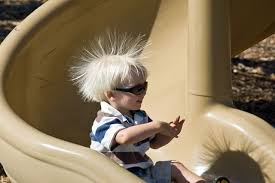
Why does the child's hair stick up?

a)

The boy is grounded since he's at the bottom of the slide

b)

He gained a charge from the slide, and since he's not grounded, his hairs have the same charge so they repel one another

c)

He gained a charge from the slide, and since he's not grounded, his hairs have opposite charges so they repel one another

d)

When hair is neutral, some have a positive side and some have negative side, so they will attract to each other, making it stand up

22.
Current is...
a)
moving protons
b)
moving electrons
c)
measured in volts
d)
measured in ohms
23.

Flow of electric current can be measured by using an

a)

voltmeter

b)

ammeter

c)

rheostat

d)

thermometer

24.
Which word means how hard it is for electrons to flow?
a)
Current
b)
Voltage
c)
Resistance
d)
Power
25.
What is resistance measured in?
a)
Ω (Ohms)
b)
V (Volts)
c)
A (Amps)
d)
W (Watts)
26.

What is voltage?

a)

The flow of protons

b)

The number of charged particles that pass each second

c)

The potential difference between two points

d)

The rate at which energy is being transformed

27.
_________________ found that current, voltage, and resistance are always related.
a)
Isaac Newton
b)
Albert Einstein
c)
Georg Ohm
28.
__________________ is the continuous flow of electric charges through a material.
a)
Electric current
b)
Resistance
c)
Voltage
d)
Static Discharge
29.
The movement of electrically charged _____ is called electric _____
a)
particles, transport
b)
ions, current
c)
particles, current
d)
ions, transport
30.

A form of energy caused by the movement of electrons

a)

electricity

b)

voltage

c)

electric current

d)

parallel circuit

31.

What is the correct unit for measuring electric current?

a)

Amperes

b)

Volts

c)

Ohms

d)

Coulombs

32.
Voltage is measured in __.
a)
volts.
b)
watts.
c)
coulombs. 
33.
Resistance is a measure of....
a)
the energy per unit charge in a circuit
b)
how hard it is for electrons to move through the circuit
c)
how hard it is for electrons to move through the battery
d)
the number of charge carriers in a circuit
34.
What is Resistance?
a)
The flow of electrons
b)
Electric potential difference
c)
A battery
d)
The ability to reduce the flow of electrons
35.

What is the formula for ohms law?

a)

1+2=3

b)

R X E = I

c)

V = I x R

d)

E = MC squared