
 Worksheets
PHYSICS KSSM FORM 4 CHAPTER 3
Total questions: 30
Worksheet time: 57mins


Newton said that any two masses will...
combine into a larger mass.
attract each other.
create gravitational fields.
push each other apart.
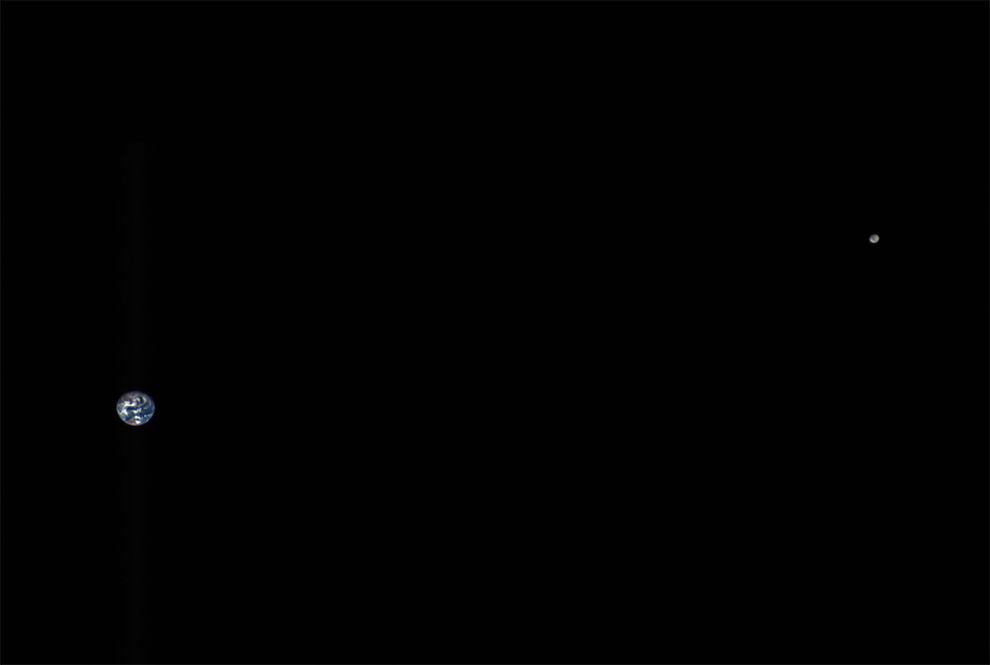
According to Newton's law of gravitation, the Earth and the Moon are gravitationally attracted to each other. The more massive Earth attracts the Moon with...
a stronger force than the Moon attracts the Earth.
a weaker force than the Moon attracts the Earth.
the same force as the Moon attracts the Earth.
a force that is sometimes stronger and other times weaker than the Moon attracts the Earth.

The picture shows three objects gravitationally interacting with each other. Which object exerts the greatest force on object B?
Object A
Object C
A and C exert an equal force on B
Cannot be determined

The picture shows three objects gravitationally interacting with each other. Which object exerts the greatest force on object B?
Object A
Object C
A and C exert an equal force on B
Cannot be determined

The distance between the two masses in the previous situation is halved. Determine the gravitational force in this new situation.
20 N
40 N
80 N
160 N

The picture shows two identical satellites, A and B, in circular orbits around the Earth. Upon which satellite does the Earth exert a stronger gravitational force?
Satellite A
Satellite B
Equal on both
Cannot be determined

The Earth exerts a gravitational force of 12 N upon satellite B. Satellite A is twice as far away from the Earth as satellite B. Determine the gravitational force the Earth exerts on satellite A.
3 N
6 N
12 N
24 N

A third identical satellite, C, is placed in orbit at half the distance from the Earth as satellite B. Determine the gravitational force the Earth exerts on satellite C.
6 N
12 N
24 N
48 N

The picture shows the gravitational field in the space surrounding the Earth. What is creating this gravitational field?
The gravitational force.
The mass of the Earth.
The distance of the Earth.
The universal gravitational constant.

The figure shows the gravitational field surrounding the Earth. Which of the following explains why the field lines point towards the Earth?
Gravity is an attractive force.
The force of gravity points towards the center of the Earth.
Falling bodies accelerate towards the center of the Earth.
All of the above.
The centripetal force on an object in circular motion is
in the same direction as the tangential speed.
in the direction opposite the tangential speed.
in the same direction as the centripetal acceleration.
in the direction opposite the centripetal acceleration.
The gravitational force between two masses is 72 N. What is the gravitational force if the distance between them is tripled?
(G = 6.673 x 10⁻¹¹ N•m2/kg2)
8.0 N
9.0 N
36 N
54 N

In the figure, according to Kepler’s laws of planetary motion,
A1 = A2.
Δt1 > Δt2.
if Δt1 = Δt2, then the orbit is circular.
if Δt1 = Δt2, then A1 = A2.
Newton’s law of universal gravitation
can be derived from Kepler’s laws of planetary motion.
can be used to derive Kepler’s third law of planetary motion.
can be used to disprove Kepler’s laws of planetary motion.
does not apply to Kepler’s laws of planetary motion.
What term describes a change in the speed of an object in circular motion?
tangential speed
tangential acceleration
centripetal acceleration
centripetal force

Kepler's First Law states
objects attract other objects with a force that is directly proportional to the product of their masses
the square of the ratio of the periods of any two planets revolving around the Sun is equal to the cube of the ratio of their average distance from the Sun
An imaginary line joining a planet and the sun sweeps out an equal area of space in equal amounts of time.
Planets move about the Sun in an elliptical orbit with the Sun at one of the foci.

Kepler's Second Law states
objects attract other objects with a force that is directly proportional to the product of their masses
the square of the ratio of the periods of any two planets revolving around the Sun is equal to the cube of the ratio of their average distance from the Sun
An imaginary line joining a planet and the sun sweeps out an equal area of space in equal amounts of time.
Planets move about the Sun in an elliptical orbit with the Sun at one of the foci.

Kepler's Third Law states
objects attract other objects with a force that is directly proportional to the product of their masses
the square of the ratio of the periods of any two planets revolving around the Sun is equal to the cube of the ratio of their average distance from the Sun
An imaginary line joining a planet and the sun sweeps out an equal area of space in equal amounts of time.
Planets move about the Sun in an elliptical orbit with the Sun at one of the foci.

This is a statement of which scientific law?
Object attract other objects with a force that is directly proportional to the product of their masses, and inversely proportional to the square of the distance between them.
Newton's First Law
Newton's Second Law
Newton's Third Law
Newton's Law of Universal Gravitation

Which of the following most accurately describes the movement of the Earth around the Sun?
The Earth moves at a constant speed around the Sun.
The Earth moves faster when it is closest to the Sun.
The Earth moves slowest when it is closest to the Sun.
The Earth's speed varies dependent upon the phase of the moon.

Which of the following is the most accurate description of "escape velocity"?
Escape velocity is the velocity needed to get away from the Earth's gravitational force.
Escape velocity is the velocity needed to get away from the Earth's gravitational force and is dependent upon the mass of the satellite.
Escape velocity is the velocity needed to get away from the Earth's gravitational force and not dependent upon the mass of the satellite.
Escape velocity is the velocity needed to get away from the Earth's gravitational force and not dependent upon the mass of the satellite but is dependent upon the geometric structure of the launch vehicle.
State the definition of Gravitational field strength
Gravitational force per unit time acting on a body at a point in a gravitational field
The force between two bodies of mass M and m is directly proportional to the product of their masses
Gravitational force per unit mass acting on a body at a point in a gravitational field

