wayground logo

Free Printable Worksheets

NEW

Font size

S
M
L
XL
Worksheets

Forces and their effects

Total questions: 28

Worksheet time: 15mins

Name
Class
Date
1.

What is a force?

a)

it is anything which is capable of changing the state of

motion or rest of a body, or deforming it.

b)

It is anything that occupies a space and has mass and volume.

c)

It is a device that is used to measure forces and to weigh bodies.

d)

is a change of position of a body over time with respect to a reference system which is considered fixed.

2.

The unit of force is the Newton

a)

N

b)

n

c)

Nn

3.

Elastic materials are

a)

those that deform when a force is applied.

b)

those that deform but return back to their original shape

c)

those that can be applied forces but go back to the beginning

d)

None is correct.

4.

Plastic materials are

a)

those that deform with a form but do not return back to their original shape.

b)

those that deform with a form and return back to their original shape.

c)

None is correct.

d)

A non-eco-friendly material

5.

It two forces are the same size, something will happen. The forces are unbalanced.

a)

True.

b)

False.

6.

Friction is the force between two touching things.

a)

True.

b)

False.

7.
What is the force that causes objects to fall to Earth?
a)
Air resistance
b)
Gravity
c)
Water resistance
d)
Pressure
8.
Which of these is NOT a force?
a)
Friction
b)
Air resistance
c)
Water resistance
d)
Electrical resistance
9.
In which direction does gravity act?
a)
Downwards
b)
Upwards
c)
In all directions
d)
Towards the centre of the Earth
10.
What force does a parachute use to slow things down before hitting the ground?
a)
Friction
b)
Air resistance
c)
Water resistance
d)
Wind
11.
What type of force is air resistance?
a)
Contact
b)
Non-contact
12.
When two objects rub together, what force do they produce
a)
Gravity
b)
Air resistance
c)
Friction
d)
Water resistance
13.
What force does an aeroplane have to try to overcome so it is not slowed down too much?
a)
Gravity
b)
Air resistance
c)
Water resistance
d)
Friction
14.
Which of these uses friction?
a)
A parachute
b)
A ball falling through the sky
c)
Brakes on a bike
d)
A wind turbine
15.
What affect does water resistance have on a boat?
a)
Just slows it down
b)
Slows it down AND helps it keep afloat
c)
Makes it sink
d)
Just makes it float
16.

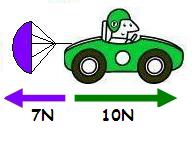
Is this an example of a balanced or unbalanced force?

a)

Balanced force

b)

Unbalanced force

c)

I don't know

17.

In this force diagram, which arrow is representing Friction?

a)

A

b)

B

c)

C

d)

D

18.

How do you know if this object is balanced?

a)

It's not balanced; it's Net Force is 14 N

b)

It is balanced because its Net Force is 0 N.

c)

It's not balanced; it's Net Force is 10 N left and 4 N up.

d)

I don't know how to tell.

19.

According to this force diagram, is this object balanced or unbalanced?

a)

Balanced

b)

Unbalanced

c)

I don't know

20.

What is the net force on this object?

a)

80 N West

b)

80 N East

c)

40 N West

d)

40 N East

21.

What is the net force?

a)

3 N

b)

3 N, right

c)

17 N, right

d)

3 N, left

22.

What is the Net Force on this object?

a)

11 N, right

b)

8 N, right

c)

3 N, left

d)

5 N, right

23.
Which one is balanced?
a)
top
b)
bottom
c)
both
24.

Who discovered Hooke's law?

a)

Robert Hooke

b)

Charlie

c)

Newton

25.

If the original length of a spring is 20m and its extended length is 30m. What is the extension?

a)

20m

b)

12m

c)

75m

d)

45m

e)

10m

26.
Hooke's Law fails when a material reaches its:
a)
breakdown
b)
elastic limit
c)
end of tether
d)
fracture stress
27.
A graph of extension against force for an elastic material is:
a)
A downward curve
b)
An upward curve
c)
A straight line from any point on the x and y axis
d)
A straight line from the origin
28.
If extension = Stretched length - original length. What is the extension of spring D.
a)
1mm
b)
2mm
c)
3mm
d)
0mm