Wayground logo

Free Printable Worksheets

Font size

S
M
L
XL
Worksheets

waves

Total questions: 40

Worksheet time: 52mins

Name
Class
Date
1.
Waves that require a medium are called 
a)
mechanical waves
b)
transverse waves
c)
light waves
d)
gamma rays
2.
What happens when you increase the amplitude of a sound?
a)
it makes the sound louder
b)
it makes the sound travel faster
c)
it increases the wavelength of the sound
d)
it increases the frequency of the sound
3.

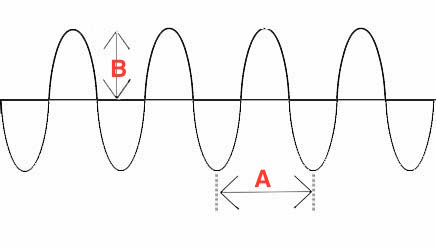
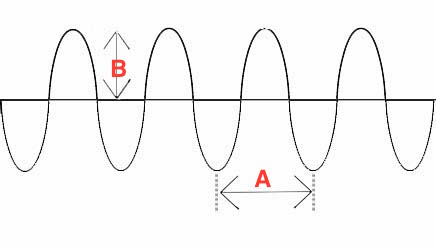
What kind of wave is pictured below?

a)

compressional wave

b)

transverse wave

c)

sound wave

d)

mechanical wave

4.
What property of this wave is represented by the letter "A"
a)
amplitude
b)
crest
c)
trough
d)
wavelength
5.
What property of the wave is represented by the letter "B"?
a)
amplitude
b)
crest
c)
trough
d)
wavelength
6.
What do waves carry from place to place?
a)
Energy, but not matter or particles
b)
Energy and matter or particles
c)
Matter or particles but not energy
d)
Neither energy nor matter or particles
7.
Which wave is pictured?
a)
Transverse
b)
Longitudinal
c)
Both
d)
Neither
8.
What type of wave move a slinky back and forth?
a)
longitudinal
b)
transverse
9.
Which vocabulary term is used to identify the distance between points C & G?
a)
Amplitude
b)
Crest
c)
Frequency
d)
Wavelength
10.
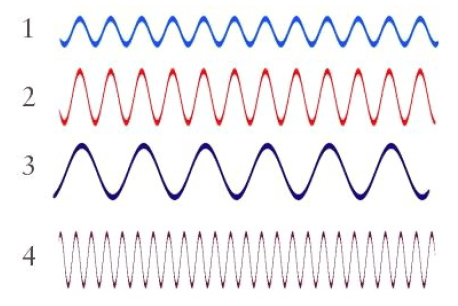
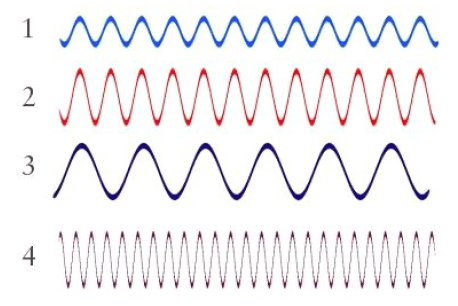
Which wave in the diagram has the greatest frequency?
a)
1
b)
2
c)
3
d)
4
11.
Which wave in the diagram has the greatest wavelength?
a)
1
b)
2
c)
3
d)
4
12.
Which of the following can sound travel through?
a)
solid
b)
liquid
c)
gas
d)
all of the above
13.

Height of a wave above the centerline

a)

amplitude

b)

crest

c)

trough

d)

wavelength

14.

How fast the wave is moving through a medium

a)

wave speed

b)

wavelength

c)

amplitude

d)

frequency

15.

When a wave bounces off of something and moves in a different direction

a)

reflection

b)

refraction

c)

absorption

d)

propagation

16.

when a wave is bent by traveling from one medium to another

a)

reflection

b)

refraction

c)

absorption

d)

propagation

17.

The highest point on a wave is:

a)

the crest

b)

the trough

c)

the top

d)

the coast

18.

You can't hear sounds in outer space because there is no

a)

medium

b)

light

c)

energy

d)

heat

19.
The frequency of a wave is measured in __________________. 
a)
inches
b)
hertz
c)
periods
d)
eras
20.
In what type of wave does the medium vibrate parallel to the direction of the wave?
a)
surface wave
b)
longitudinal wave
c)
transverse wave
d)
electromagnetic wave
21.
In longitudinal waves, the parts where the coils are spread apart are called what?
a)
rarefactions
b)
compressions
c)
mechanicals
d)
longitudes
22.
As the frequency of a wave increases, the __________________ decreases.
a)
amplitude
b)
resting point
c)
wavelength
d)
crest
23.
In a longitudinal wave, the parts where the coils are close together are called what?
a)
longitudes
b)
rarefactions
c)
compressions
d)
contractions
24.
Which travels faster, light or sound?
a)
light
b)
sound
25.
When light hits the shirt in the picture, which color will bounce off?
a)
Blue
b)
Indigo
c)
Orange
d)
Violet
26.
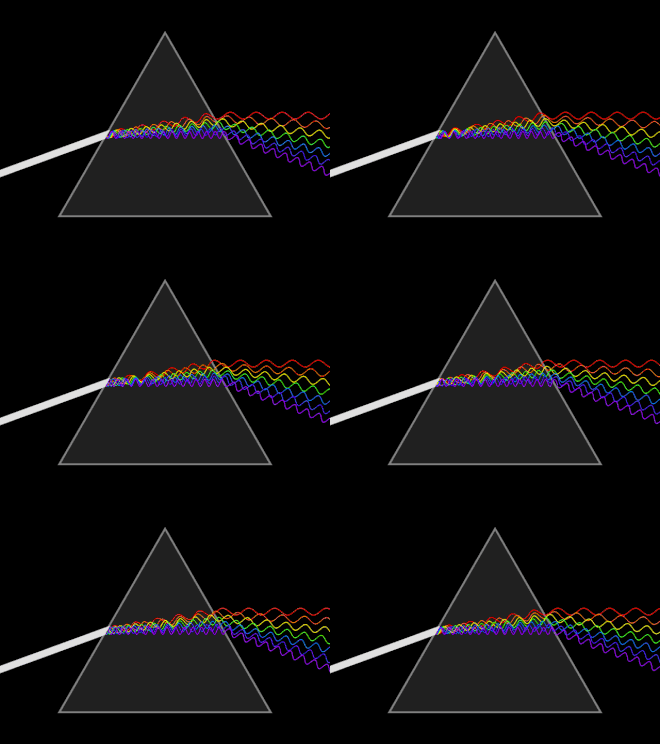
When light hits something like a raindrop or a prism, it will...
a)
Be absorbed
b)
Refract, or bend
c)
Neither 
27.

What happens to all of the light when it hits this object?

a)

reflection

b)

absorption

c)

transmission

28.

What is the process called for how rainbows are formed?

a)

Reflection

b)

Refraction (bending)

c)

Transmission

d)

Scattering

29.

Longitudinal waves have:

a)

crests and troughs

b)

crests and compressions

c)

compressions and rarefactions

d)

troughs and rarefactions

30.

What would happen to the wavelength if the frequency was doubled?

a)

the wavelength would be halved

b)

the wavelength would be doubled

c)

the wavelength would stay the same

d)

frequency does not affect wavelength

31.

Which of the following produces longitudinal waves ?

a)
b)
c)
d)
32.

Diagram below shows a ball floating in a water tank.

Which is the correct movement of the ball, when the wave propagates ?

a)
b)
c)
d)
33.

A system is oscillated at a frequency equivalent to its natural frequency by an external force.

This phenomenon is called

a)

Damping

b)

Resonance

c)

Rectification

d)

Pitching

34.

Diagram below shows a graph of wave motion.

What quantities are shown by P and Q?

a)

P: Amplitude ; Q: Period

b)

P: Amplitude ; Q: Wavelength

c)

P: Wavelength ; Q: Period

d)

P: Wavelength ; Q: Frequency

35.

Diagram below shows a graph of an oscillation system experiences damping.

Which of the following quantity does not change?

a)

Size of oscillation

b)

Period of oscillation

c)

Energy of oscillation

d)

Amplitude of oscillation

36.

Diagram below shows the displacement-time graph of an oscillating spring.

The oscillating spring undergoes …

a)

damping

b)

resonance

c)

interference

d)

forced oscillation

37.

The diagram shows the graph of displacement against time for a particle in a water wave.

What is the frequency of the water wave?

a)

0.5 Hz

b)

1.0 Hz

c)

2.0 Hz

d)

3.0 Hz

38.

Diagram below shows a displacement-time graph of an oscillating spring.

The spring undergoes …

a)

damping

b)

resonance

c)

interference

d)

force oscillation

39.

Which diagram shows a transverse wave with amplitude 4 cm and wavelength 8 cm?

a)
b)
c)
d)
40.

Diagram below shows an oscillating system.

Which graph shows the correct relationship between displacement and time for the oscillating system?

a)
b)
c)
d)