wayground logo

Free Printable Worksheets

NEW

Font size

S
M
L
XL
Worksheets

QUIZ 1::GRADE 10 GIRLS::STATIC ELECTRICITY::TERM 3::2020

Total questions: 17

Worksheet time: 21mins
Name
Class
Date
1.
If two charges repel each other, the two charges must be
a)
Positive and neutra
b)
Positive and negative
c)
positive and neutral
d)
negative and negative
2.
If you rub a glass rod with a piece of silk, the rod becomes positively charged. This means that
a)
friction destroyed electrons in the rod.
b)
the silk has become negatively charged.
c)
protons have moved to the rod.
d)
glass attracts more protons.
3.
If you bring a charged object near an electrically neutral surface without allowing the object to touch the surface, the charges in the surface are rearranged by
a)
friction.
b)
convection.
c)
induction.
d)
conduction.
4.
Objects that have opposite charges
a)
are attracted to each other, and the force between the objects pulls them together.
b)
are attracted to each other, and the force between the objects pushes them apart.
c)
are repelled by each other, and the force between the objects pulls them together.
d)
are repelled by each other, and the force between the objects pushes them apart.  
5.
A region around a charged particle that can exert a force on another charged particle is called an
a)
electric pulse.
b)
electric charge.
c)
electric force.
d)
electric field.
6.
Electric field lines are drawn
a)
In a radial direction, from negative to positive.
b)
In a radial direction, from positive to negative.
c)
In a tangent direction, from positive to negative.
d)
In a tangent direction, from negative to positive.
7.

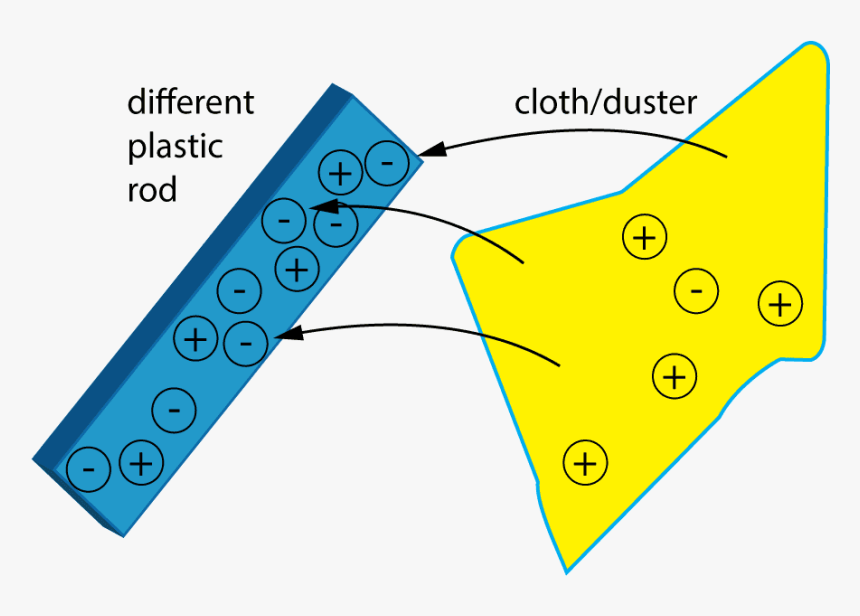
A plastic rod and a piece of cloth are both uncharged. A student rubs the plastic rod with the cloth. The plastic rod becomes negatively charged.

Which row of the table is correct for the charge on the cloth?

a)

POSITIVE AND BIGGER CHARGE

b)

POSITIVE AND EQUAL CHARGE

c)

NEUTRAL CHARGE

d)

NEGATIVE AND SMALLER CHARGE

8.

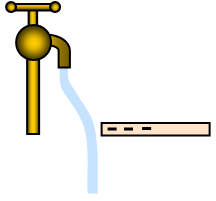
The student holds the plastic rod near to a stream of water coming from a tap. The stream of water bends towards the plastic rod.

Which shows the correct arrangement of charges in the stream of water?

a)

FULL NEGATIVE CHARGE IN WATER

b)

FULL POSITIVE CHARGE IN WATER

c)

NEAR TO ROD POSITIVE CHARGE COMES IN WATER

d)

NEAR TO ROD NEGATIVE CHARGE COMES IN WATER

9.

A torch has a battery and a bulb. The current in its circuit is 0.08 A. Calculate the amount of charge passing a point in this circuit in 2 minutes.

a)

9.9 C

b)

9.3 C

c)

9.6 C

d)

0.16 C

10.

There is a current of 1.2 mA in a circuit. Calculate the charge transferred by this current in 40 s. State the unit

a)

0.048 C

b)

0.068 C

c)

48 C

d)

0.068 A

11.

A student ties two balloons to a support with some string. The student rubs both balloons with a dry cloth which gives the balloons a negative charge. The diagram shows the balloons after they were rubbed.

The balloons ............................................... each other because they have the same ..............................................

The cloth is left with a ............................................... charge.

a)

Attract , Charge, Positive

b)

Attract, Current, Negative

c)

Repel , Charge, Positive

d)

Repel , Current, Positive

12.

The three methods of charging are

a)

Conduction,Insulation and Friction

b)

Conduction , Induction and Friction

c)

Conduction ,Radiation and Friction

d)

Induction, Contact and Insulation

13.

A lightning strike on a metal tower can be described as follows In the cloud, A thunder cloud contains moving ice particles. Some of these ice particles are negatively charged and some are positively charged. The negatively charged particles move to the bottom of the cloud.

During the lightning flash. Eventually a flash of lightning travels between the cloud and the tower.

a.Charge on top of the cloud is........................................


b. Charge on top of the tower is........................................

a)

a.Negative b.Negative

b)

a.Negative b.Positive

c)

a.Positive b.Positive

d)

a.Positive b.Negative

14.
The difference between attract and repel is that to attract is to pull something closer and repel is to push something away.
a)
True
b)
False
15.
If a substance has a higher number of electrons than protons on its surface, what type of charge does it have?
a)
A positive charge.
b)
A negative charge.
c)
A neutral charge
d)
No charge at all
16.
Why can you get a shock if you touch a metal doorknob after walking across a wool carpet?
a)
You have gained electrons; the doorknob has no electrons.
b)
You have gained neutrons; the doorknob has fewer electrons.
c)
You have lost electrons; the doorknob has many electrons.
d)
You have gained electrons; the doorknob has many electrons.
17.
Charging by Friction results in two objects with the same charge.
a)
True
b)
False