wayground logo

Free Printable Worksheets

Font size

S
M
L
XL
Worksheets

11.2 Populations

Total questions: 33

Worksheet time: 31mins

Name
Class
Date
1.

Immigration means moving out of a population.

a)

True

b)

False: into

2.

Three coyotes per square kilometer is an example of population density.

a)

True

b)

False

3.

If foxes arrive in an area and catch and eat a large number of rabbits, the foxes are causing an increase in the birth rate of the rabbit population.

a)

True

b)

False: death rate

4.

Sunlight can be a limiting factor for populations of plants.

a)

True

b)

False

5.

Water and food are examples of for populations.

(a)  

6.

The size of a population increases if the number of individuals added to the population is equal to the number of individuals leaving the population.

a)

True

b)

False: greater than

7.

If an area has all the wolves that it can support, the wolf population has reached its .

(a)  

8.

A population can decrease due to deaths or .

(a)  

9.

If animals cannot find enough places to build nests, it is because (a)   is a limiting factor for the population.

10.

If animals cannot find enough places to build nests, it is because (a)   is a limiting factor for the population.

11.

A flood that covers and meadow and drowns animals and a late frost that kills young plants are examples of how (a)   can affect the size of a population.

12.

If the amount of food or resources available increases, the carrying capacity for an animal:

a)

Stays the same

b)

Increases

c)

Decreases

d)

Fluctuates

13.

How would you describe the population size at the12th unit of time?

a)

The population is constant.

b)

The population is decreasing.

c)

The population is increasing.

d)

The population increases then decreases.

14.

All of the meerkats that live in the same place at the same time make up a ____________.

a)

Community

b)

Ecosystem

c)

Population

d)

Biosphere

15.

All of the populations in a given area make up a ____________.

a)

community

b)

habitat

c)

ecosystem

d)

species

16.

The size of a population compared to the amount of space available is called the _________________.

a)

biotic potential

b)

population density

c)

limiting factor

d)

carrying capacity

17.

Anything that restricts the size of a population is a ________________________.

a)

biotic potential

b)

carrying capacity

c)

species

d)

limiting factor

18.

What is happening to the population between the 4th and 8th unit of time?

a)

It is increasing slowly.

b)

It is increasing rapidly.

c)

It is constant.

d)

It is decreasing.

19.

All of the elephants that live in this area at the same time make up a _____________________.

a)

ecosystem

b)

community

c)

population

d)

biosphere

20.

I pour two cups of Lucky Charms into a bowl. I pick out fifteen marshmallows. Fifteen marshmallows per two cups of Lucky Charms is an example of which of the following?

a)

Limiting factor

b)

Biotic potential

c)

Ecosystem

d)

Population density

21.
If the number of births in a population is the same as the number of deaths in a population, what will happen to the growth of the population?
a)
It will increase.
b)
It will decrease.
c)
It will stay the same.
d)
It will fluctuate.
22.
If the number of births is greater than the number of deaths in a population, what will happen to the growth of the population?
a)
It will increase.
b)
It will decrease.
c)
It will stay the same.
d)
It will fluctuate.
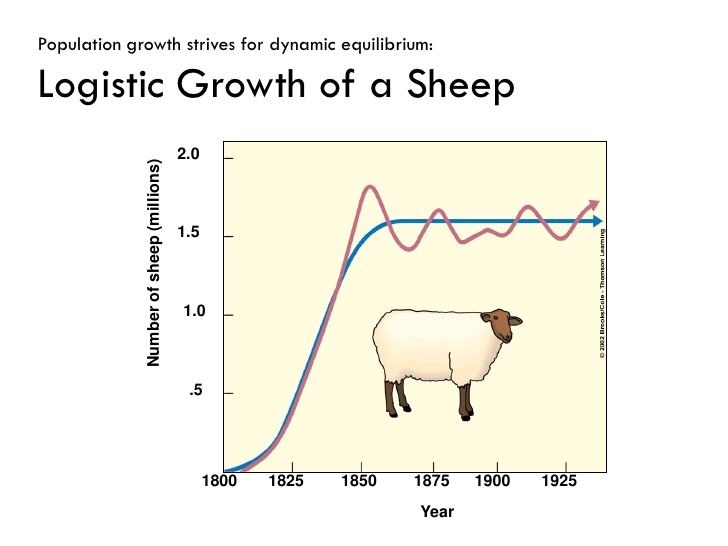
23.
What is the carrying capacity for this sheep population?
a)
1.8 million
b)
1.25 million
c)
1.6 million
d)
1.o million
24.
If there is more food than usual in an ecosystem, then the population will mostly likely...
a)
stay the same
b)
decrease
c)
increase
25.
Any thing or organism that regulates the size of a population of another organism is known as __________.
a)
a limiting measure
b)
a limiting factor
c)
factorization
d)
materialization of precipitation
26.
which statement sounds accurate based on the graph data. 
a)
The zebra and lions do not affect each other
b)
when lions population increases, so does the zebra population
c)
When the zebra population increases, it causes the lion population to also increase
d)
when zebra populations go down, the zebra population goes up. 
27.
Limiting factors are sometimes helpful because they can keep the population from getting too large.
a)
True
b)
False
28.
When there is a lack of resources such as food, water, sunlight, shelter, and space this is often called __________.
a)
limiting factors
b)
wet
c)
messy
d)
found in rocks
29.
If the population of a certain predator increases, there is often _______ its prey
a)
a decrease the population of
b)
an increase of the population of 
c)
great news for its prey of
d)
no  impact found on
30.
If a disease destroying barley plants in a field swept through an ecosystem, what would happen to the barley eating bird population in the the field ?
a)
The bird population would stay the same
b)
The bird population would infinitely increase
c)
The bird population would decrease
31.
What are some abiotic factors that could be limiting factors in the Iowa River ecosystem?
a)
Temperature, fertilizer runoff from fields, drought or flood
b)
Invasive species, floods
c)
Temperature, droughts, floods, over fishing
32.
What happens when an environment reaches its carrying capacity?
a)
Populations will decrease
b)
Resources such as food, water, and space will be unlimited
c)
Populations will increase
d)
Nothing, everything will stay the same.
33.
Temperature, light, air, water, and soil are all  _____  parts of the environment
a)
alive
b)
biotic 
c)
abiotic
d)
living