
Font size
 Worksheets
Static Electricity
Total questions: 36
Worksheet time: 32mins
Which of these is NOT a way to create a static charge on an object?
Friction
Induction
Electroaction
Contact
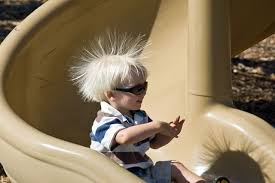
Charging by ____ occurs when electrons are transferred from one object to another by direct contact, without rubbing.
reduction
induction
contact
friction

The ball on the string is being repelled (pushed away) by the metal bar.
What could potentially be the charge on the ball?
It MUST be positive
It MUST be negative
It MUST be neutral
It could be positive or neutral
It could be negative or neutral

The picture shows a comb that was used on a cold, dry day. Which two of the following can best help explain why
some of the paper bits seem to be picked up while other are not.
Protons moved more easily in the paper that was attracted to the comb.
Electric force gets weaker the farther away objects are from each other.
Some paper had iron in it and some didn’t.
Magnetic force gets weaker the farther away objects are from each other.
Each piece of paper has a different mass, and the bigger the mass the smaller the effect the electric force will have on it.

A(n) ______________________________ is an instrument used to detect the presence of an electric charge.
scale
van de graaff generator
electroscope
What is NOT a good conductor
Water
Metal
Rubber
If an electroscope, charged up with excess negative charge, is touched and grounded, then it will end up with ___ charge.
No
A Negative
A Positive
None of the above
A negatively charged balloon is brought near a metal can that rests on a wood table. The side of the can furthest from the balloon is momentarily touched by a human, and then released, while the balloon remains in place. The balloon is then moved away. At the very end of this process, the can will be...
Positively Charged
Negatively Charged
Neutral
Polarized
The charge of one electron is -1.6 X 10 -19 Coulomb. If a neutral object loses 1.5x10⁶ electrons, then what will be its charge?
+1.4 x 10 -13 C
+2.4 x 10 -13 C
-2.4 x 10 -12 C
+2.4 x 10 -14 C
[CHALLENGE] Object A has a x-y coordinate position of (+5.0, 0.0). Object B has a x-y coordinate location of (0.0, +4.0). If object A has a charge of -5.8 µC and object B has a charge of +8.9 µC, then what is the resultant electric field strength at the origin(magnitude) .
5.4 x10³ N/C
4.4 x10⁻³ N/C
5.4 x10⁻³ N/C
15.4 x10³ N/C
Object A has a x-y coordinate position of (+5.0, 0.0). Object B has a x-y coordinate location of (0.0, +4.0). If object A has a charge of -5.8 µC and object B has a charge of +8.9 µC . what would be the magnitude of the net electric force upon a +1.3 µC charge if placed at the origin.
0.0060 N
0.0080 N
0.0090 N
0.0070 N
If the leaves of an electroscope spread apart, it indicates that _____.
the leaves of the electroscope are neutral
the leaves of the electroscope have received a charge, or the electroscope is polarized
no charge is moving through the electroscope
there is static electricity in the electroscope
A negatively charged rod is brought near a neutral electroscope, causing the leaves to diverge. This is an example of....
Conduction
Polarization
Insulation
Friction

The TOTAL NUMBER of electrons present in 1 Coulomb of charged electrons :
6.25⋅10−18
6.25⋅1018
62.5⋅1018
625⋅1018
−6.25⋅1018
The electric field lines for a positive charge are always directed away from the charge. True or False?
True
False


Al cargar un electroscopio, si el INDUCTOR es NEGATIVO el electroscopio se carga NEGATIVO.
TRUE
FALSE
DEPENDE DE LAS CONDICIONES ATMOSFÉRICAS
I didn't realize that true and false were words in Spanish
Looking at an object's place in the triboelectric series is useful because it tells you...
How conductive a material is
How much affinity that object has for electrons
How each it is for static electricity to build on that object
How good an object is at judging an electric tribunal
Which of the following is TRUE?
A conductor will never have a charge on it
A conductor will always have an electric field inside of it
A conductor's electric field lines will always point perpendicular to its surface
A conductor will never stop conducting until the fat lady sings
Which of the following is NOT an example of a faraday cage?
An elevator
An RFID-blocking wallet
The suits that are worn by Tesla-warriors while they fight their electricity battles
An airplane
None of the above, they all are Faraday Cages

