
 Worksheets
Evidence for Evolution
Total questions: 21
Worksheet time: 26mins

The picture shown is an example of
Vestigial structures
Homologous structures
Analogous structures
Fossils

Which process of evolution is demonstrated below?
Comparative anatomy
Homologous structures
Comparative embryology
Vestigial structures

Which statement provides the best evidence that Ambulocetus natans is an ancestor of Basilosaurus isis?
Homologous structures occur in each fossil
Similar nitrogenous bases are found in the DNA of each fossil
The fossils were found in different locations
The youngest fossils is larger than the older fossils

Which evidence for evolution is shown below?
Comparative embryology
Homologous structures
Biochemical evidence
Vestigial structures

See picture for question
Live in the same type of ecosystem
Have slowly evolved to become herbivores
Have a common ancestor
Exchanged DNA at some point in the past
The bones in the figure above are-
Evidence of a common ancestor
Evidence that animals can walk
Evidence that fossils are old
Evidence of nothing
Genome maps provide the DNA sequences of chromosomes. Some scientists have compared the genome maps of a hedgehog and a sloth. What do these genome maps allow the scientists to determine?
The color patterns of the offspring of each species
How much the size ranges of the two species differ
The methods of protein synthesis that each species uses
How closely related the two species are to each other.
What conclusion can you draw from the fact that many modern whale species have vestigial pelvic and leg bones?
The ancestors of whales may have been land mammals
Whales could walk if they wanted to
Whales are preparing to evolve into land animals
Someday whales will be able to walk and will have legs
Scientists discover that cells from two species of organisms are made up of similar proteins, suggesting a close evolutionary relationship. If the scientists do further biochemical analyses, which additional finding would support this conclusion?
The fossils of both organisms are found relatively close to each other in the fossil record.
The anatomical structure of both organisms is similar.
The DNA nucleotide sequence of both organisms is similar.
Both populations of organisms have undergone natural selection over time.

A food web showing feeding relationships of organisms where the fossil skull was found
Population and migration data for small wild cats living in the ecosystem where the skull was found
The fossil record and DNA comparisons of big cats and small cats
The historical record of interactions between different species of big cats

The fact that both these mammals incubate their immature offspring in a pouch provides evidence that they-
Belong to the same species
Must range great distances to eat
Have very similar skeletal structures
Are descended from a common ancestor

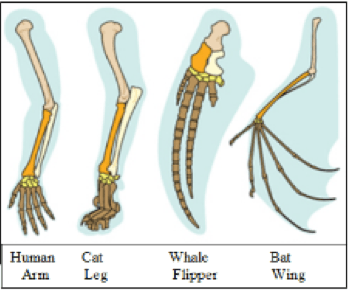
The picture shows similarities among the forelimbs of three animals. The similarities provide evidence for which of the following hypotheses?
Legs and wings may have evolved from flippers.
All mammals have evolved from an ancestor that was a bat.
A cat’s leg, a whales’sflipper, and a bat’s wing have identical functions
Cats, whales, and bats had the same ancestor millions of years ago.

Redi's hypothesis that spontaneous generation does not occur
Haeckel's hypothesis that embryological development mimics the evolution of species
Wallace's hypothesis that geography affects the distribution of species
Darwin's hypothesis that the development of a species is a slow, gradual process
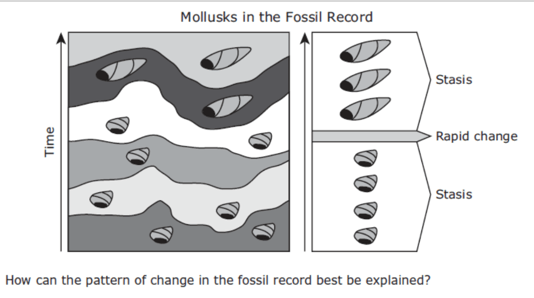
How can the pattern of change in the fossil record best be explained?
The mollusks were well adapted to their stable environment. A large, sudden change occurred in their environment. After the change the mollusks with the bigger shells were better adapted for the new environment.
The mollusks were well adapted to their stable environment. The mollusks hybridized with a smaller species of mollusk. A new species of mollusk with a bigger shell resulted.
The mollusks were not well adapted to their environment. The length of the mollusks' shells changed gradually over time. The mollusks in the original population that had small shells died over a period of many years.


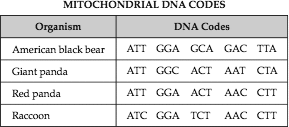
What conclusions can be made based on this table shown?
the American black bear and the giant panda are most closely related
the giant panda and the red panda are most closely related
the red panda and the racoon are the most closely related
the giant panda and the racoon are most closely related

Which of the following is NOT considered evidence for evolution?
Homologous structures
Vestigial Structures
Genetic comparisons
Photosynthetic algae
Scientists tested a bat, a dog, a snake, and a human to see how their amino acids differed in a specific protein. This is a form of ...
Evidence from molecular biology
Analogous structure
Fossil record evidence
Evidence from vestigial structures

