wayground logo

Free Printable Worksheets

NEW

Font size

S
M
L
XL
Worksheets

The Great Depression

Total questions: 50

Worksheet time: 25mins

Name
Class
Date
1.
Which was NOT a LONG-TERM cause of the Great Depression?
a)
Buying stock on margin
b)
Stock market crash (Black Tuesday)
c)
too much production and consumer spending
d)
Laisezz-faire economic policies
2.
The Great Depression began in
a)
1925
b)
1929
c)
1932
d)
1940
3.

Who was president at the time of the Stock Market Crash of 1929?

a)

Calvin Coolidge

b)

Franklin D. Roosevelt

c)

Theodore Roosevelt

d)

Herbert Hoover

4.
Which economic factor contributed most directly to the start of the Great Depression?
a)
low worker productivity
b)
high income taxes
c)
decreasing tariff rates
d)
buying stocks on margin
5.

What tool - passed during the Hoover Administration - designed to protect American manufacturers actually ended up creating a worldwide depression?

a)

Reconstruction Finance Committee

b)

Hawley-Smoot Tariff

c)

New Deal

d)

Rugged Individualism

6.
How did "bank runs" impact the American people during the Great Depression?
a)
Banks eventually ran out of money to loan, and people's life savings were gone.
b)
Banks made loans throughout the Great Depression, helping people pays bills until they could find work.
c)
Banks were able to people's deposits safe, but they could not loan out any more money.
d)
Banks were not at all involved in the Great Depression because people did not use them.
7.
What effect did the Dust Bowl storms have on the Great Depression?
a)
Many farmers were forced to leave the Great Plains.
b)
Unemployment decreased gradually.
c)
Many homes long the Mississippi River were flooded.
d)
Hoover was re-elected as president.
8.
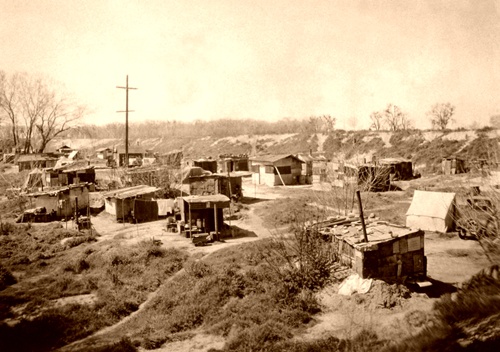
What were the villages full of shacks located in cities filled with unemployed Americans called?
a)
Hoovervilles
b)
Okies
c)
Bonus Army Bases
d)
Rooseveltowns
9.

The Bonus Army incident in 1932 best illustrates the idea that

a)

F.D.R.'s relief programs were unsuccessful.

b)

many felt that Herbert Hoover was not handling the Depression well.

c)

protests by veterans during the Depression were effective.

d)

the U.S. Army had increased in size and power during the Depression.

10.
What is another name for the Stock Market Crash?
a)
Black Friday
b)
Taco Tuesday
c)
Black Tuesday
d)
Throwback Thursday
11.
What was the name of FDR's plan to reconstruct America following the Great Depression?
a)
No Deal
b)
New Deal
c)
Reconstruction
d)
FDR's Plan
12.
During the early 1930s, the main goal of the Bonus Army was to pressure the Hoover administration to
a)
strengthen the nation’s defenses
b)
end the military draft
c)
bring American troops home from overseas
d)
support the early payment of money promised to veterans
13.
A major difference between the philosophies of President Herbert Hoover and President Franklin D. Roosevelt in responding to the Great Depression is that Roosevelt
a)
wanted to rely on private charities to provide assistance
b)
stressed the need for individual rugged individualism
c)
supported direct relief to people out of work
d)
thought the government should not be involved in economic reform
14.
FDR addressed the American public in weekly broadcasts known as:
a)
FDR Hour
b)
Hangin' With Franklin
c)
Fireside Chats
d)
Around the Fire
15.
As part of the New Deal, the Securities and Exchange Commission (SEC) and the Federal Deposit Insurance Corporation (FDIC) were created to
a)
allow for a quick recovery of stock prices
b)
provide direct loans to businesses
c)
protect individual investors from stock fraud and bank failure
d)
allow banks and companies to invest in the stock market
16.
A major reason that President Franklin D. Roosevelt proposed adding Justices to the Supreme Court in 1937 was to
a)
make the Court processes more democratic
b)
end corruption and favoritism in handling cases
c)
influence Court decisions related to New Deal programs
d)
ensure the appointment of members of minority groups
17.

What happened during the bank Holiday?

a)

All banks were closed, reformed and restored

b)

All banks closed due to bankrupcy

c)

The banking system collapsed

d)

Banks were allowed to take weekends off

18.

The FDIC was part of which R of the New Deal

a)

It was part of Relief because it gave jobs to the unemployed

b)

It was part of Recovery because it was a program to encourage spending

c)

It was part of Reform because it reformed commerical banks and protected peoples monies

19.
To fight the Depression, the first thing Roosevelt set out to do was to  
a)
A. provide direct relief to people. 
b)
B. set up public works programs.
c)
C. restore confidence in the banks. 
d)
D. provide relief for farmers.
20.
Franklin Roosevelt’s “court-packing plan” was a serious mistake because 
a)
A. many Americans opposed the idea of forced retirement. 
b)
B. the angry judges reacted by striking down much of the New Deal legislation. 
c)
C. it appeared to interfere with the Constitution’s separation of powers. 
d)
D. the angry judges struck down the plan as unconstitutional.
21.
The period of time in 1933 when the newly elected Franklin Roosevelt sent bill after bill to Congress came to be called the 
a)
A. Bank Holiday. 
b)
B. Hundred Days. 
c)
 C. Rise to Power. 
d)
D. New Deal.
22.

Why did the Supreme Court rule parts of the New Deal unconstitutional?

a)

The Supreme Court justices were Republicans.

b)

Roosevelt was exceeding his Constitutional authority.

c)

Congress was passing laws the Court supported over Roosevelt.

d)

The Supreme Court justices were just nine angry men.

23.
The three goals of the new deal were: _____ for the needy, economic ____, and financial _____.
a)
assistance, aid, absolutism
b)
homes, stability, freedom
c)
relief, recovery, reform
d)
assistance, reform, relief
24.
Which was a guiding principle of New Deal economic policies?
a)
“Rugged individualism” will end social inequality
b)
Government must assume greater responsibility for helping the unfortunate
c)
Antitrust legislation could destroy the free enterprise system
d)
State governments should have more power over the economy than the national government
25.
The ____ was an agency formed to insure bank deposits up to a certain amount.
a)
Social Security
b)
SEC
c)
FDIC
d)
Tennessee Valley Authority
26.
Which New Deal agency was responsible for building forest trails and roads, planting trees, and improving national parks?
a)
AAA
b)
CCC
c)
FERA
d)
WPA
27.
Agency that protected the price of crops. 
a)
AAA
b)
CCC
c)
CWA
d)
FDIC
28.
Which of the following types of people did Lange photograph?
a)
actors
b)
migrants
c)
cowboys 
d)
soldiers
29.

10. One of Dorothea’s most famous photography was called _____.

a)

Pea Pickers Camp

b)

Migrant Mother

c)

American Gothic

d)

Dust Bowl Refugee

30.
Who was Dorothea Lange?
a)
Photographer who took historically important pictures that documented the effects of the time
b)
A famous movie actress who spent time helping those impacted by the Dust Bowl
c)
FDR's wife
d)
A famous business woman who gave jobs to women to help support their family's 
31.
Why are Dorothea Lange's photographs worth seeing?
a)
Her photographs document the struggles of government officials
b)
Her pictures show how weak that generation was
c)
She documents the struggles of white men
d)
Her photographs tell the story of the hardship so many Americans suffered during this time
32.

The creator of this political cartoon was expressing his concerns about -

a)

the Senate confirmation hearings of Supreme Court nominee Clarence Thomas

b)

the US declaration of war on Japan after the bombing of Pearl Harbor

c)

the expansion of executive power during the Great Depression

d)

the involvement of US government officials in the Iran-Contra scandal

33.

Which New Deal program still in existence today provides an income for retired people?

a)

Social Security Administration

b)

Securities and Exchange Commission

c)

Federal Deposit Insurance Corporation

d)

Farm Credit Administration

34.

Why did many midwestern farmers migrate from the Great Plains to California?

a)

There was no unemployment on the West Coast

b)

California was experiencing a gold rush

c)

The Dust Bowl pushed farmers out of the Great Plains

d)

The Stock Market crash led farmers to lose their homes on the Great Plains

35.

How did FDR show excellent leadership during the Great Depression?

a)

He tried to take control of the entire government

b)

He ran for a third and fourth term as president

c)

He used Fireside chats to calm the Americans people and tell them their fear was making things worse

d)

He used television ads to encourage people to support his policies

36.

Why did people on the left (Huey Long, Father Coughlin, Dr. Townsend) dislike the New Deal?

a)

They felt the state governments got too much power

b)

They believed the New Deal programs did not go far enough to fix the Great Depression

c)

They felt the President was becoming a dictator

d)

They believed the New Deal gave the government too much authority (power)

37.
What was one factor that led to the Great Depression?
a)
government limitations on the amount of money in circulation
b)
increases in the tax rate for corporations
c)
excessive speculation in the stock market
d)
high wages paid by employers
38.
The Dust Bowl experiences of the Oklahoma farmers during the Great Depression demonstrated the
a)
success of government farm subsidies
b)
 limitation of civil liberties during times of crisis 
c)
 result of the Indian Removal Act 
d)
effect of geography on people’s lives 
39.
Buying and selling stocks in the hopes of making a quick profit.
a)
Stock Flipping
b)
Speculation
c)
Deficit Spending
d)
Skip
40.
Why were shantytowns for the homeless sometimes called "Hoovervilles?"
a)
President Herbert Hoover ordered their construction
b)
They were symbolic of President Herbert Hoover's failure to help victims of the Depression
c)
The name honored President Herbert Hoover for his efforts to fight homelessness
d)
Skip
41.

Shares of ownership in a corporation are called:

a)

bond

b)

future

c)

mutual fund

d)

stock

42.

How does the stock market impact the U.S. economy?

a)

Individuals invest in the stock market because they don't trust banks.

b)

Individuals invest in the stock market to earn money for the future.

c)

Individuals invest in the stock market because interest rates are high.

d)

Individuals invest in the stock market to save money for clothing.

43.

Stock prices are going up in a:

a)

Bear Market

b)

Bull Market

c)

Peak Market

d)

Soft Market

44.

Stock prices are going down in a:

a)

Bear market

b)

Bull market

c)

Peak market

d)

Soft market

45.

When an investor pays 10% of the face value of a stock on credit?

a)

Bear Market

b)

Bull Market

c)

Speculation

d)

Margin Buying

46.

What was the economic stance of Presidents Harding, Coolidge, & Hoover leading up to the Stock Market Crash?

a)

Go Big Business

b)

The Return to Normalcy

c)

Socialist

d)

Laissez-faire

47.

This act forced commercial banks and investment banks to remain separate.

a)

The Emergency Bank Act

b)

The FDIC

c)

The Glass-Steagall Act

d)

The Securities and Exchange Commission Act

48.

Which two philosophies drove President Hoover's policies during the early 1930s?

a)

Rugged Individualism and Moral Diplomacy

b)

Trickle Down Economics and Rugged Individualism

c)

Trickle Down Economics and Nativism

d)

The New Deal and Isolationism

49.

Migrants from the Great Plains headed west in search of better lives were called

a)

Okies

b)

Speculators

c)

Wagners

d)

Hoosier

50.

What is one way that charities helped the poor during the Great Depression?

a)

Hoovervilles

b)

Soup kitchens

c)

Dust bowls

d)

Public works