
 Worksheets
1st Year Assessment 1
Total questions: 20
Worksheet time: 22mins

What does this symbol indicate?
Poison/Toxic
Bio Hazard
Radioactive
Corrosive

What does this symbol indicate?
Corrosive substances are present; protect your hands.
Wash your hands.
Extreme temperatures are present; wear appropriate gloves.
Toxic Chemicals

What does this symbol indicate?
Oxidising
Flamable
Fire Extinguisher
No Open Flame

List three hazards in this image. Write answers as
1.
2.
3.
Which of the below instruments is used to measure the length of a swimming pool
Meter stick
ruler
Trundle wheel
opisometer

A vernier caliper is sued to measure the
length of a football pitch
diameter of a coin
volume of a liquid
Mass of a solid
1 kilogram is equal to how many grams .......
10
100
1000
1

What is this?
Conical Flask
Beaker
Jug
Graduated cylinder
What is the SI unit for length?
meter
litre
Km
Mile

What is the volume of The Rock?
10.0 cm3
15.0 cm3
20.0 cm3
25.0 cm3

What is the volume of the Cuboid?
12 cm3
23 cm3
17 cm3
60 cm3
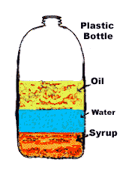
Which liquid is the least dense?
oil
water
syrup
plastic bottle

An eraser has a mass of 4g and a volume of 2cm3. What is its density?
8 g/cm3
2 g/cm3
1/2 g/cm3
24 g/cm3

D=M÷V (Calculate the density of the cube.)
2 g/cm3
4 g/cm3
6 g/cm3
8 g/cm3
A Moon will
Orbits the sun
Orbit a planet
Is a rock floating through space
Closest planet to earth

A person’s weight, in Newtons (N), can be calculated by multiplying their mass in kilograms
(kg) by the surface gravity acting on their mass.
Calculate the weight of a 68 kg person on Earth
68
252.28
100
667.08

Use the data in the table to compare the planets’ distance from the Sun against their mean surface temperature.(how hot the planet is)
The closer you are to the Sun the hotter the planet
Smaller planets are made of gas
The further you go from the sun the colder the mean surface temperature is
The bigger the planet , the more gravity it has

