wayground logo

Free Printable Worksheets

NEW

Font size

S
M
L
XL
Worksheets

Change Over Time

Total questions: 25

Worksheet time: 41mins

Name
Class
Date
1.

_______ are unique traits developed by organisms to help them survive, thrive, and reproduce in their particular environment.

a)

cells

b)

mutations

c)

chromosomes

d)

adaptations

2.

Natural selection is defined as

a)

the changes in the characteristics within a population that lead to survival.

b)

the process by which humans select the most desirable organisms in a population.

c)

the changes that occur in a population that do not affect survival.

3.
An inherited trait that makes an individual different from other members of its species is called (can be good or bad) --
a)
an adaptation
b)
a variation
c)
species
d)
natural selection
4.
What was the name of the ship on which Darwin traveled?
a)
Nimitz
b)
Retriever
c)
Beagle
5.
The two ways scientists can find the age of a fossil are relative dating and
a)
natural selection
b)
embryology
c)
absolute dating
6.
The statement that the oldest layer will be at the bottom in an undisturbed sequence of rock layers is called the Principle of ....
a)
Inclusions
b)
Unconformities
c)
Cross-Cutting Relationships
d)
Superposition
7.
The Principle of Cross-Cutting Relationships states that an igneous intrusion is 
a)
always younger than the layers it cuts across
b)
always older than the layers it cuts across
c)
the same age as the rock it melted
d)
none of the answers are correct
8.
Relative age dating is used to determine the...
a)
actual age of an event
b)
length of time between two events
c)
age of one event in comparison with other events
d)
rate at which a gologic process occurs
9.
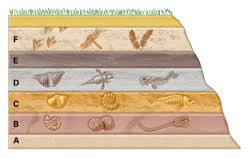
Which of the following correctly lists the layers in order from oldest to youngest?
a)
A, B, C, D, E
b)
E, B, C, D, A
c)
E, D, C, B, A
d)
C, B, A, D, E
10.
The time it takes for half of a radioactive isotopes to decay into stable isotopes is called the
a)
isotope decay
b)
radiometric dating
c)
half life
d)
absolute age
11.
Which rock layer in the diagram seems to be the oldest?
a)
F
b)
E
c)
B
d)
A
12.
How old do Paleontologists believe the Earth is?
a)
2016 years old
b)
3.54 billion years old
c)
4.54 billion years old
d)
4.54 million years old
13.

What kind of fossils are these?

a)

Mold fossils

b)

Cast fossils

c)

True Form fossils

d)

Trace fossils

14.

What kind of fossil is this?

a)

Mold fossil

b)

Cast fossil

c)

True Form fossil

d)

Trace fossil

15.

This kind of fossil leaves behind evidence of an animal's behavior or activity.

a)

Mold fossil

b)

Cast fossil

c)

Trace fossil

d)

True Form fossil

16.

Preserved remains (true) fossils are usually found in

a)

amber, rock, ice

b)

amber, ice, cement

c)

amber, tar, rock

d)

amber, tar, ice

17.

The deeper the layer the fossil is found, the older the fossil will likely be.

a)

True

b)

False

18.

In which kind of rock do we usually find a fossil?

a)

sedimentary rock

b)

igneous rock

c)

metamorphic rock

19.
Which is the most recent era of time- the one that we are currently in?
a)
Mesozoic 
b)
Paleozoic 
c)
Cenozoic 
d)
Precambrian 
20.
The era that dinosaurs ruled the Earth's land, air and oceans.
a)
Cenozoic
b)
Paleozoic
c)
Precambrian
d)
Mesozoic
21.

What are fossils that are abundant, easily recognizable, short lived, and widespread called?

a)

Preserved fossils

b)

Index fossils

c)

Imprints

d)

Radioactive dating

22.

Saying you are older than your sister is an example of?

a)

Absolute age dating

b)

Relative age dating

c)

Fossils

d)

Radioactive dating

23.

What does absolute age tell us about a rock layer or fossil?

a)

The 'exact' age of a fossil determined by radiometric dating

b)

The relative age of a fossil determined by radiometric dating

c)

Younger rock layers sit on top of older rock layers

d)

Older rock layers sit on top of younger rock layers

24.

The end of an era, and the end of life for groups of organisms, is called?

a)

Death

b)

Mass extinction

c)

Transition

d)

Turning point

25.

Who first suggested the continental drift theory?

a)

Charles Darwin

b)

Alfred Wegener

c)

Isaac Newton

d)

Dmitri Mendeleev