wayground logo

Free Printable Worksheets

NEW

Font size

S
M
L
XL
Worksheets

Enzymes

Total questions: 24

Worksheet time: 16mins
Name
Class
Date
1.
What is a substance called if it speeds up a chemical reaction?
a)
reusable
b)
catalyst
c)
specific
d)
fragile
2.
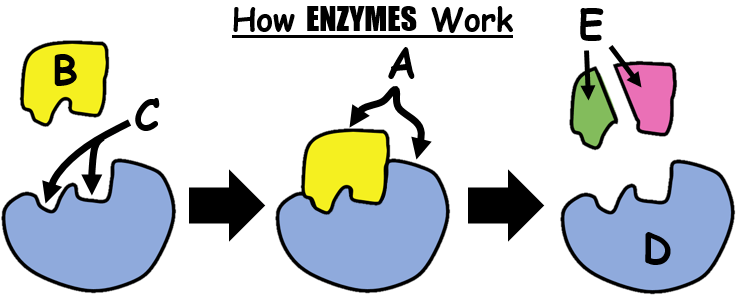
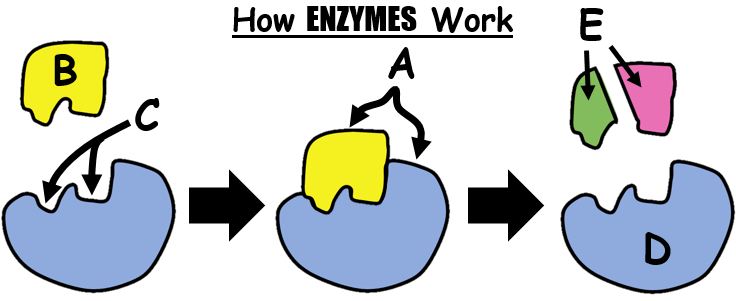
In the diagram, what is letter A? 
a)
product
b)
substrate
c)
enzyme-substrate complex
d)
active site
3.
Enzymes are...
a)
nucleic acids
b)
proteins
c)
lipids
d)
carbohydrates
4.
What is the function of an enzyme?
a)
enzymes break themselves into small pieces
b)
enzymes slow down chemical reactions
c)
enzymes speed up chemical reactions
d)
enzymes combine products to form reactants 
5.
Letter D...
a)
active site
b)
enzyme
c)
substrate
d)
products
6.
With what 3 letters do enzymes typically end?
a)
-ose
b)
-ase
c)
-ese
d)
-tic
7.
Any substance that is acted upon by an enzyme is called a(n)?
a)
Coenzyme
b)
Substrate
c)
Vitamin
d)
Polypeptide
8.
Enzymes will make a reaction go _______ and use ______ energy.
a)
faster, less
b)
faster, more
c)
slower, less
d)
slower, more
9.
Every enzyme has a optimal temperature and pH. True or False?
a)
True 
b)
False
10.
Enzymes are composed of which of the following monomers? 
a)
amino acids
b)
carbohydrates
c)
nucleotides
d)
monosaccharides
11.
Enzymes are composed of which of the following monomers? 
a)
amino acids
b)
carbohydrates
c)
nucleotides
d)
monosaccharides
12.

Without proper enzyme regulation you would die

a)

true

b)

false

13.

An enzyme ________ the activation energy needed for a reaction to occur.

a)

decreases

b)

increases

c)

does nothing to

d)

increases then decreases

14.

The enzyme and substrates have

a)

adverse shapes

b)

complementary shapes

c)

contrary shapes

d)

similar shapes

15.

The specific location where the substrates bind to the enzyme is called the

a)

specific site

b)

appropriate site

c)

active site

d)

ignition site

16.
A molecule binds to an enzyme and decreases the ability of the active site to bind to the substrate. This is called:
a)
Allosteric Activation
b)
Allosteric Inhibition
c)
Competitive Activation
d)
Competitive Inhibition
17.
Organic molecules that temporarily bind to enzymes and enhance an enzyme's ability are called:
a)
CoFactors
b)
CoEnzymes
c)
Allosteric Inhibitors
d)
Allosteric Activators
18.
Molecules that bind to enzymes and enhance an enzyme's ability are called:
a)
CoFactors
b)
CoEnzymes
c)
Allosteric Inhibitors
d)
Allosteric Activators
19.
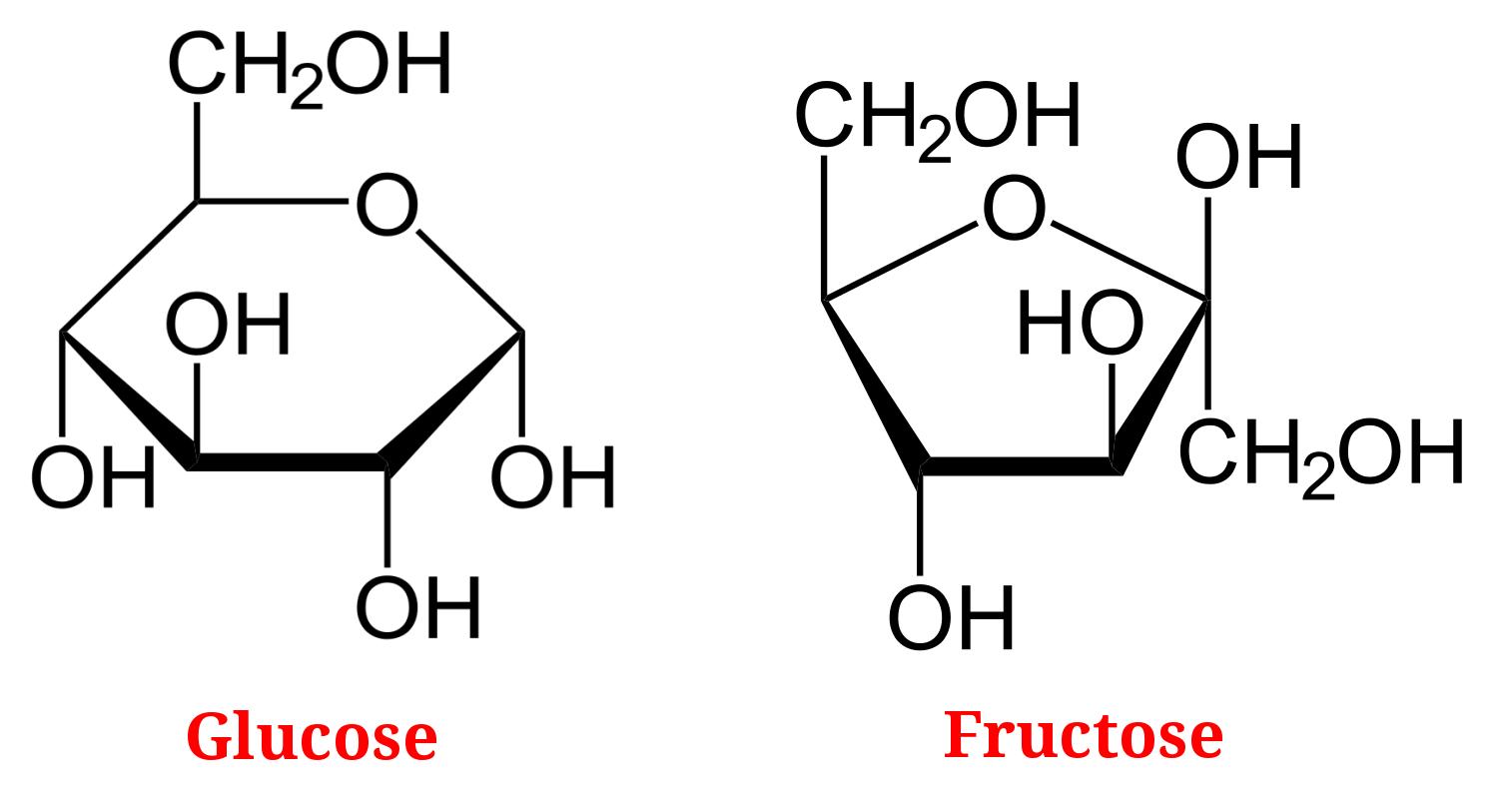
An enzyme that changes glucose into fructose would be a(n):
a)
Isomerase
b)
Lyase
c)
Oxidoreductase
d)
Transferase
20.

What happens when enzymes are heated to a high temperature?

a)

The enzymes die

b)

The shape of the enzyme changes as it denatures

c)

The enzymes become more active

d)

The enzymes remain the same

21.

Which of the following denatures an enzyme?

a)

High Temperatures

b)

Incorrect pH

c)

Both

22.
Each enzyme only has 1 substrate that will fit its active site.  What is this called?
a)
reusable
b)
catalyst
c)
specificity 
d)
fragile
23.

Every enzyme has a optimal temperature and pH. True or False?

a)

True

b)

False

24.

An enzyme ________ the activation energy needed for a reaction to occur.

a)

decreases

b)

increases

c)

does nothing to

d)

increases then decreases