
 Worksheets
EA5: Homework week 5.10 (II)
Total questions: 50
Worksheet time: 25mins
Name
Class
Date
1.

The diagram shows layers of sedimentary rock and examples of the fossils each layer contains, Which layer contains the oldest fossils?
a)
A. Layer 2
b)
B. Layer 4
c)
C. Layer 1
d)
D. Layer 3
2.
Where are most fossils found?
a)
A. In sand dunes
b)
B. In volcanoes
c)
C. In igneous rocks
d)
D. In sedimentary rocks
3.

Which fossil layer is the youngest?
a)
A. Layer A
b)
B. Layer B
c)
C. Layer C
d)
D. Layer D
4.
How are Sedimentary Rocks formed?
a)
A. Cooling and Hardening
b)
B. Melting and heating
c)
C. Compacting and Cementing
d)
D. Time
5.
How are fossils created?
a)
A. Traces of organisms harden like rock.
b)
B. Dead organisms are quickly buried for millions of years.
c)
C. Animals get trapped.
d)
D. All of the above
6.
Which statement is true about the fossil record?
a)
It is a record of all living things
b)
It shows how our climate has remained the same over time
c)
It provides evidence for history of life on Earth
d)
It does not support the theory of evolution
7.
An organism that no longer exists on Earth is called
a)
Decayed
b)
Evolved
c)
Extinct
d)
Preserved
8.

What type of fossil is this?
a)
Mold
b)
Cast
c)
Preserved remains
d)
Trace fossil
9.

What type of fossil is this?
a)
Trace fossil
b)
Mold
c)
Cast
d)
Carbon film
10.

What is the correct order of the rock layers from oldest to youngest?
a)
B, C, D, E, A
b)
A, B, C, D, E
c)
E, D, C, B, A
d)
B, C, D, A, E
11.

What is the correct order of the rock layers from oldest to youngest?
a)
F, E, C, B, A, D
b)
A, B, C, D, E, F
c)
F, E, D, C, B, A
d)
D, F, E, C, B, A
12.
Fossils are usually found in
a)
igneous rock
b)
extrusions
c)
intrusions
d)
sedimentary rock
13.

Which of the following is NOT an example of a fossil?
a)
a petrified dinosaur bone
b)
a footprint captured in mud
c)
a seashell found on the beach
d)
an insect stuck in amber
14.
Scientists who study fossils are called
a)
Geologists
b)
Paleontologists
c)
Fossil Scientists
d)
Meteorologists
15.
What type of fossil is this?
a)
Mold
b)
Cast
c)
Preserved remains
d)
Trace fossil
16.

According to the law of superposition, which layer is the youngest?
a)
A
b)
B
c)
C
17.
Which is an example of a trace fossil?
a)
animal tracks
b)
coprolite
c)
burrows
d)
all of the answers given here
18.
The preserved remains or evidence of ancient living things...
a)
clay
b)
fossils
c)
igneous rocks
d)
silt
19.
How do fossils form?
a)
An organisms is rapidly buried. The sediments and minerals replace the tissues.
b)
An organism is buried slowly. Only bones can become fossils
20.
Which is a mold?
a)
the impression left by an organism
b)
a copy of the organism, like a statue
21.
Which is a cast?
a)
the impression in a rock left by the organism
b)
a copy of the organisms made of sediment
22.
In order for a fossil to form, which of the following events must happen FIRST?
a)
Slowly, minerals in the water replace the bone.
b)
Sediment covers the bone.
c)
An animal dies.
d)
The bone is no longer a bone, but a rock copy.
23.

_____ is any living thing, plant or animal, even you!
a)
A paleontologist
b)
An organism
c)
A fossil
d)
A rock
24.
What happens when a group of animals become extinct?
a)
All of its members have died.
b)
Only a few of its members are still living.
c)
The animals can no longer lay eggs.
d)
All of its members move to another place.
25.
What does petrified mean?
a)
turned to stone
b)
turned to fire
c)
decompose
d)
turned to ashes
26.

What type of fossil is this?
a)
Mold
b)
Cast
c)
Preserved remains
d)
Petrified
27.
Which of the following is NOT something you could learn from a fossil?
a)
The size of the animal
b)
What the animal ate
c)
The color of the animal
d)
Where the animal lived
28.
In order for a fossil to form, which of the following events must happen FIRST?
a)
Slowly, minerals in the water replace the bone.
b)
Sediment covers the bone.
c)
An animal dies.
d)
The bone is no longer a bone, but a rock copy.
29.

Why don't we know what many ancient plants looked like?
a)
They had too many soft parts.
b)
They were all eaten by dinosaurs.
c)
There weren't ancient plants.
d)
They had too many hard parts.
30.
Where can the oldest layer be found?
a)
The top layer
b)
The middle layer
c)
They are all the same age
d)
The bottom layer
31.
How are fossils created?
a)
Traces of organisms get turned into stone.
b)
Dead organisms are quickly buried for millions of years.
c)
Animals get trapped.
d)
All of the above
32.
Which fossil layer is the youngest?
a)
A. Layer A
b)
B. Layer B
c)
C. Layer C
d)
D. Layer D
33.
The Law of Superposition helps scientists to determine what?
a)
The absolute age of rock layers
b)
The age of fossils
c)
The relative age of rock layers
d)
the super powers of rocks
34.

Look at the diagram, what layer did animal E first show up in?
a)
Layers #4
b)
Layers #5
c)
Layers #6
d)
Layers #7
35.
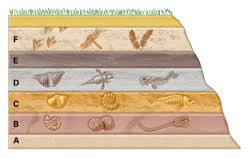
Which rock layer contains the newest fossils?
a)
F
b)
E
c)
B
d)
C
36.
What is hardened tree sap called?
a)
coprolites
b)
index fossils
c)
gastroliths
d)
amber
37.

Which layer formed first?
a)
Rock Layer W
b)
Rock Layer X
c)
Rock Layer Y
d)
Rock Layer Z
38.
What are the three states of matter?
a)
solid, volume, mass
b)
density, volume, mass
c)
solid, liquid, gas
d)
density, gas, volume
39.
Something that takes up space and has mass.
a)
volume
b)
matter
c)
mass
d)
density
40.
A state of matter that has a definite volume and shape.
a)
solid
b)
liquid
c)
gas
d)
matter
41.
The amount of space something takes up
a)
density
b)
volume
c)
mass
d)
matter
42.
A watermelon has more matter than a grape, so it has more
a)
mass
b)
eat
c)
solid
d)
greater
43.
What is one way matter change states?
a)
matter loses mass
b)
heat is added
c)
it doesn't change
d)
by doing nothing
44.
Matter is made of _________.
a)
solids
b)
gases
c)
atoms
d)
nutrients
45.
______________ does not have a definite shape or volume.
a)
liquid
b)
solid
c)
gas
46.
A description of objects that can be measured and observed.
a)
gas
b)
mustangs
c)
physical properties
d)
melting point
47.
A physical property can be observed with your
a)
Eyes
b)
Ears
c)
Tastes
d)
All of the above
48.
An example of a physical property is
a)
flammability
b)
acidic
c)
color
d)
ability to rust
49.

Substance with a DEFINITE volume, but NO definite shape...
a)
solid
b)
liquid
c)
gas
50.
A property of matter that describes its ability to change into entirely new substances is called a(n)____________
a)
flammability
b)
reactivity
c)
nonflammability
d)
chemical property
100 %

