
 Worksheets
Biodiversity Unit Review
Total questions: 112
Worksheet time: 2hrs 52mins

Food Web B is an example of...
Low biodiversity and low sustainability. If the producer dies then all the food web will suffer.
High biodiversity and high sustainability. If an organism is removed the food web will continue with no effect.

Which shows more biodiversity Image A or Image B. Why?
Image B is more biodiverse, because shows more different species than image A.
Image A is more biodiverse, because shows a greater number of organisms that image B
Both images show the same biodiversity

The circle graphs display data about four ecosystems in an area. The different color segments represent different species found in the ecosystem. The size of the segments show the percentage of organisms that are of that species. Based on the information in the circle graphs, which ecosystem is most sustainable if a natural disaster strikes the area?
A
B
C
D
Which of the following groups has the highest diversity of the planet?
plants
insects
bacteria
mammals

In general, as you move from the equator to the poles, what happens to biodiversity>
Increases
Decreases
Remains the same

These dogs are an example of
diversity within species
diversity between species

The Galapagos finches are shown above. What type of diversity is this?
diversity between species
diversity within species
genetic diversity
ecosystem diversity

diversity within species
diversity between species

Use the following codes:
1 = Variation within a species
2 = Variation between species
to identify the statements shown as examples of variation within a species or variation between species. Record your answer as a 4 digits answer.
(a)
The ___________ the diversity, the more likely a species is to survive changes to their environment
greater
lesser

What is the manipulated variable in the study shown?
level of biodiversity
latitude
species richness
population size

What can be concluded from the graph above?
the higher the latitude, the greater the biodiversity
the lower the latitude, the lower the biodiversity
there is higher biodiversity in the polar regions
there is higher diversity in the equatorial regions

Global warming causes an increase in coastal water temperatures. Increased coastal water temperature causes a decrease in reproduction of krill. Which of these would most likely experience an increase in population?
gull
herring
anchovy
phytoplankton
The relationship between herriny and anchovy in this food web are
predator-prey
interspecies competition
mutualism
consumer-producer
A black bear, being able to eat a wide variety of food items and live in a wide variety of habitats, is a good example of an animal which
i) is a specialist
ii) is a generalist
iii) has a narrow niche
iv) has a broad niche
i and iii
i and iv
ii and iii
ii and iv
Organisms that tend to live in areas where the temperature and food supplies are relatively stable tend to be
specialists
generalists
consumers
producers
A Giant Panda has a highly specialized diet and can only live in very specific habitats. It can be considered a
general species
niche
invasive species
specialist species
The diet of white-tailed deer consists primarily of shrubs. Sika are another species of deer that eat both grasses and shrubs. After an extended drought period, why might the Sika population be favoured over the white-tailed deer population?
Sika require less food than do the white-tailed deer
Sika require more water than do the white-tailed deer
Sika have more food sources than do the white-tailed deer
Sika have fewer food sources than do the white-tailed deer

Organism X lives in the body of organism Y. X feeds on nutrients from the body of Y without providing any benefit to Y and Y suffers from having X on its body.
The above situation describes a relationship that is…
Mutualistic
Parasitic
Commensal
Predator-prey
How does resource partitioning contribute to the overall stability of an ecosystem?
resource partitioning only benefits a few species, leading to instability in the ecosystem.
resource partitioning reduces competition and allows for coexistence, leading to overall stability in the ecosystem.
resource partitioning increases competition and disrupts coexistence, leading to instability in the ecosystem.
resource partitioning has no effect on competition or coexistence in the ecosystem.
Reef-building coral are marine animals with single-celled algae living in their tissues. The coral provides protection for the algae and the algae provides food for the coral. Which of these statements best explains what would happen to the coral if the algae die?
The coral would grow well because it does not have a competitor.
The coral would die because it needs the food produced by the algae.
The coral would grow well because it does not have a parasite.
The coral would die because it cannot produce food for the algae.
It is commonly observed that blue-eyed parents produce offspring with blue eyes. It can be concluded that eye color is likely a…
Heritable characteristic
Dominant characteristic
Recessive characteristic
Non-heritable characteristic
No two zebras have exactly the same pattern of stripes. This is an example of
variation
adaptation
natural selection
survival of the fittest

Julie collected data on the structure of the human ear from four members of her class.Which of the following terms describe lobe traits?
Heritable characteristic and continuous variation
Heritable characteristic and discrete variation
Non-heritable characteristic and continuous variation
Non-heritable characteristic and discrete variation
Which of the following all show discrete variation?
body height, hair type, heart rate
blood type, eye colour, fingerprint type
foot length, tongue rolling ability, hand span
body mass, eye colour, earlobes attached
Which of the following characteristics are examples of discrete variation?
i) blood type ii) sex (male or female) iii) skin colour
i and ii
ii and iii
i and iii
i, ii, and iii
An albino kangaroo is a kangaroo that is pure white. This characteristic is classified as a ...
Non-Inherited Variation
Continuous Variation
Discrete Variation
Singular Variation
Determine if the following trait is a heritable or non-heritable trait:
Ability of a mouse to learn a maze
non-heritable trait
heritable Trait
Determine if the following trait is a heritable or non-heritable trait::
Color blindness of a person
non-heritable trait:
a heritable trait:
Your height is considered to be a heritable characteristic but is affected by ...
Age
Diet
Bone Mass
Blood Type

Examine the data represented here. In 1978 which variation of the trait for beak size was most frequent?
7 mm
9mm
10 mm
14mm

Which of these is necessary for natural selection to occur?
genetic engineering
genetic variation
asexual reproduction
environmental stability
Over a period of years, the average rainfall in an area decreases, causing environmental changes. Which of the following populations would be most likely to survive these environmental changes?
a population with the greatest amount of genetic variation
a population with the least amount of genetic variation
a population that has been altered through artificial selection
a population with the smallest population size

As is typical in many mammal populations, offspring with an average weight at birth have a higher survival rate than offspring with a very low or very high birth weight. Based on this information, which of the following graphs is the best prediction of what will happen to the range of birth weights in this population over time?


Which of these scenarios is an example of natural selection?
Farmers crossbreed two types of cows to produce a breed of cow that has high quality beef and can tolerate a hot climate.
Giraffes that have longer necks survive a dry season by eating leaves from the tops of trees. Those giraffes breed more successfully that year.
Dogs that have a desirable coat color are bred with one another to produce puppies with the same coat color.
People kill rattlesnakes that rattle when approached by humans, but people do not kill rattlesnakes that remain silent. The quiet snakes survive and breed.
After many generations, an insect species evolved resistance to a particular pesticide. According to natural selection, this occurred because spraying pesticides
killed most of the insects in the population
caused mutations in the insect species’ gene pool
caused another insect species to go extinct
selected for insects that were able to survive and reproduce

What type of asexual reproduction is it?
budding
vegetative propagation
spore production
binary fission
Type of plant reproduction which the plant can reproduce without flowers.
Sexual reproduction
Fertilization
Pollination
Asexual reproduction
The union of a male sperm cell with a female egg cell is referred to as…
Pollination
Fertilization
Parthenogenesis
Asexual reproduction
Which flower structure produces a male gamete?
Ovary
Stigma
Anther
Ovule
Which of the following situations is not an example of asexual reproduction?
A hydra producing a bud
A plant propagating from a root
Bacteria dividing by binary fission
Fertilization to form a zygote
Which type of reproduction tends to produce more offspring?
Sexual
Asexual
They occur at the same rate
Which type of reproduction results in offspring that are identical to the parent?
Sexual
Asexual
Neither
Both

Sexual, Asexual, or Both?
Sexual
Asexual
Both
Neither

What type of asexual reproduction is it?
budding
regeneration
sporulation
binary fission

What type of asexual reproduction is it?
vegetative propagation
sporulation
budding
binary fission
The male gamete is a ______. The female gamete is a _____. When the two gametes come together, it's called _____.
egg, sperm, offspring
sperm, egg, offspring
sperm, egg, gamete
sperm, egg, asexual reproduction
sperm, egg, fertilization

The part that received the pollen grains
A
B
C
G

What is the name of part 7?
Pistil
Filament
Stamen
Anther

Which of the following can be considered the pistil?
1
2
3
4
Which organism would you classify as sexually reproducing?
A strawberry plant that reproduces through runners in the ground
A starfish that reproduces by breaking off and regenerating parts of its body
An amoeba that splits through binary fission
A chicken egg that is fertilized by a rooster

What stage of sexual reproduction is this?
fertilization
cleavage
pollination
mitosis
Natalie is trying to extract the DNA because she knows that it is a very important molecule for all living things. Which of the following is not a reason why DNA is so important?
It controls all of the functions of the cells in an organism.
It contains all of the information necessary for reproduction.
It is responsible for variation with a species.
It is the only living part of a cell.
The central office of a delivery company that controls the operations of the company is comparable to what part of the cell?
chromosome
gene
nucleus
trait
Which of the following BEST describes the relationship between DNA, genes, and chromosomes?
DNA contains chromosomes and is found in genes.
Genes are sections of DNA, and chromosomes are made of tightly coiled DNA.
What comparison best describes the relationship between genes and chromosomes?
Chromosomes and genes are both like chapters in a book.
Chromosomes and genes are both like words in a book.
Chromosomes are a book and genes are the chapters.
Genes are a book and chromosomes are the chapters.
A scientist is looking at a section of a chromosome that carries the code for red hair in a human. What part of a chromosome is he observing?
Trait
Gene
DNA Sequence
The genome
Investigators find DNA in blood left behind at a crime scene. In order to get a DNA match to a suspect, they could test the DNA from
blood
skin cells
saliva
any of the above
Which reason explains why nerve cells function differently than muscle cells?
In nerve cells all the genes are expressed.
In muscle cells all the genes are expressed.
In both kinds of cells the same genes are expressed.
In both kinds of cells different genes are expressed.
Which of the following functions is not achieved through meiosis?
The production of gametes
Growth and cellular repair
Sexual reproduction
Recombination of genetic material
The division to produce human sex cells is referred to as…
Meiosis, which produces 23 chromosomes
Mitosis, which produces 23 chromosomes
Meiosis, which produces 46 chromosomes
Mitosis, which produces 46 chromosomes

The numbers in the diagram below represent the chromosome number found in each of the dog cells shown. What are the processes that are occurring at A and B (respectively)?
meiosis and fertilization
meiosis and pollination
mitosis and fertilization
mitosis and pollination

After an egg cell containing 16 chromosomes is fertilized by a sperm, how many chromosomes will be present in the zygote?
8
16
32
64

The image shows the chromosomes in a pool frog's skin cells. How many chromosomes would be in an egg cell?
13
10
52

A human has 46 chromosomes in a skin cell. Complete the chart above
(a)
Which of these is produced as a result of fertilization?
a zygote with twice the number of chromosomes as a gamete
an egg with half the number of chromosomes as a zygote
a gamete with twice the number of chromosomes as a zygote
a zygote with half the number of chromosomes as a gamete

Which of the following bar graphs best represent the cell division process above?


In cats, black fur is dominant over white fur color. If a purebred black male cat were crossed with a purebred white female cat, what color would one expect the offspring to be?
All black
All white
All grey
Some black, some white

In mice, black fur (B) is dominant to white fur (b). According to the Punnett square shown, how many offspring would be black?
0
1
2
3
4

White hair (W) is dominant in horses, and non-white (w) is recessive. A dominant WW horse is crossed with a recessive ww horse, as shown in the Punnett square. What percentage of offspring would have white hair?
0%
50%
75%
100%

According to the figure, what is the constricted pod shape?
hybrid
incompletely dominant
dominant
recessive

Cody crosses a plant producing wrinkled peas with a plant producing smooth peas. Weeks later, he discovers that all the offspring plants have smooth peas. Cody drew the Punnett square above to show the genotypes of the offspring plants. Which is the dominant phenotype in the pea plants used in Cody’s experiment?
smooth
wrinkled
RR
Rr
In humans, having freckles (F) is dominant to not having freckles (f). What is the percent chance that a married couple with no freckles will give birth to a child who has freckles?
0%
25%
50%
75%
100%

This type of dominance is ........................... because the heterozygote shows a phenotype that is .............................. .
complete, weaker
incomplete, the same as the parents
incomplete, blended
complete, stronger

Incomplete dominance occurs in cats, which allows them to be Black, White, or gray as shown on this Punnett square. What percentage of the offspring will be black?
25
50
75
100

A red flowered plant (RR) is crossed with a white flowered plant (WW). The gene for petal color in these plants expresses incomplete dominance. What percentage of the offspring will have red (RR) flowers?
0%
25%
50%
100%
The hair form gene shows incomplete dominance. If your genotype is SS, you will have straight hair. If your genotype is CC, you will have curly hair. If your genotype is SC, you will have wavy hair. Mr. and Mrs. Anderson both have wavy hair (SC). What percentage of their children will also have wavy hair (SC)?
25%
50%
75%
100%
In humans, having freckles (F) is dominant to not having freckles (f).
Two people with freckles get married and give birth to three children. Two of the kids have freckles and one does not.
Both parents must have which genotype?
FF
Ff
ff
Long hair rabbits are mated with short hair rabbits. All the offspring are have medium hair. If two of those medium hair rabbits were mated, what percentage of their offspring will have have long hair?
75%
0%
25%
100%
A scientist cloned a goat. Which of these is a true statement about the cloned goat?
It has new genes and traits.
It lacks the genes for reproduction.
It has genes that are identical to the original goat.
It looks the same as the original goat but has different genes.

The beef industry in the USA and Canada depends on artificial reproductive technologies such as the one shown to produce cattle with high-quality meat. Alberta farmers are raising high-quality cattle by using modern reproductive technologies such as…
Cloning
Artificial insemination
Genetic engineering
Natural selection
What is the difference between genetic engineering and artificial selection?
Genetic engineering involves direct manipulation of an organism's DNA, while artificial selection relies on breeding individuals with desirable traits over generations.
Genetic engineering is a natural process, whereas artificial selection is a laboratory technique.
Genetic engineering only applies to plants, while artificial selection can be used on animals.
Genetic engineering is faster than artificial selection, which takes many generations.

Big, healthy corn cobs were developed by early aboriginal people likely through the use of
Cloning
Random chance
Artificial selection
Mutating genes
All of the following are advantages of genetically engineered products except
pest resistant crops
more nutritional foods
unknown long term health effects
creating more human insulin
Which of these is not a way in which biotechnology can benefit agriculture?
increase crop population
reducing the loss of crops to insects
producing better-tasting fruits
improving farm machinery
Which of the following statements is an ethical concern related to human cloning?
“It is not fair to create clones to be used solely for the purpose of supplying organs for transplants.”
“It is very costly to create clones.”
“When creating clones, dangerous chemicals are used that can harm the environment.”
“Clones might not have personalities.”
Which of the following reasons cannot be given as a cause of the decrease in worldwide biodiversity?
A greater dependence on wood for fuel
An increase in the demand for consumer goods
An increased need to clear land for agriculture
A decrease in human population growth in developing countries

A student gathered data about the size of several populations in an ecosystem and organized the data into a table about population sizes in ecosystems. In this ecosystem, lizards eat grasshoppers. Snakes eat mice. Grasshoppers and mice eat grass. Which of these would best explain the trend in population sizes in this ecosystem?
Disease reduced the size of the mouse population.
A species that eats snakes was introduced to the ecosystem.
A pesticide was used to control the size of the grasshopper population.
Most of the grass in the ecosystem was removed to make room for a parking lot.
Grizzly bears once lived from the mountains of British Columbia to Manitoba. The building of roads and other human activities have had an impact on the range of grizzly bears to the point where they are now found only in the mountains and foothills along the Rocky Mountain Range. This is an example of…
A biological species
A bioindicator species
An extirpated species
An impacted species

Of the causes of the extinction of animal species listed above, the three that could be natural causes are…
II, III and IV
I, IV and V
IV, V and VI
I, V and VI
Bioinvasion of an area will most likely result in
an increase in habitat
a decrease in biological diversity
an increase in natural disasters
a decrease in exotic organisms
Which is a method of conservation which requires the preservation of a species outside of their natural habitat?
Ex Situ
In Situ
National Parks
Resource use policies

Chen concluded that the community in which the largest animal populations were healthiest was the…
Community before European contact because the carnivores kept the herbivore populations stable.
Current community because there is a wide variety of herbivores.
Community in the early 1900s because there was less competition for food amongst the herbivores.
Community before European contact because the herbivores would have had a lot of exercise.

To explain the change in the community from the time before European contact until the early part of this century, Chen hypothesized that…
Global warming in the early 1900s caused the environment to be unsuitable for some animals.
Natives killed all the large herbivores.
Large herbivores could not survive due to lack of vegetation.
Hunting to meet the needs of settlers drastically altered the composition of the community.
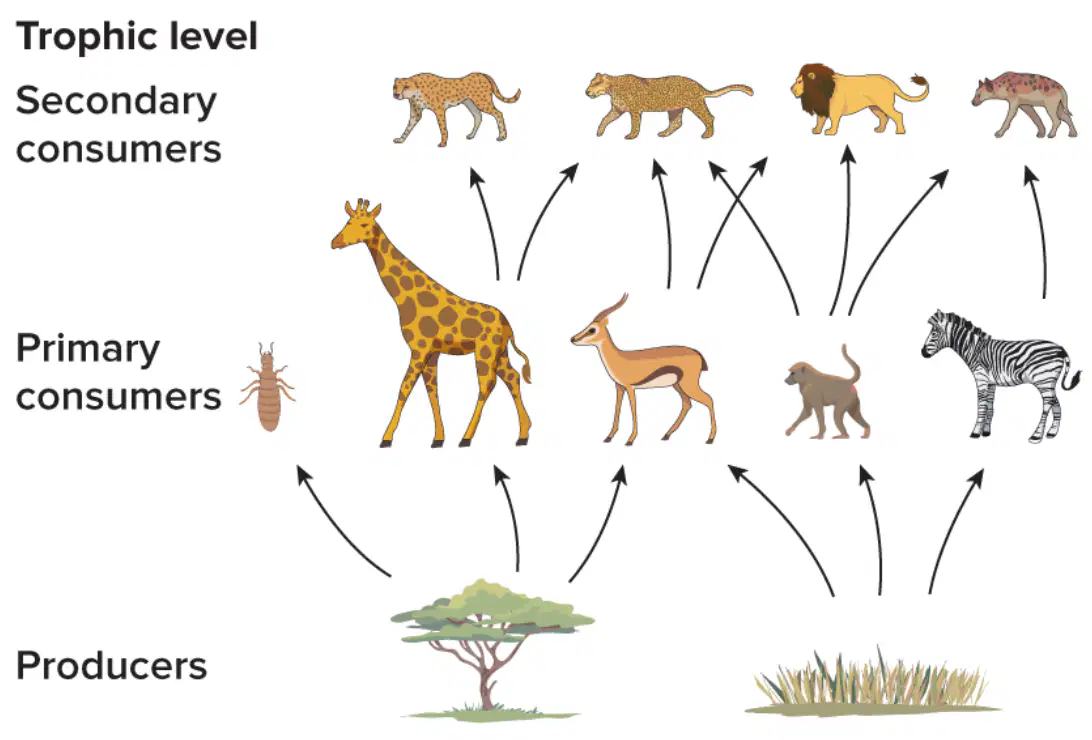
Examine the food web of an African savana. Which statement describes what would likely happen if a new disease killed most of the antelope?
The amount of energy available to the populations of leopards and lions would increase, reducing their population size.
The population size of most trees and grasses would decrease because other primary consumers would eat them.
Populations of other primary consumers (insects, giraffes, oragutans and zebras) would increase because there would be less energy available to them.
The amount of energy available to the populations of leopards and lions would decrease, reducing their population size.
Which is NOT an advantage of In Situ Conservation?
It maintains the animal's normal behaviour.
It provides a place to return animals from breeding programs.
Species can occupy their natural position in the food chain.
Species are raised and bred in containment.

Based on the graph shown, what is the effect of removing a keystone species on an ecosystem?
species richness oscillates between extremes
species richness stabilizes
species richness increases
species richness decreases

Which of the following will NOT reduce biodiversity?
Habitat loss
Pollution
Climate change
Conservation
Which of the following is an example of a protected area?


What is the responding variable in this graph?
Year
% animals extinct
Mammals
"According to the World Bank, destroying Biodiversity cost the world $2.7 trillion a year." Which perspective is expressed here?
political
economic
technological
health and wellness
The "Species At Risk Act" is an example of
zoo
seed bank
resource use policy
proteted area
Forest clearing, farming, and road building are all examples of
Biodiversity
Population distribution
Habitat loss
Climate Change
A species that is not supposed to be in an ecosystem (non-native) and has no competition
invasive species
fossil fuels
direct harvesting
indicator species

Students used this graph to compare the biodiversity index of four ecosystems. To determine the biodiversity index for each ecosystem they divided the number of species in an area by the number of individual organisms in the area. Which statement correctly compares the ecosystems shown in this graph?
Ecosystem C is more likely to be sustainable than Ecosystem A.
Ecosystem B supports the health of the organisms better than Ecosystem C.
Ecosystem A probably provides more ecosystem services than Ecosystem D.
Ecosystem B and Ecosystem D are equally likely to recover after a natural disaster.

