wayground logo

Free Printable Worksheets

Font size

S
M
L
XL
Worksheets

APUSH Exam Review - Units 6 & 7

Total questions: 100

Worksheet time: 51mins

Name
Class
Date
1.
This period during the 1870s to 1900 is known for it's rise of railroads, big business, industrialization and social problems in the United States.
a)
World War I
b)
Progressive Era
c)
Gilded age
d)
Roaring Twenties
2.
in 1882, the Government passed this legislation that restricted immigration for 10 years from a certain group into the United States.
a)
Nativist Act
b)
Mexican Reparition Act
c)
Dawes Act
d)
Chinese Exclusion Act
3.
During the Gilded age, workers came together to work for better pay, working conditions, and less hours. Leaders such as Samuel Gompers help led many of this workers in....
a)
Philanthropy
b)
Labor Unions
c)
Political Bosses
d)
Credit Unions
4.
"New Immigrants" that came to the United States in the early 1900s were from which part of Europe?
a)
South Europe
b)
NE Europe
c)
SW Europe
d)
SE Europe
5.
Men such as Andrew Carnegie believed in giving money to libraries, musuems and schools to help benefit people who wanted to move up in the social ladder. 
a)
geopolitical
b)
political bosses
c)
Social Darwinism
d)
Gospel of Wealth
6.
The Pendleton Act of United States in 1883 decided that government jobs should be awarded on the basis of merit (test) instead of political affiliation.
a)
direct voting
b)
civil service reform
c)
political machines
d)
civil labor unions
7.
Due to the corruption of the railroads companies, the U.S. government created this act to regulate railroad companies to be reasonable in prices.
a)
Interstate Commerece Act
b)
Dawes Act
c)
Transcontiental Act
d)
Laissez Faire Act 
8.
Because of the rapid growth of Industrilization in the North people moved out of rural towns to?
a)
Rural farms
b)
Urbanzied cities
c)
Subrebs cities
d)
El rancho
9.
Many Immigrants faced issues once they arrived such as language barriers, but these group of people mostly restricted new immigrants from emtering the country.
a)
Democrats
b)
Republicans
c)
Donald Trump
d)
Nativists
10.
What New York politician ran a political machine in New York City beginning in 1869, during the Gilded Age, that was incredibly corrupt.  For example, a projected cost of $250,000 for a courthouse turned in to $13,000,000 because of kickbacks and bribes.
a)
Daley
b)
Grant
c)
Tilden
d)
Tweed
11.
What was a city government marked by corruption, bribery, and Kickbacks (common during the Gilded Age) called?
a)
credit mobilier
b)
political machine
c)
corrected democracy
d)
electoral politics
12.

In 1890, during the Gilded Age, who wrote about and photographed the horrible living conditions of America's working poor in the book, How the Other Half Lives?

a)

Upton Sinclair

b)

Ida Tarbell

c)

Ida Wells

d)

Jacob Riis

13.
William Graham Sumner was a popular researcher and writer during the Gilded Age.  He believed that government programs to help the poor were useless because, "...a drunkard in the gutter is just where he ought to be..."  That is, Sumner believed that we all had a certain station or place that was ordained and could not be changed.  This Gilded Age philosophy was called which of the following?
a)
Evolution
b)
Monetary Policy
c)
Social Darwinism
d)
Welfare Capitalism
14.
One reason nativists worried about influx of immigrants in 1880s...
a)
Feared immigrants gain control of city and state governments
b)
Believed immigrants receive preferential treatment from federal government and receive land
c)
Thought country's ports could not handle increasing numbers of immigrants and exports
d)
Considered immigrants from southern and eastern Europe a threat to traditional American cultural values
15.
How Haymarket Square affected Knights of Labor?
a)
Massive gathering of workers forced federal government to place limits on union's activities
b)
Workers lost confidence in union's leadership after union president given details of rally to police
c)
Union members grew disillusioned as newspapers blamed workers for violence
d)
Union's emphasis on recruiting immigrants angered American-born workers
16.
How did KoL differ from AFL?
a)
KoL advocated strikes as tactic
b)
KoL opened membership to women, blacks, and ethnic minorities
c)
KoL developed stronger relationships with policymakers at federal level
d)
KoL focused on working conditions and workplace safety instead wages and benefits
17.
Populists supported "free silver" because they believed:
a)
It would result in deflation
b)
It would increase bank regulations
c)
It would result in inflation
d)
None of the following - they supported continuation of the Gold Standard
18.
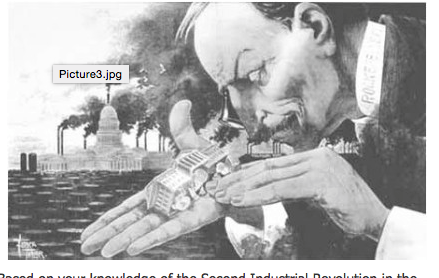
Based on your knowledge of the Industrial Revolution in the United States, what statement is this cartoon making?
a)
The federal government is ruining the oil industry by placing too many restrictions and regulations on business owners.
b)
The oil industry is thriving due to a healthy working relationship with the federal government.
c)
The owner of Standard Oil has too much power and influence over the federal government.
d)
Emissions from oil refineries are polluting the air and harming the environment.
19.
What was the main goal of most muckraking journalists?
a)
Gain fame through articles of high popular interest
b)
Expose socioeconomic problems in need of political attention
c)
Increase public awareness of America's great potential
d)
End corrupt relationships between politicians and big business
20.
John Muir and Theodore Roosevelt worked together on which movement?
a)
safe food and drug laws
b)
conservation
c)
racial equality
d)
child labor laws
21.
What does Trust-busting mean?
a)
end discrimination
b)
stop monopolies (restore competition)
c)
label ingredients on food and drugs
d)
election for political offices 
22.
What did the NAACP focus on?
a)
child labor
b)
equal rights
c)
conservation
d)
protection of animals
23.
Upton Sinclair's The Jungle had which unintended effect?
a)
it showed racial discrimination
b)
it showed the harmful things that were in the nation's food
c)
it established trade guidelines
d)
it fixed drug regulations
24.
A law that prohibits the sale of mislabeled or contaminated food
a)
Pure Food and Drug Act
b)
Meat inspections
c)
Food and Drug Administration
d)
Occupational Safety and Health Admin 
25.
To remove through a vote
a)
referendum
b)
socialism
c)
recall
d)
capitalism
26.
To remove through a vote
a)
referendum
b)
socialism
c)
recall
d)
capitalism
27.
New laws can be proposed by voters by collecting signatures on a petition
a)
recall
b)
referendum
c)
impressionism
d)
initiative
28.
This amendment allows people to vote directly for Senators
a)
16th
b)
17th
c)
18th
d)
19th
29.
The protection of nature and its resources is known as 
a)
recycling
b)
conservation
c)
communism
d)
socialism
30.
Because Roosevelt went after large trusts, he was known as a 
a)
muckraker.
b)
trustbuster.
c)
suffragist.
d)
businessman.
31.
What continent did 90% of immigrants come to the United States from during the late 1800s?
a)
Europe
b)
Asia
c)
Latin America
d)
Africa
32.
What was the time period called that suggested that the U.S. appeared to be fine, but beneath the surface there was corruption and serious problems?
a)
False America
b)
Gilded Age
c)
Teasing Times
d)
Erroneous Era
33.
W.E.B. Du Bois helped found the NAACP, or the National Association for the Advancement of Colored People, in 1909.
a)
True
b)
False
34.
The cultural fusion and integration of different groups of people that occurred in the U.S. around the time was called ____________________. 
a)
integration
b)
assimilation
c)
immigration
d)
procrastination
35.
Speech by William Jennings Bryan 
a)
The Gettysburg Address
b)
Cross of Gold
c)
I Have a Dream
d)
Homestead Act 
36.
The innovation of this transportation help open up the national market? 
a)
boats
b)
railroads
c)
automobiles 
d)
horse drawn carriages 
37.
During the 19th and early 20th century, These men helped immigrants with jobs and housing in order to control votes during election? 
a)
political parties
b)
El Chapo
c)
political bosses
d)
republican party
38.
The Farmer's Alliance and the Grange, both founded during the Gilded Age, stood for additional government regulation of trade and creating the conditions for more political power and economic well being for farmers (as compared to industrialists).  What 1890s group was founded, supporting these ideas, and attacking the Gold Standard?
a)
Progressives
b)
Free Soil Party
c)
IWW
d)
Populists
39.
Congressional action taken in 1890, during the Gilded Age, that made "contracts, conspiracies, and combinations" that restrained free trade illegal.  This was done to stop the abusive practices of organized trusts in oil, sugar, tobacco...
a)
Sherman Antitrust Act
b)
Celler-Kefauver Act
c)
Clayton Antitrust Act
d)
Interstate Commerce Act
40.
Congressional action taken in 1887, during the Gilded Age, to stop the unfair and abusive practices of railroad companies.  That is, to stop railroad companies from giving low prices to large shippers (Corporations) and high prices to farmers who had no other shipping options.
a)
Sherman Antitrust Act
b)
Celler-Kefauver Act
c)
Clayton Antitrust Act
d)
Interstate Commerce Act
41.
Suffrage
a)
The right to work in factories 
b)
The right to live in America
c)
The right to vote
d)
The right not to vote
42.
Who was the most influential African American during this time, encouraging African Americans to GRADUALLY move up in society?
a)
Malcolm X
b)
Booker T. Washington
c)
George Washington Carver
d)
Martin Luther King Jr.
43.
Which territory was annexed by the US because of the economic value of its sugarcane plantations?
a)
Alaska
b)
Midway
c)
Hawaii
d)
Samoa
44.
The explosion of the USS Maine
a)
proved that McKinley was a weak president
b)
rallied Americans against Spain
c)
caused American prejudice about Spanish immigrants
d)
formed a bond between America and Cuba
45.
The Anti-Imperialist League was a group that
a)
fought in both World Wars
b)
opposed the creation of an American colonial empire
c)
died in battle while fighting for America
d)
signed a petition in favor of a law that would ban all treaties
46.
What US president was famous for his usage of dollar diplomacy?
a)
Taft
b)
Roosevelt
c)
Hay
d)
Wilson
47.
Anti-imperialists thought imperialism was ___. 
a)
bad for the economy
b)
racist
c)
a good idea
d)
democratic
48.
The phrase “speak softly and carry a big stick” refers to ___.
a)
Roosevelt’s desire to withdraw from international affairs
b)
McKinley’s desire to stay out of Cuba
c)
Roosevelt’s foreign policy of words backed up by military power
d)
McKinley’s policy of expansionism
49.
___ was forced to trade with the United States by Commodore Perry.  This sparked modernization.
a)
 Japan
b)
Hawaii 
c)
Panama
d)
China 
50.
The US supported the rebellion in ___ against the Columbians.
a)
 Japan 
b)
 Hawaii 
c)
China
d)
Panama
51.
A volunteer cavalry unit with Teddy Roosevelt leading as 2nd in command. They helped take control of Cuba by winning the battle of San Juan Hill.
 
a)
William Randolph Hearst 
b)
Commander George Dewey
c)
Rough Riders
d)
Teddy Roosevelt 
52.
Journalists writing exaggerated news stories to sell newspaper. Examples stories about the de Lome letter and the USS Maine
a)
Imperialism
b)
Yellow journalism
c)
Protectorate 
d)
Open Door Policy
53.
All countries would be allowed to trade with China
a)
Imperialism
b)
Yellow journalism
c)
Protectorate
d)
Open Door Policy
54.
Described the likelihood of 1 in 10 black men becoming leaders of their race in the world; wrote "The Talented Tenth"
a)
Booker T. Washington
b)
Martin Luther King, Jr.
c)
Nat Turner
d)
W.E.B. Dubois
55.
Advocated an accomodation theory appraoch to racism hoping that change would come gradually through skill development and work
a)
Harriet Beecher Stowe
b)
Rosa Parks
c)
Booker T. Washington
d)
W.E.B. Dubois
56.
Why was the U.S. Cavalry Buffalo Soliders important in regards to race relations?
a)
It provided for a way for African Americans to move west
b)
The agency helped educate, clothe, and feed freedmen
c)
The military unit was segregated due to their race
d)
It furthered the right for women's suffrage
57.
What Supreme Court case ruled "separate but equal" was legal?
a)
Redskins vs Giants
b)
Aylor vs Byrd
c)
Brown vs Board of Education
d)
Plessy vs Ferguson
58.
What best describes Jim Crow laws?
a)
better opportunities for women
b)
African Americans gaining full civil and political rights
c)
discrimination laws focused on Native Americans
d)
unequal opportunities for African Americans in housing, jobs, and education
59.
What was the name of the African American pioneers who moved to the Great Plains after the Civil War?
a)
The Reservationists
b)
The Exodusters
c)
The Sodbusters
d)
The Pioneers
60.
What is the Law that gave pioneers 160 acres of land to live on and farm for 5 years?
a)
Homesteaders
b)
Gold Rush
c)
Levi Strauss
d)
Homestead Act
61.
The image best represents
a)
The first telegraph sent from coast to coast
b)
Completion of the railroad at Promontory Point, Utah
c)
The effect of the Chinese Exclusion Act
d)
the Homestead Act
62.
Which caused the rise of Populism?
a)
rising agricultural prices
b)
The use of silver instead of greenbacks
c)
Calls for racial segregation
d)
The inability of farmers to pay off their debts
63.
 What animals were massively important for many Native American groups in the West and provided food, clothing, and shelter for their people?
a)
Long Horns
b)
Buffalos
c)
Beavers
d)
Wildcats 
64.
What conflict was the last major battle of the Indian Wars? 
a)
a. the Battle of Antietam 
b)
b. the Fetterman Massacre 
c)
c. the Massacre at Sand Creek 
d)
d. the Battle of Wounded Knee 
65.
What explanation below explains why railroad companies were able to charge high prices to farmers to ship their crops in the late 1800s?
a)
There was a great deal of competition between various railroad companies
b)
The railroads foreclosed on many farms and took the farmers’ properties
c)
The railroad companies had essentially no competition.
d)
They were able to charge high prices because the railroad companies owned the Grange.
66.
The goal of programs such as the Carlisle Indian School was American Indian
a)
Treaty Enforcement
b)
Cultural Assimilation
c)
Self-Determination
d)
Tribal Recognition
67.
Dawes Act
a)
Sioux Indians massacred here
b)
Native were forced to assimilate
c)
Native lands were protected
d)
Indians are moved on Trail of Tears
68.
The Influence of Sea Power Upon History
a)
Henry Cabot Lodge
b)
John Hay
c)
Alfred Thayer Mahan
d)
Robert LaFollette
69.
Allows US Intervention in Cuba
a)
Platt Amendment
b)
Teller Amendment
c)
De Lome Letter
d)
Insular Cases
70.
The US gained Puerto Rico and Guam
a)
Treaty of Versailles
b)
Treaty of Paris (1793)
c)
Treaty of Paris (1898)
d)
Treaty of Ghent
71.
Leader of the National Woman's Party
a)
Carrie Chapman Catt
b)
Florence Kelley
c)
Ida Tarbell
d)
Alice Paul
72.
Much stronger legislation, used by Wilson to break apart major corporations
a)
Clayton Anti Trust Act
b)
Sherman Anti Trust Act
c)
Interstate Commerce Act
d)
Federal Securities and Exchange Commission
73.
Conservation, Control of Corporations, Consumer Protections
a)
Square Deal
b)
New Deal
c)
Return to Normalcy
d)
New Freedom
74.
Organization in control of propaganda during WWI
a)
Office of War Information
b)
Committee on Public Information
75.
International agreement outlawing war
a)
Kellogg-Briand Treaty
b)
Treaty of Versailles
c)
Dawes Plan
d)
Washington Conference
76.
WWI laws that outlawed speaking against the war effort 
a)
Espionage and Sedition Acts
b)
Alien and Sedition Acts
77.
Agreement which was broken by the Germans shortly before American entry in WWI
a)
Zimmerman Note
b)
Gentleman's Agreement
c)
Sussex Pledge
d)
Munich Agreement
78.
Law establishing minimum wage and maximum hours
a)
Wagner Act
b)
Sherman Anti-Trust Act
c)
Fair Labor Standards Act
d)
Federal Emergency Relief Act
79.
Organization created by Hoover to aid banks and businesses
a)
Reconstruction Finance Corporation
b)
National Recovery Administration
c)
Federal Deposit Insurance Corporation
d)
Congress of Industrial Organizations
80.
FDR's foreign policy in the Western Hemisphere
a)
Moral Diplomacy
b)
Big Stick Policy
c)
Good Neighbor Policy
d)
Dollar Diplomacy
81.
Supreme Court decision that affirmed government powers during a military emergency
a)
Korematsu v. US
b)
Schenck v. US
c)
Plessy v. Ferguson
d)
Schecter v. US
82.

How did the Harlem Renaissance influence the world? Click all that apply

a)

it only had an impact on the immediate area of New York

b)

it spread from the area of Harlem to other parts of the nation

c)

it not only influenced African Americans, but other cultures as well

83.

Who was Langston Hughes?

a)

famous African American author and poet

b)

famous African American musician

c)

famous African American artist

84.
The Zoot Suit Riots were an eruption of tension that led to 5 days of rioting between which groups...
a)
African-Americans and US Army Soldiers
b)
Mexican-American youth and White Servicemen 
c)
Japanese-Americans and White Servicemen
d)
Multiracial Street Gangs and White Servicemen
85.

The Great Migration refers to

a)

The movement of African Americans from the south to the north

b)

The movement of African Americans from the north to the south

c)

The spread of African culture after slavery ended

d)

The advocacy of political union of all the indigenous inhabitants of Africa

86.
The need for workers in the Southwest led to the ____________ Program that allowed the recruitment of Mexicans to work in the U.S. during World War II.
a)
Bracero
b)
Navajo
c)
Barrio
d)
None of these are correct
87.
To make sure troops had everything they need, Americans were forced to ______________
a)
ration
b)
give everything they had to troops
c)
have less children
88.
Why were posters like this produced during World War II? 
a)
A. to encourage women to join community defense organizations in case of invasion 
b)
B. to encourage women to work in defense industries in order to support the war effort 
c)
C. to encourage women to serve in government and replace men drafted into the military 
d)
D. to encourage women to join the military and support their country by fighting overseas
89.

Which WWII leader became President after FDR passed, wanted to save American lives in the Pacific, and decided to drop the atomic bombs?

a)

Franklin D. Roosevelt

b)

Winston Churchill

c)

Harry S. Truman

d)

Joseph Stalin

90.

What event changed the role of the US and led to us declaring war and sending troops into battle?

a)

attack on Pearl Harbor

b)

Lend-Lease Act

c)

Operation Torch

91.
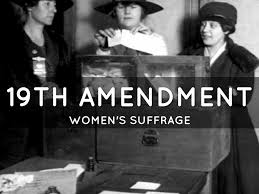
Which amendment guarantees women the right to vote?
a)
1st Amendment
b)
4th Amendment
c)
19th Amendment
d)
12th Amendment
92.
What is one way the New Deal was supposed to help the economy out of the Great Depression?
a)
by eliminating trading on the stock market
b)
by encouraging war with Germany and Japan
c)
by creating jobs through various new programs
d)
by giving people money through new bank laws
93.
• Became President after Herbert Hoover
• Pushed for many new programs called “The New Deal”
• President during World War II  

 The list above refers to which person?
a)
Duke Ellington
b)
Abraham Lincoln
c)
Theodore Roosevelt
d)
Franklin Roosevelt
94.
Which New Deal program targeted the problem faced by bank failures?
a)
AAA
b)
FDIC
c)
Social Security
d)
SEC
95.
Which decade saw bank failures, the Dust Bowl, and the New Deal?
a)
1910s
b)
1920s
c)
1930s
d)
1940s
96.
Which decade saw the rise of the automobile, the red scare, and Scopes Trial?
a)
1910s
b)
1920s
c)
1930s
d)
1940s
97.
Prohibition created which one of the following?
a)
Reduction in crime.
b)
Reduction in alcohol related deaths
c)
Organized Crime.
d)
More money being made.
98.
This was a major innovation found in most homes by the end of the 20s.
a)
Radio
b)
Television
c)
Telephone
d)
Microwave.
99.
Which boat was sunk by the Germans?
a)
U.S. Maine
b)
Lusitania
c)
Titantic
d)
Princess
100.

Identify reasons for American Imperialism

a)

Economic Interests

b)

Military Interests

c)

Cultural Superiority

d)

Self Interests