
NEW
Font size
S
M
L
XL
 Worksheets
Newton's Second Law
Total questions: 15
Worksheet time: 10mins
Name
Class
Date
1.
An object's velocity can be changed by changing its speed, its direction, or both.
a)
True
b)
False
2.
The increasing speed of a falling object is caused by _____________.
a)
force
b)
mass
c)
speed
d)
gravity
3.
Newton's second law of motion describes acceleration as force divided by __________.
a)
mass
b)
inertia
c)
speed
d)
direction
4.
According to __________, the acceleration of an object is equal to the net force acting on the object divided by the object's mass.
a)
Newton's Second Law
b)
Newton's Third Law
c)
Newton's First Law
5.
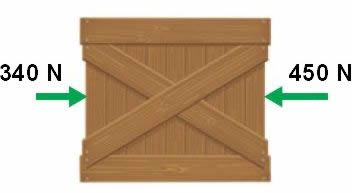
What happens when unbalanced forces act on an object at rest?
a)
the object remains at rest
b)
the object begins moving in an unpredictable direction
c)
the object begins moving in the direction of the net force
d)
the object begins moving opposite to the direction of net force
6.
F= mass * acceleration
A 20 kg bike accelerates at 10 m/s2. what is the force acting upon it?
a)
25 Newtons
b)
20 Newtons
c)
200 Newtons
d)
10 Newtons
7.
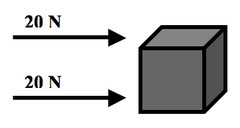
What is the net force?
a)
40 N left
b)
0 N Balalnced
c)
400 N right
d)
40 N right
8.
An object of mass 10 kg is accelerated upward at 2 m/s2. What force is required?
a)
20 N
b)
2 N
c)
5 N
d)
0 N
9.
What Unit do we Measure Force in?
a)
Newtons
b)
Joules
c)
Volts
d)
Lumens
10.
What is a Balanced Force? Two objects where...
a)
They both have equal force
b)
One has more force than the other
c)
Both have no force
d)
One has more gravity than the other
11.

Will it take more force to push an empty shopping cart or a shopping cart that is full?
a)
The empty shopping cart
b)
The full shopping cart
c)
They will take the same amount of force
d)
Depends on what is in the full shopping cart
12.
How much force is needed to accelerate a 2 kg physics book to an acceleration of 6 m/s/s?
a)
36 N
b)
12 N
c)
3 N
d)
0.33 N
13.
When force is 20 N, mass is 5 kg, what is acceleration?
F = ma
F = ma
a)
25 m/s/s
b)
5 m/s/s
c)
100 m/s/s
d)
4 m/s/s
14.
Forces can change an object's motion by changing its ------, its direction, or both.
a)
speed
b)
velocity
c)
gravity
d)
net force
15.
Newton's Second Law can be expressed as
a)
v = d / t
b)
E = mc2
c)
F = ma
d)
m1v1 = m2v2
Reset

