wayground logo

Free Printable Worksheets

NEW

Font size

S
M
L
XL
Worksheets

Radioactivity

Total questions: 44

Worksheet time: 7hrs 20mins

Name
Class
Date
1.
An isotope of an element has the same number of _________, but a different number of _________.
a)
Protons, electrons
b)
Protons, neutrons
c)
Electrons, neutrons
2.
Which type of radiation releases an electron?
a)
Alpha radiation
b)
Beta radiation
c)
gamma radiation
3.
What particle is released when an unstable isotope undergoes alpha radiation?
a)
an helium nucleus
b)
an electron
c)
a photon of light
4.
What type of radiation can be stopped by clothing or a piece of paper?
a)
Alpha radiation
b)
Beta radiation
c)
gamma radiation
5.
What type of radiation can be the most harmful?
a)
microwaves
b)
x-rays
c)
infrared
d)
visible
6.
Which is NOT a characteristic of gamma radiation?
a)
High energized photon of light
b)
Can be stopped by a sheet of aluminum foil
c)
Is the most harmful type of radiation to humans
d)
Our use of protection is concrete, or several inches of lead
7.
What type of decay is shown here
a)
alpha decay
b)
beta decay
c)
gamma decay
8.
What is Half-life?
a)
The amount of time it takes for some of the nuclei in a sample of the isotope to decay
b)
The amount of time it takes for half the electrons in a sample of the isotope to decay
c)
The amount of time it takes for half the nuclei in a sample of the isotope to decay
d)
the amount of time it takes to double the nuclei in a sample of the isotope to decay
9.
The three types of nuclear radiation in increasing order of penetrating power are ____.  
a)
  alpha, beta, gamma 
b)
X ray, beta, gamma
c)
alpha, gamma, beta 
d)
X ray, gamma, beta 
10.

Which type of nuclear radiation can be stopped 60 cm of aluminum or 7 cm of lead?

a)

Alpha

b)

Beta

c)

Gamma

11.

Which particle has a negative charge

a)

Alpha

b)

Electron

c)

Proton

d)

Neutron

12.

What is an isotope

a)

An atom with the same number of neutrons different number of protons

b)

An atom that has lost or gained an electron

c)

An atom with the same number of protons, different number of neutrons

d)

An atom with the same number of electrons and different neutrons

13.

The centre of an atom is called

a)

the electron

b)

the proton

c)

the nucleus

d)

the neutron

14.

Which charge does alpha particle have?

a)

positive

b)

negative

c)

it has no charge

15.

Which charge does a beta particle have?

a)

positive

b)

negative

c)

it has no charge

16.

Which charge does gamma radiation have?

a)

positive

b)

negative

c)

it has no charge

17.

What elements were discovered by Maria and Pierre Curie at the end of the 19th century?

a)

Uranium (U) and Rutherfordium (Rf)

b)

Rutherfordium (Rf) and Polonium (Po)

c)

Radium (Ra) and Uranium (U)

d)

Radium (Ra) and Polonium (Po)

18.

What do we call the electrical power plants where a process called nuclear fission is used to get electrical energy?

a)

Hydroelectric power plants

b)

Geothermal power plants

c)

Solar power plant

d)

Wind power plant

e)

Nuclear power plant

19.

The most dreadful accident involving a Nuclear Power Plant happened in 1986 in...

a)

Kiev

b)

Chernobyl

20.

When and where were dropped the first two atomic bombs by US forces?

a)

In 1945 over the Japanese cities of Hiroshima and Tokyo

b)

In 1942 over the Japanese cities of Nagasaki and Tokyo

c)

In 1942 over the Japanese cities of Hiroshima and Nagasaki

d)

In 1945 over the Japanase cities of Hiroshima and Nagasaki
21.
What makes something radioactive?
a)
elements with an atomic number above 81
b)
an unstable nucleus
c)
contaminated sewage
d)
It decays over time
22.
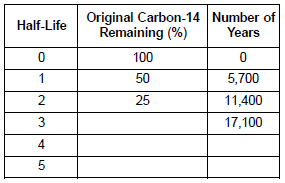
After the third half-life, how much of the sample is left?
a)
1/2
b)
1/3
c)
1/16
d)
1/8
23.
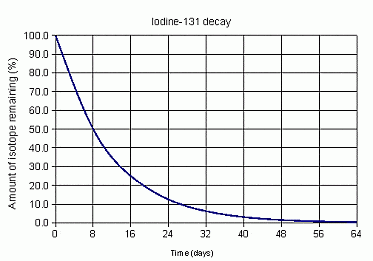
If 10 mg of iodine 131 is given to a patient, how much is left after 24 days? The half-life of iodine-131 is 8 days.
a)
1.25mg
b)
1.25g
c)
10g
d)
10mg
24.
The half-life of strontium-90 is 25 years. How much strontium-90 will remain after 100 years if the initial amount is 4.0 g?
a)
3.0g
b)
0.25mg
c)
0.3g
d)
0.25g
25.
If the half-life of uranium-232 is 70 years, how many half-lives will it take for 10 g of it to be reduced to 1.25 g?
a)
1 half-life
b)
2 half-lives
c)
3 half-lives
d)
4 half-lives
26.

After 22,800 years, approximately what percentage of the original carbon-14 remains?

a)

15%

b)

12.5%

c)

6.25%

d)

3.125%

27.
What is the half-life of iodine-131?
a)
32 days
b)
8 days
c)
16 days
d)
24 days
28.

The % of the parent isotope remaining after 1 Half Life.

a)

50%

b)

25%

c)

12.5%

d)

6.25%

29.

The % of the parent isotope remaining after 2 Half Lives.

a)

50%

b)

25%

c)

12.5%

d)

6.25%

30.

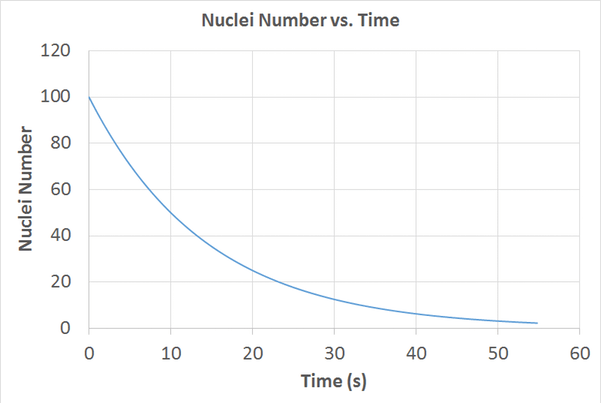
What is the Half life of this isotope?

a)

5 seconds

b)

10 seconds

c)

15 seconds

d)

20 seconds

31.

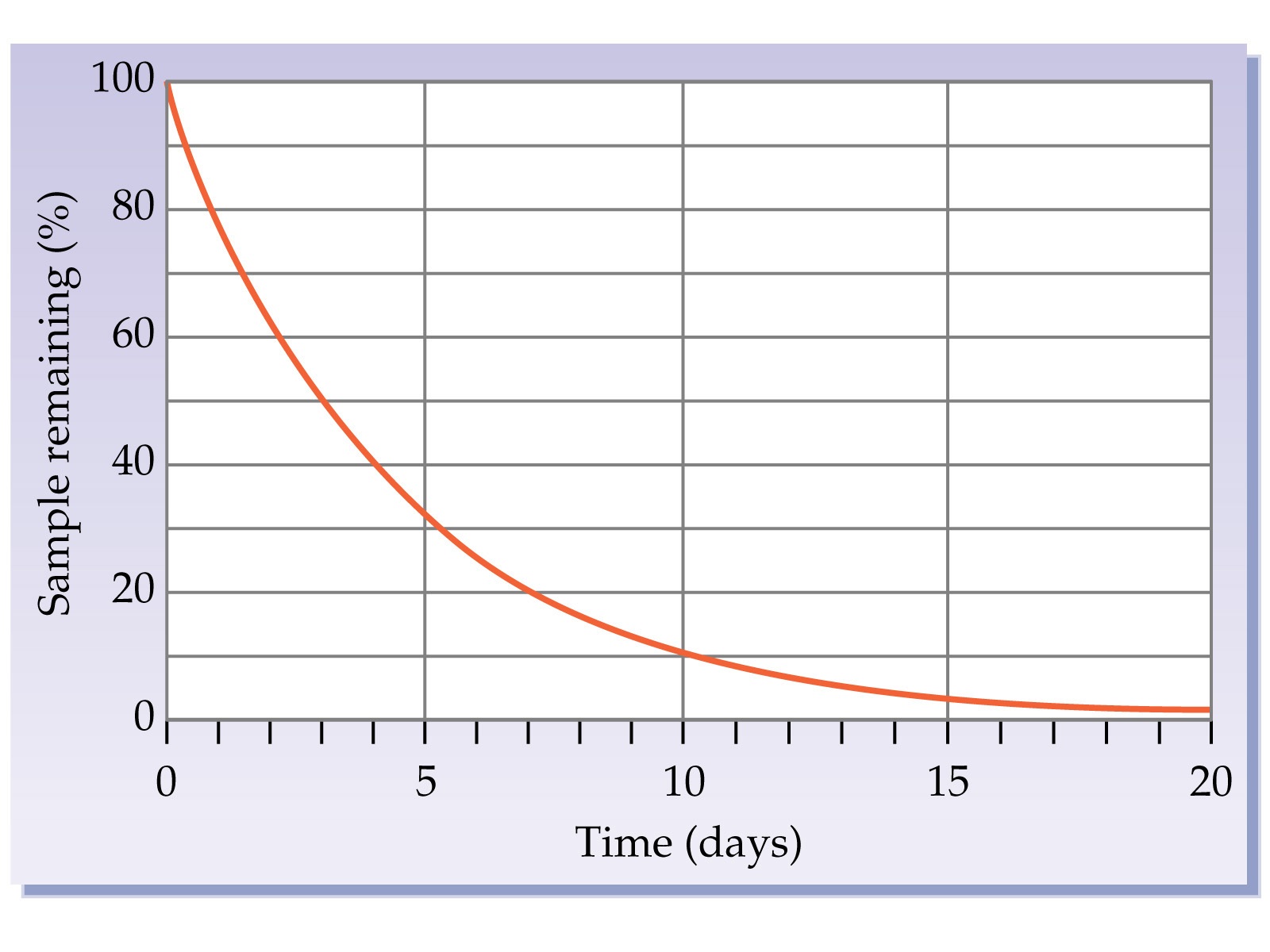
What is the Half Life of this isotope?

a)

3 days

b)

5 days

c)

8 days

d)

10 days

32.
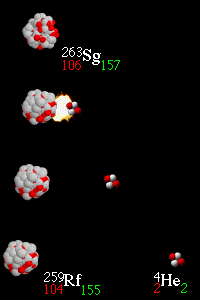
What type of decay is being illustrated in following picture? 
a)
beta decay
b)
alpha decay 
33.
Imagine you have 50,000 atoms of uranium-238. If U-238 has a half-life of 4.5 billion years, how many U-238 atoms will be left after 4.5 billion years? 
a)
25,000
b)
50,000
c)
12,500
d)
0
34.
Alpha particles.....
a)
a) are positively charged.
b)
b) consist of two protons and four neutrons.
c)
c) can penetrate any thickness of matter
d)
d) All of the above 
35.
During beta decay, a nucleus .... 
a)
gives up two protons and two neutrons.
b)
  maintains the same number of protons and neutrons.
c)
  loses a proton and gains a neutron.
d)
gains a proton and loses a neutron. 
36.
Nuclear Power is - 
a)
Renewable
b)
Non-renewable
37.
Nuclear power uses ____ for fuel.
a)
steel
b)
coal
c)
uranium
d)
hydrogen
38.
Nuclear energy uses _____ to turn turbines to power a generator.
a)
wind
b)
water
c)
steam
d)
solar
39.
Energy is stored in the ___ of an atom.
a)
proton
b)
neutron
c)
electron cloud
d)
nucleus
40.
An example of an uncontrolled fission reaction is _______________
a)
Nuclear power plants
b)
Radio active decay
c)
Atomic Bomb
d)
On the surface of the sun
41.

Can be stopped by aluminum foil; has no mass and negative charge.

a)

beta particle

b)

alpha partcle

c)

gamma ray

d)

half-life

42.
The splitting of a nucleus into smaller nuclei is
a)
fusion
b)
fission
c)
decay
d)
gamma radiation
43.

Powerful radiation that can cause biological damage.

a)

beta particle

b)

alpha particle

c)

gamma ray

d)

carbon dating

44.

The type of radioactive particle that can be stopped by a sheet of paper is the ____.

a)

alpha particle

b)

uranium

c)

beta particle

d)

gamma ray