
NEW
Font size
 Worksheets
Grade 8 Periodic table and bonding
Total questions: 27
Worksheet time: 28mins
Nitrogen will form which of the following ions?
N-1
N-3
N-5
N+5

Why is this electron being transferred from lithium to fluorine?
So they can both achieve a full out shell
Because it wants to
Because it is a right side electron
Because it does not like lithium
Which of the following would produce a a negative ion?
Ca
Al
K
F
What does the group number tell us about the structure of an atom?
Number of shells
Number of electrons
Number of electrons in the outer shell
Number protons
What does the period number tell us about the structure of an atom?
Number of shells
Number of electrons
Number of electrons in the outer shell
Number protons
What ions will the movement of this electron create?
Li+ and F+
Li- and F+
Li- and F-
Li+ and F-
What is the electron configuration of potassium, K, which has an atomic number of 19
2,8,8,8
2,8,8,1
1,8,8,2
2,2,8,7
The electron structure of an element is 2,8,8,3. What group and period is this element in?
group 4 period 4
group 3 period 4
group 4 period 3
group 3 period 3
A bond between a metal and a nonmetal is called a(n)
covalent bond
ionic bond
metallic bond
transfer bond
A bond between a nonmetal and a nonmetal is called a(n)
covalent bond
ionic bond
metallic bond
transfer bond
What type of bond involves the sharing of electrons between atoms?
covalent bond
ionic bond
metallic bond
transfer bond
Identify the following compound as ionic or covalent: MgO
ionic
covalent

What type of bonding does this picture show?
Ionic
Covalent
Which factors increase the rate of a reaction?
increasing temperature
increasing concentration
increasing surface area
all of these
Which of the following increase the reaction rate?
less surface area
lower temperature
increased concentration

Icing sugar has a greater ______ _____ than a solid cube of
sugar.
Surface Area
Catalyst
Temperature
Objects hitting each other
Collision
Catalyst
Explosion
Reaction
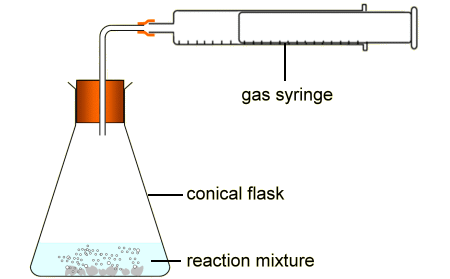
Which piece of equipment is used to measure the volume of gas produced in the reaction?
The gas syringe
The conical flask
The delivery tube
The reaction mixture
In the reaction between magnesium and hydrochloric acid the surface area of the pieces of magnesium was varied to see how it affected the volume of hydrogen gas produced. What is the independent variable in this experiment?
surface area of magnesium
volume of hydrogen produced
concentration of the acid
mass of the magnesium
In the reaction between magnesium and hydrochloric acid the surface area of the pieces of magnesium was varied to see how it affected the volume of hydrogen gas produced. What is the dependent variable in this experiment?
surface area of magnesium
volume of hydrogen produced
concentration of the acid
mass of the magnesium
In the reaction between magnesium and hydrochloric acid the surface area of the pieces of magnesium was varied to see how it affected the volume of hydrogen gas produced. What is a control variable in this experiment?
surface area of magnesium
volume of hydrogen produced
concentration of the acid
What are the products of the reaction between magnesium and hydrochloric acid?
Magnesium + chlorine + hydrogen
Magnesium chloride + hydrogen
Magnesium hydride + chlorine
What are the products of the reaction between calcium carbonate and hydrochloric acid?
Calcium + carbon dioxide + hydrogen
Calcium chloride + carbon dioxide + water
Calcium chloride + carbon dioxide + hydrogen
Calcium chloride + carbon dioxide

