
 Worksheets
SCALE IN THE SOLAR SYSTEM
Total questions: 20
Worksheet time: 16mins
Name
Class
Date
1.
Which planet in our solar system is closest to the Sun?
a)
Earth
b)
Jupiter
c)
Mercury
d)
Saturn
2.
Which definition accurately describes the Astronomical Unit (AU)?
a)
The average distance between the planets.
b)
The average distance between Earth and Mars.
c)
The average distance between the Earth and the Sun.
d)
The average size of the Earth compared to the Sun.
3.
A student made a model of how the Earth, Moon, and Sun orbit. She used ping-pong balls
to represent each one. She painted each one a different color. Then, she placed the Moon
and Earth close together and the Sun much further away.What is one limitation of the student's model?
to represent each one. She painted each one a different color. Then, she placed the Moon
and Earth close together and the Sun much further away.What is one limitation of the student's model?
a)
She used the same size balls.
b)
She made earth orbit the sun.
c)
She moved the Sun away from the Earth and Moon.
4.
How do the sizes of the inner planets compare to the sizes of the outer planets?
a)
The inner planets are larger.
b)
The outer planets are smaller.
c)
There is no size difference between the inner and outer planets.
d)
The inner planets are smaller.
5.
How many times larger is the diameter of the planet Jupiter compared to the diameter of the Earth?
a)
roughly 3x larger
b)
roughly 7x larger
c)
roughly 12x larger
d)
roughly 17x larger
6.
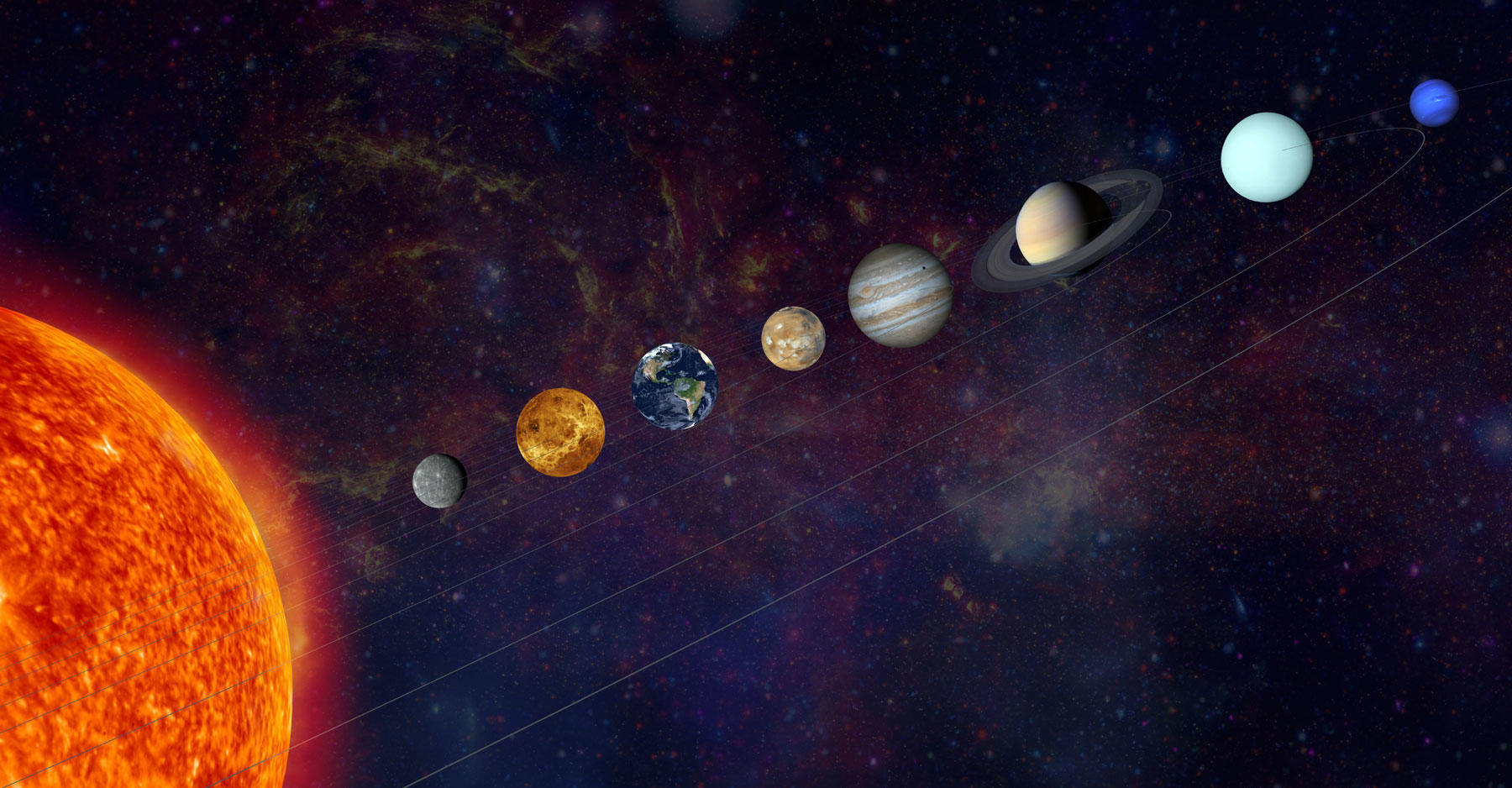
True or False
The planets are all equally distanced from each other.
The planets are all equally distanced from each other.
a)
True
b)
False
7.

This shows
a)
Size difference between the planets accurately
b)
Distance between the planets accurately
c)
All choices
8.
The _______ is between the orbits of Mars and Jupiter.
a)
Oort Cloud
b)
Asteroid belt
c)
Kuiper belt
d)
Photosphere
9.
Why can planets be seen in different locations at different times?
a)
because the Sun moves around the planets
b)
because telescopes are located in different places
c)
because of the different months of the year
d)
because planets move in an orbit around the Sun
10.
Which planet is the largest in the solar system?
a)
Earth
b)
Venus
c)
Saturn
d)
Jupiter
11.
What is the center of our solar system?
a)
The sun
b)
Earth
c)
Jupiter
d)
Saturn
12.
Our Solar System_________
a)
Has 8 planets that are very close together
b)
Has 8 planets, but is mostly empty space
c)
Has 9 planets that are very close together
d)
Has 9 planets, but is mostly empty space
13.
Why do scientists use scale to study the Solar System?
a)
The solar system is too large to study without using scale
b)
The solar system is too small to study without using scale
c)
Scientists don't need to use scale because we have satelites
d)
All of the above
14.
Why is making a model of the solar system difficult?
a)
Don't have the right materials
b)
The solar system is so big and the objects in it are so small in comparison
c)
There are too many parts in a model
d)
Because the science concepts are too difficult
15.
Which of the following orders the planets correctly from the Sun?
a)
Mercury, Venus, Earth, Mars, Jupiter, Saturn, Uranus, Neptune
b)
Mercury, Venus, Earth, Mars, Jupiter, Saturn, Neptune, Uranus
c)
Neptune, Uranus, Saturn, Jupiter, Mars, Earth, Venus, Mercury
d)
Earth, Venus, Mars, Mercury, Jupiter, Saturn, Neptune, Uranus
16.
Outside on the playground, students are making a scale model of the solar system. Which of
the following tools will be needed to measure the distance of the planets from the Sun on
the model?
the following tools will be needed to measure the distance of the planets from the Sun on
the model?
a)
Balance
b)
Thermometer
c)
Computer
d)
Meter Stick
17.
Which of the following is an accurate model of how the Sun, Earth, and Moon move?
a)
Sun and moon orbit Earth
b)
Earth and moon orbit Sun
c)
Earth orbit's the Sun and the moon orbits Earth
d)
Earth and sun orbit moon
18.
How many days does it take the Earth to revolve around the Sun?
a)
30 days
b)
365 days
c)
100 days
d)
40 days
19.
What is the nickname of Mercury, Venus, Earth, and Mars?
a)
rocky planets
b)
rock stars
c)
first four
d)
final four
20.
What is... a huge object in space made up of gas and giving off light and heat from nuclear reactions?
a)
planet
b)
comet
c)
star
d)
galaxy
100 %

