
 Worksheets
BWS Physics AQA GCSE Waves
Total questions: 43
Worksheet time: 47mins
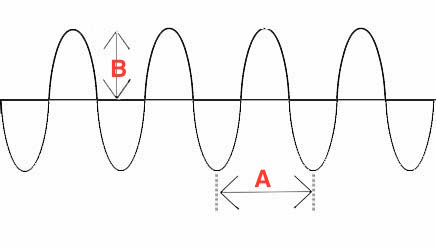
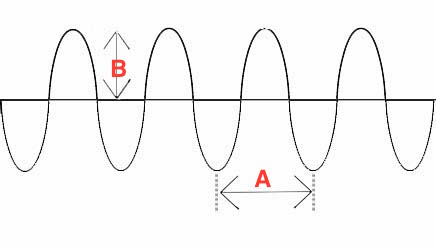
What property of this wave is represented by the letter "A"
amplitude
crest
trough
wavelength
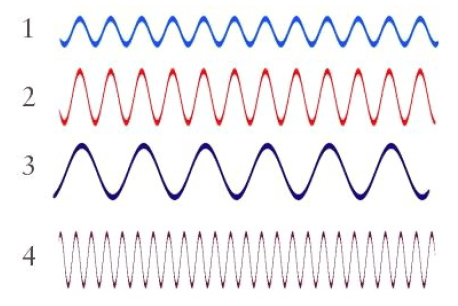
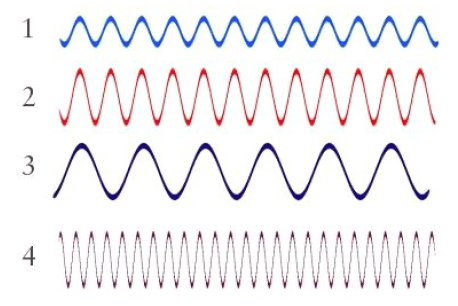
Which of the following can sound travel through?
solid
liquid
gas
all of the above
In which material does sound travel fastest?
solid
liquid
gases
What is transferred by a wave?
energy
matter
particles
mass

Which image represents a longitudinal wave?
A
B
Sound waves are which type of waves?
transverse
seismic
longitudinal
frequency


Which type of electromagnetic wave has the lowest energy of this group?
Radio
Microwave
Infrared
Ultraviolet

Radio waves and _______ are used in communication
Microwaves
Gamma rays
Visible light
Ultraviolet
The following path of an electron emits a light wave that our eyes can detect.
Ground -> Excited
Excited -> Ground
One full orbit of the nucleus
Protons emit light. The question is misleading.

Which of the following are examples of transverse waves?
Gamma waves
Ultrasonic waves
Ultraviolet waves
Sound waves
Visible light

What is the amplitude of this wave?
0.20 m
0.40 m
2.0 s
4.0 s
What is the time period of this wave?
0.20 m
0.40 m
2.0 s
4.0 s
What is the frequency of this wave?
0.25 Hz
0.50 Hz
2.0 s
4.0 s

Which of the following is the wave equation used to find wave speed?
T = 1/f
f = 1/T
v = f/λ
V = f x λ

The time period of this wave is 2 seconds. What is the wave speed?
1.0 m/s
2.0 m/s
4.0 m/s
8.0 m/s

A gamma ray has a frequency of 1.0 x 10 20 Hz and travels at 3.0 x 10 8 m/s. What is it’s wavelength?
3.3 x 10 -13 m
3.0 x 10 -12 m
3.3 x 10 11 m
3.0 x 10 12 m

Max is sitting in his boat observing water waves enter the harbour. He counts 20 waves passing into the harbour in one minute. What is the frequency?
0.33 Hz
3.0 Hz
20 Hz
1200 Hz

All waves transfer energy?
True
False

Which of the following is the correct order for the electromagnetic spectrum shown above?
Gamma, X-ray, UV, Visible, IR, Microwave, Radio
Radio, IR, Microwave, Visible, UV, X-ray, Gamma
Gamma, UV, X-ray, Visible, IR, Microwave, Radio
Radio, Microwave, IR, Visible, UV, X-ray, Gamma

Which of the following do all regions of the electromagnetic spectrum have in common?
Travel at the speed of light (3.0 x 10 8 m/s)
Cannot travel in a vacuum
Can be reflected, refracted and polarised
Need a medium to travel in

Which of the following is a danger of UV radiation?
Causes skin cancer
Causes hearing damage
Easily absorbed by water in the body’s cells
Can cause cancer of the brain

Which of the following is a danger of IR radiation?
Causes burns
Causes hearing damage
Easily absorbed by water in the body’s cells
Causes cancer
This is considered as the fastest kind of seismic waves.
Love waves
Body waves
Primary waves
Secondary waves
Which seismic wave can only travel through solids?
Sound waves
Infrasound waves
Primary waves
Secondary waves
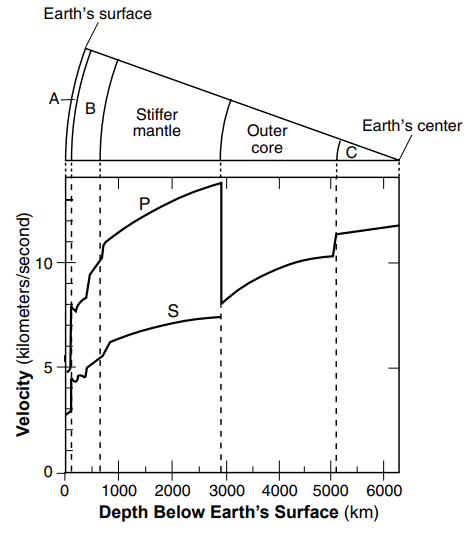
Primary (P) Waves can pass through...
solids only
liquids only
vacuum only
solids and liquids
Which seismic wave can travel through the earth's core?
S wave
P wave

