
 Worksheets
Second Year Summer '20
Total questions: 60
Worksheet time: 25mins
The Hornpipe is in 6/8 time
True
False
Sean nos singing means
New Style Singing
Old Style Singing
Normal Singing
None of the above
The end of Irish tunes usually include
Wide leaps
A variety of different chords
A repeated last note
Irish music began with
The oral tradition
The written tradition
Which of the following is not an Irish instrument
Banjo
Tin Whistle
Wooden Flute
Bodhran
The reel is in
4/4 time
6/8 time
9/8 time
3/4 time

This rhythm is a
Slip Jig
Jig
Horn pipe
Reel

This is a typical bar of rhythm for
Reel
Jig
Hornpipe
Slip jig
Chose an instrument commonly used in Irish Music
Double Bass
Saxophone
Tin Whistle
Tuba
The harper and composer Turlough
Maloney
O Carolan
de Burca
de Gascoine
What instrument did Turlough O' Carolan learn when he was very young?
The guitar
The harp
The drums
The piano
Seán Ó Riada won an award for composing the music for which film?
Mise Éire
Mise Sasana
Mise An Spáinn
Mise An Fhrainc
What family does the flute belong to?
Brass
Percussion
String
Woodwind
The clarinet and saxophone use a piece of bamboo to create their sound. What is this called?
Reed
Embouchure
Mouthpiece
Valves
What is the lowest pitched brass instrument in the orchestra?
Trumpet
French Horn
English Horn
Tuba
What is the lowest pitched string instrument?
Violin
Viola
Double Bass
Piano
What family does the saxophone belong to?
Brass
Woodwind
Percussion
String
How does the trombone change pitch?
Valves
A Slide
A bow
A pick
Most brass instruments change notes by pushing what?
A slide
Valves
Strings
Keys
Who controls the orchestra?
Conductor
Driver
Violin player
There is no one.
Which of these is not a member of the woodwind family?
Piccolo
Clarinet
Tuba
Bassoon
How do brass instruments make their sound?
Double reed
Buzzing into a mouthpiece
Using a bow
Using a pick

Clarinet
Bassoon
Cello
Triangle
Oboe


Bassoon
French Horn
Timpanu
Trombone

French Horn
Glockenspiel
Double Bass
Bassoon

Violin
Double Bass
French Horn
Tuba
Glockenspiel


What is pitch?
A throw
Highness or lowness of sound
Loudness or softness of sound
A series of musical notes
What is the musical alphabet?
ABCDEFGHIJ
ABCDEFGHIJKLMNOP
ABCDEFG
ABCDEFGHIJKLMNOPQRSTUVWXYZ

Name the pitch.
C
D
E
F

Name the pitch.
C
D
E
F

Name the pitch.
D
E
F
G

Name the pitch.
F
A
C
E

Name the pitch.
F
A
C
E

Name the pitch.
C
D
E
F

Name the pitch
C
D
E
F
Adding an accompaniment to a melody has the effect of adding another layer to enrich the ____________ of the music.
Volume
Texture
Speed
Pitch

In the ___________________ there are many melodic voices that are independent or imitative.
Monophonic texture
Homophonic texture
Polyphonic texture
Melody & accompaniment texture

_______________ is written for only one voice or part.
Polyphonic texture
Homophonic texture
Monophonic texture
Melody & accompaniment texture

In a _____________________________ there is one melody, and all the voices and accompaniments move rhythmically together (all the voices has the same rhythm).
Polyphonic texture
Homophonic texture
Monophonic texture
Melody & accompaniment texture

Choose the correct texture: Gregorian Chant.
Homophonic texture
Monophonic texture
Polyphonic texture
Melody & accompaniment texture
What is a solo?
Everyone playing together.
One person playing on their own.
Two people playing together.
A type of instrument.
What is the name for a repeated pattern?
A solo.
An ostinato.
Call and response.
Introduction.
Call and response is....
Everyone playing together.
When one person plays the everyone else answers.
A solo.
How we have to start a piece of music.

The short lines above and below the staff are called…
Rests
Notes
Staff
Ledger Lines
Who writes music?
Composer
Director
Writer
Conductor
Who is the head of orchestra?
Composer
Singer
Player
Conductor
What is the tonality for the following excerpt?
Minor
Major
Atonal
What is the tonality for the following excerpt?
Minor
Major
Atonal
A symbol or word used in musical notation indicating to gradually quicken tempo.
Accelerando
Ritardando
Energico
Rallentando
A direction to play lively and fast
Cadenza
Allegro
Adagio
Lento
The structure of a piece of music
Organization
Form
Figure
Construction
The distance in pitch between two notes
Step
Diatonic
Interval
Harmony
A single line of music played or sung. A musical sentence.
Measure
Phrase
Recitative
Refrain
Short detached notes, as opposed to legato
Pointed
Timbre
Staccato
Marcato
An "off the beat" accent
Marcato
Syncopation
Texture
Rhythm
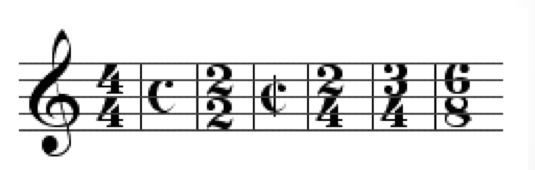
What is the name of the symbol at the beginning of a piece of music that tells us what kind of note is worth one beat, and how many beats are in a measure?
Time Signature
Key Signature
Rhythm
Pitch
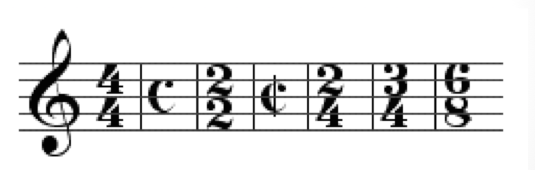
What does the top number of a time signature tell us?
How many beats are in the song
What type of note gets the beats
How many beats are in a measure
How loud the song is
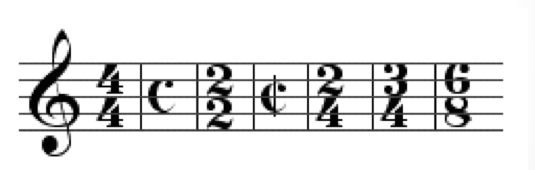
What does the bottom number of a time signature tell us?
How many beats in a song
What type of note gets the beat
How many beats in a measure
How loud the song is

