wayground logo

Free Printable Worksheets

Font size

S
M
L
XL
Worksheets

Biology Cumulative Test

Total questions: 45

Worksheet time: 18mins

Name
Class
Date
1.
Which enzyme has the job of unzipping the double helix?
a)
Helicase
b)
Polymerase
c)
Ligase
d)
Primerase
2.
If a strand reads:
3' A A A T T T C 5'
The matching strand would read...
a)
5' T T T A A A G 3'
b)
3' T T T A A A G 5'
c)
5' A A A T T T C 3'
d)
3' U U U A A A G 5'
3.
Polymerase is able to replicate the new DNA ______ along the leading strand.
a)
continuously
b)
only in short fragments
c)
very slowly
d)
prokaryotically
4.
Sometimes, DNA is called "semi-conservative." Why might this be?
a)
The old strand is "conserved" and used to make the new strands
b)
Uracil is "conserved" in that it is only used to make the new strands
c)
ATP is "conserved" via the usage of facilitated diffusion
d)
Ligase is "conserved" in that it is denatured by the process
5.

The monomers units of DNA and RNA are

a)

amino acids

b)

monosaccharides

c)

nucleotides

d)

fatty acids

6.

The signal that marks the end of a gene and causes transcription to stop is

a)

polymerase

b)

ligase

c)

a terminator

d)

methionine

7.

The RNA codon AUG means

a)

add amino acid methionine

b)

start the protein here

c)

add the amino acid tyrosine

d)

end the polypeptide chain here

8.

The transfer of genetic info from DNA to RNA is called

a)

translation

b)

transcription

c)

initiation

d)

elongation

9.

Which of the following sequences best describes the flow of information that takes place when a gene directs the synthesis of a cellular component?

a)

RNA-DNA-RNA-PROTEIN

b)

DNA-RNA-PROTEIN

c)

PROTEIN-RNA-DNA

d)

DNA-AMINO ACID-RNA-PROTEIN

10.

Translation consists of which of the following?

a)

conversion of genetic info from the language of nucleic acids to the language of proteins

b)

conversion of genetic info from DNA to RNA

c)

addition of nucleotides to a DNA template

d)

DNA replication

11.

The info carried by DNA is in

a)

an amino acid sequence

b)

the sugars and phosphates that form the backbone

c)

the order of bases in the molecule

d)

the total number of nucleotides

12.
Genotype refers to the ...
a)
physical expression of the genes
b)
the possible combination of alleles in a gene
c)
whether an allele is dominant or recessive
d)
how an organism will appear
13.
An offspring will receive how many alleles from each parent to determine a specific trait?
a)
one
b)
two
c)
three
d)
five
14.
What is a phenotype
a)
The genetic make up (code)
b)
The physical trait
15.
having two of the same genes for the trait (sometimes called purebred).
a)
homozygous
b)
hetrozygous
c)
protein
d)
chromosome
16.
An allele whose trait only shows up when no dominant allele is present.
a)
hidden allele
b)
dominant allele
c)
recessive allele
d)
present allele
17.
Snapdragon flowers come in red, pink and white.  What type of inheritance is this?
a)
Complete Dominance
b)
Incomplete Dominance
c)
Codominance
d)
Polygenic Inheritance
18.

What type of structures are shown?

a)

Homologous

b)

Analogous

c)

Vestigial

d)

Heterologous

19.

What type of structures are shown?

a)

Homologous

b)

Analogous

c)

Vestigial

d)

Heterologous

20.

What is shown ?

a)

embryology

b)

fetalology

21.

Evolution is a THEORY and is subject to change if new evidence is found.

a)

True

b)

False

22.
Evolution is...
(according to the video)
a)
A change in the gene pool
b)
A field of study where one studies weather.
c)
The study of rock strata.
d)
The study of cladograms
23.
Which mechanism of evolution is represented by the pinky finger?
a)
non-random mating
b)
natural selection
c)
population shrinks
d)
mutation
24.
Which mechanism of evolution is represented by the ring finger?
a)
non-random mating
b)
natural selection
c)
population shrinks
d)
mutation
25.
Which mechanism of evolution is represented by the middle finger?
a)
non-random mating
b)
natural selection
c)
population shrinks
d)
mutations
26.
Which mechanism of evolution is represented by the pointer finger?
a)
non-random mating
b)
natural selection
c)
population shrinks
d)
gene flow
27.
Which mechanism of evolution is represented by the thumb?
a)
non-random mating
b)
natural selection
c)
population shrinks
d)
gene flow
28.
What is a gene pool?
a)
a place where genes can swim
b)
change in a species
c)
all the genes in a population
d)
the opposite of natural selection
29.
Which mechanism shows genes leaving (immigration) or coming into (emigration) a gene pool?
a)
mutations
b)
natural selection
c)
gene flow
d)
non-random mating
30.
The diagram below shows the cycling of nutrients in an ecosystem.
The removal of which of the following groups would cause an immediate decrease in the amount of energy flowing through the system?
a)
Producers
b)
Consumers
c)
Decomposers
d)
Inorganic nutrients
31.
What is the original source of almost all energy in most ecosystems?
a)
carbohydrates
b)
sunlight
c)
water
d)
carbon
32.
An organism that produces its own food supply from inorganic compounds is called a(an)
a)
heterotroph
b)
consumer
c)
detritivore
d)
autotroph
33.
What is the term for each step in the transfer of energy and matter within a biological community?
a)
energy path
b)
food web
c)
trophic level
d)
food pyramid
34.
symbiotic relationship in which both organisms benefit
a)
competition
b)
Mutualism
c)
nitrogen fixation
d)
energy pyramid
35.
The energy at each trophic level in the pryamid of energy decreases by a factor of ____.
a)
10
b)
1
c)
100
d)
2
36.
What does a food web represent?
a)
All connections of energy flow throughout all organisms in a habitat.
b)
The specific ways that mutualism is carried out.
c)
A single pathway or energy flow between organisms. 
d)
How carnivores get their food. 
37.
diagram that shows the energy available to each trophic level in an ecosystem; 10% is passed on to upper levels, the rest is lost as heat
a)
succession 
b)
cellular respiration
c)
energy pyramid
d)
biochemical cycle
38.
symbiotic relationship in which one organisms benefits and the other organism is not affected
a)
invasive (non-native) species
b)
mutualism 
c)
nitrogen fixation
d)
commensalism
39.
A pond ecosystem is shown in the diagram below. Which statement describes an interaction that helps maintain the dynamic equilibrium of this ecosystem?
Which statement describes an interaction that helps maintain the dynamic equilibrium of this ecosystem?
a)
The frogs make energy available to this ecosystem through the process of photosynthesis.
b)
The algae directly provide food for both the rotifers and the catfish.
c)
The green-backed heron provides energy for the mosquito larvae.
d)
The catfish population helps control the populations of water boatman and waterfleas.
40.
What phase is this cell in?
a)
Cytokinesis
b)
Mitosis
c)
Prophase
d)
Metaphase
41.

The division of the cytoplasm is called?

a)

anaphase

b)

mitosis

c)

cytokineses

d)

G0

42.

What type of cell will form a cell plate during mitosis?

a)

Haploid cells

b)

Plant Cells

c)

Animal Cells

d)

Diploid Cells

43.

Non dividing state of the cell cycle

a)

Interphase

b)

Mitosis

c)

Telophase

d)

Cytokinesis

44.
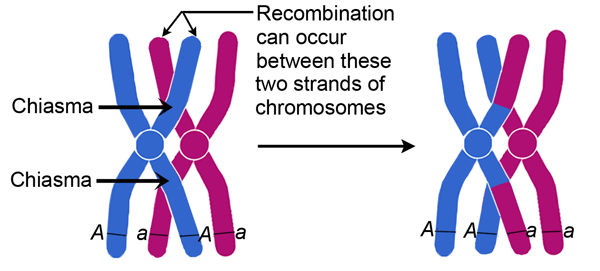
This image shows chromosomes during Prophase 1. Which of the following correctly describes the process shown?
a)
segregation of sister chromatids
b)
condensation and segregation of alleles
c)
mutationin which the DNA content of the gene is altered
d)
crossing - over in which alleles are exchanged
45.
How would you describe the cells produced by meiosis?
a)
2 identical diploid cells
b)
2 identical haploid cells
c)
4 genetically unique diploid cells
d)
4 genetically unique haploid cells