
 Worksheets
Chapter 14 Test 2020
Total questions: 27
Worksheet time: 41mins
The bending of light is called:
reflection
diffraction
refraction
dispersion
What type of lens is thinner in the middle than at the edges?
Convex
Concave
Objective
Magnifying
When light passes through a convex lens, it does this.....
Diverge, or spread apart
Converge, or come together
Reflect, or bounce off
Create a rainbow
When light waves move from passing through air to passing through a glass lens when happens to them?
They slow down and change direction
They speed up and change direction
They maintain the same speed and change direction
They maintain their same speed and direction
What type of lens do you have in your eye?
Concave
Prismatic
Objective
Convex
The angle of the incoming rays of light are also called the.....
Angle of reflection
Angle of refraction
Angle of incidence
Wave angle
The thinner the convex lens, the ___________________ its focal length.
Shorter
Longer
Thicker
Thinner
T or F? Because the light rays never meet, a concave lenses can produce only a virtual image.
True
False

Which lens can produce images that are either smaller or larger than the object?
a
b
Which of the following is used to calculate the critical angle :
n1sin(θ1)=n2(θ2)
f1=xi1+x01
sinθc=n1n2
m=hohi=−xoxi
Which equation is used to determine magnification :
n1sin(θ1)=n2(θ2)
f1=xi1+x01
sinθc=n1n2
m=hohi=−xoxi
Which lens has a negative focal length?
concave
convex
Describe completely the image formed when a 3 meter high person stands 8 meters in front of a very large convex lens which has a focal length of 4 meters.
Virtual, upright, smaller than the person
virtual, upright and larger than the person
real, inverted and 3 meters tall
real, inverted and smaller than the person
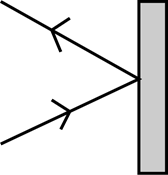
In the illustration, the light ray striking the object is-

How does light energy move?
Longitudinal Waves
Wavelengths
Transverse Waves
Ocean Waves
What color has the longest wavelength and lowest frequency?
Violet
Orange
Red
Blue
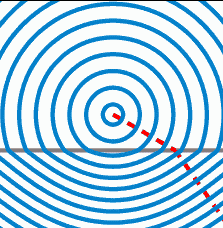
Snell's Law describes the relationship between the ________ angle and the _______ angle of waves passing through two different media
incident - reflected
incident - refracted
incident - bounced
answer is not here
What is the speed of light in a vacuum?
3.0 x 10⁸ m/s
1.0 x 10⁸ m/s
10 m/s
5.0 x 10⁸ m/s

Light travels from air (n = 1.00) into a "mystery" material. The incident ray of light hits the surface at angle of 43o and the refracted ray enters the mystery material at an angle of 27o. What is the index of refraction of the mystery material? n1sin(Θ1) = n2sin(Θ2)
1.5
1.0
0.67
2.1

Light travels from air (n = 1.00) into a glass block that has an index of refraction of 1.46. The incident ray of light hits the surface at angle of 45o. At what angle will the light ray enter the glass? n1sin(Θ1) = n2sin(Θ2)
45o
29o
31o
64o

Based on the image, as light passes from medium 1 to medium 2
light speeds up and bends towards the normal
light speeds up and bends away from the normal
light slows down and bends towards the normal
light slows down and bends away from the normal
The _______________ of light can change when light is refracted because the velocity changes.
frequency
wavelength
medium
transparency
An object is placed 20.0 cm from a thin converging lens along the axis of the lens. If a real image forms behind the lens at a distance of 8.00 cm from the lens, what is the focal length of the lens?
13.3 cm
-13.3 cm
5.71 cm
12.0 cm
If atmospheric refraction did not occur, how would the apparent time of sunrise and sunset be changed?
Sunrise would be earlier, and sunset would be later.
Sunrise would be later, and sunset would be earlier.
Both would be earlier.
Both would be later.
(2 pts) Comment on the pros and cons of distance learning for you.
(3 pts) Write a paragraph discussing your future plans in general (you can add specifics if you would like) - from now until next year at this time.

