wayground logo

Free Printable Worksheets

NEW

Font size

S
M
L
XL
Worksheets

Climate & Weather (Rabaca)

Total questions: 35

Worksheet time: 25mins

Name
Class
Date
1.

Which of the following is a description of climate?

a)

Today it is hot and sunny in Phoenix, Arizona.

b)

Summers are usually mild in Lansing, Michigan.

c)

Last week it rained every day in San Antonio, Texas.

d)

Yesterday was cold and windy in Anchorage, Alaska.

2.

If a person is describing the daily changes in temperature and precipitation, they are referring to an area's —

a)

Geology

b)

Climate

c)

Geography

d)

Weather

3.

Which of the following is an example of weather data?

a)

The average high temperature in May is 21°C in the Midwest of the United States

b)

Central Australia usually receives less than 110 mm of rainfall all year

c)

The relative humidity was 24% at noon on July 23 in Tempe, Arizona

d)

On average, there is 88mm of rain in the Gulf Coast region in July

4.

What could the title of this table be?

a)

Climate Report for Pine Hill, NJ

b)

Average Temperatures for Pine Hill, NJ

c)

Weather Report for Pine Hill, NJ

d)

Precipitation Report for Pine Hill, NJ

5.

The table shows some weather data collected over a five-day period. What pattern over the five days can be observed in the collected data?

a)

There was more rain on the warmer days.

b)

Rain came along with lower temperatures.

c)

There were fewer clouds as the week went on.

d)

Temperature increased during the week.

6.

Climate data is not the same as weather data. Which of the following is a description of climate data?

a)

New York had a record rainfall on Wednesday.

b)

Lima, Peru had a low temperature last night of 17°C.

c)

Winds are currently from the south in Ann Arbor, Michigan.

d)

The coast of Antarctica has very short summers.

7.
The tropical rainforest has experienced 50 to 260 inches of rainfall annually for the last  few decades.
a)
Weather
b)
Climate
8.
Wind speed is changing as the Hurricane moves over land.
a)
Weather
b)
Climate
9.
We can expect rain on Tuesday.
a)
Weather
b)
Climate
10.

Precipitation is

a)

rain, sleet, snow or hail.

b)

only rain.

c)

only snow or hail.

11.

Land closer to the equator is

a)

colder.

b)

warmer.

c)

dry.

12.

Low pressure brings

a)

'lousy' weather

b)

'happy' weather

13.

High pressure means

a)

'lousy' weather

b)

'happy' weather

14.
_______ affects weather because the further north or south you go from the Equator, the less solar energy (heat).
a)
altitude
b)
latitude
c)
sunlight
d)
atmosphere
15.
Large body of air with the same temperature, pressure, and moisture characteristics is called?
a)
warm front
b)
cold front
c)
air mass
d)
jet stream
16.
The boundary between two air masses that meet is called?
a)
front
b)
back
c)
side
d)
air mass
17.
The result of the weight of a column of air pushing down on an area is called _.
a)
altitude
b)
pressure
c)
density
d)
air pressure
18.
How hot or cold something is - 
a)
friction
b)
temperature
c)
gravity
19.
A polar climate is?
a)
warm and cool
b)
consistently moderate
c)
consistently cool
d)
consistently warm
20.
The temperature of a tropical climate is?
a)
consistently warm
b)
consistently cool
c)
consistently moderate
d)
warm and cool
21.

Which climate zone do we live in?

a)

Temperate

b)

Tropical

c)

Polar

d)

Continental

22.

How many climate zones have we discussed in class?

a)

1

b)

7

c)

5

23.
Which month has the highest average temperature?
a)
August
b)
July
c)
June
d)
May
24.
A cold, dry air mass would be called - 
a)
continental tropic
b)
continental polar
c)
maritime polar
d)
continental maritime
25.
When a warm air mass slides on top of a cold air mass, and you have drizzly rain and then warmer weather, what type of front is it?
a)
warm front
b)
cold front
c)
occluded front
d)
stationary front
26.
What type of weather would a continental tropical air mass bring?
a)
dry and cold weather
b)
wet and cold weather
c)
dry and warm weather
d)
wet and warm weather
27.
An air mass that formed over the ocean near the equator would probably be - 
a)
maritime polar
b)
maritime tropical
c)
continental polar
d)
continental tropical
28.

What does symbol # 2 represent on a weather map?

a)

stationary front

b)

occluded front

c)

warm front

d)

cold front

29.

What does symbol # 1 represent on a weather map?

a)

stationary front

b)

occluded front

c)

warm front

d)

cold front

30.
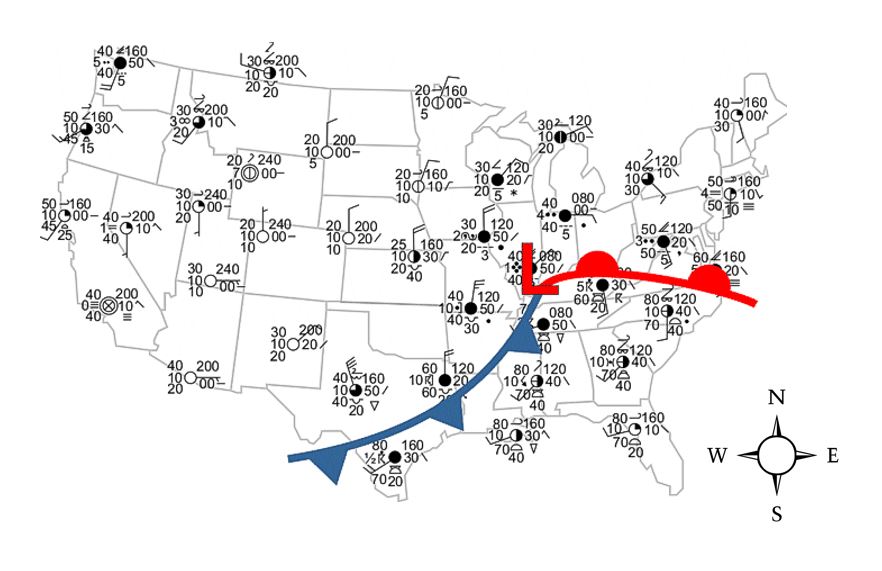
What direction is the cold front moving on the map? 
a)
Southwest
b)
Northwest
c)
Southeast
d)
Northeast
31.
What type of weather would you expect to see after a warm front has passed through an area?
a)
cool and clear skies
b)
warm and humid
c)
thunderstorms
d)
foggy
32.
What type of weather would you expect to see after a cold front has passed through an area?
a)
cool and clear skies
b)
warm and humid
c)
thunderstorms
d)
foggy
33.
This event can best be identified as what?
a)
cold front
b)
warm front
c)
stationary front
d)
occluded front
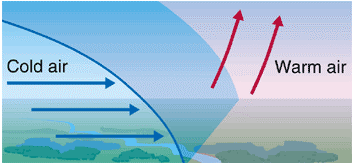
34.
A cold air mass moves underneath a warm air mass causing the warm air to rise. This  event can best be identified as — 
a)
cold front
b)
warm front
c)
stationary front
d)
occluded front
35.
What type of storm front if this?
a)
Warm Front
b)
Cold Front
c)
Stationary Front
d)
Occluded Front