
 Worksheets
1 Term Exam 5th
Total questions: 15
Worksheet time: 33mins
Name
Class
Date
1.
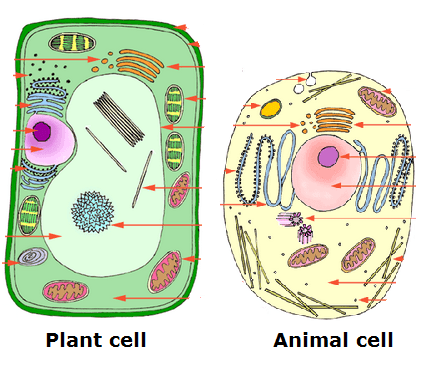
What distinguishes a plant cell from an animal cell? (How do you tell them apart) Hint: There's 3 ways (Check all 3)
a)
Central Vacuole
b)
Mitochondria
c)
Cell Wall
d)
Ribosomes
e)
Chloroplasts
2.
In cells a large oval organelle that contains the cells genetic material in the form of DNA and controls many of the cells activities
a)
organelle
b)
ribosome
c)
cell wall
d)
nucleus
3.

a small grain shaped organelle found in the cytoplasm of a cell or on the R-ER that produced proteins
a)
cytoplasm
b)
ribosome
c)
cell membrane
d)
mitochondria
4.
What kind of transport does not require energy?
a)
Active
b)
Vacuole
c)
Passive
d)
Na/K Pump
5.
What is facilitated diffusion?
a)
Transport that uses proteins to help move molecules across the membrane.
b)
Movements of substances through a membrane.
c)
When molecules spread from High to Low concentration on their own.
d)
When pressure pushes something through a membrane.
6.
Which of the following is the best example of osmosis?
a)
NA/K Pump
b)
Water moving though the cell membrane
c)
Kidneys
d)
Photosynthesis
7.
Active transport does not require energy.
a)
True
b)
False
8.
Subatomic particles with a negative charge
a)
Electrons
b)
Neutrons
c)
Protons
d)
Quarks
9.
Subatomic particles with a positive charge
a)
neutrons
b)
atomic mass
c)
protons
d)
isotopes
10.
Subatomic particles that are neutral in charge
a)
Neutrons
b)
Protons
c)
Nucleus
d)
Electrons
11.
JJ Thomson's theory was nicknamed _______.
a)
Billiard Ball Theory
b)
Solar System Theory
c)
Electron Cloud
d)
Plum Pudding
12.
He developed the planetary model of the atom.
a)
Rutherford
b)
Bohr
c)
Chadwick
d)
Dalton
13.
what is the biggest group on the table
a)
metals
b)
nonmetals
c)
metaloids
d)
halogens
14.
how many rows are on the table
a)
4
b)
5
c)
6
d)
7
15.
how many groups/families are on the table
a)
15
b)
16
c)
17
d)
18
100 %

