wayground logo

Free Printable Worksheets

NEW

Font size

S
M
L
XL
Worksheets

Genetics

Total questions: 45

Worksheet time: 38mins

Name
Class
Date
1.

Two identical alleles for a trait is known as

a)

homozygous

b)

heterozygous

c)

mutation

d)

codominance

2.

A physical appearance is

a)

genotype

b)

heterozygous

c)

phenotype

d)

codominance

3.

What does Pp mean?

a)

two dominant alleles

b)

heterozygous alleles

c)

one dominant allele

d)

two dominant and recessive alleles

4.

Who studied different characteristics of pea plants by cross-pollinating plants?

a)

Gregor Mendel

b)

Albert Punnett

c)

Sir Isaac Newton

d)

David Kuster

5.

What does a Punnett Square determine?

a)

all of Mendel's discoveries about genetic crosses

b)

all the outcomes of a genetic cross

c)

only the recessive allele combinations

d)

only the dominant allele combinations

6.

Genotype is

a)

stem height

b)

feather color

c)

physical appearance

d)

genetic makeup

7.

The term that relates to physical characteristics that are studied in genetics.

a)

traits

b)

offspring

c)

generations

d)

hybrids

8.

Factors that control traits are

a)

purebreds

b)

genes

c)

recessives

d)

parents

9.

A mutation is

a)

any change that is harmful

b)

any change in a gene or chromosome

c)

any change that is helpful

d)

any change in the phenotype

10.

If a homozygous black cat (BB) is crossed with a homozygous white cat (bb), what is the probability of having a cat with white fur?

a)

100%

b)

0%

c)

75%

d)

25%

11.

What does RR mean

a)

two dominant alleles

b)

heterozygous alleles

c)

at least one dominant allele

d)

one dominant and one recessive allele

12.
Genotype refers to the ...
a)
physical expression of the genes
b)
the possible combination of alleles in a gene
c)
whether an allele is dominant or recessive
d)
how an organism will appear
13.
An offspring will receive how many alleles from each parent to determine a specific trait?
a)
one
b)
two
c)
three
d)
five
14.
Which of the following is a phenotype?
a)
BB
b)
Bb
c)
bb
d)
Blue eyes
15.
having two of the same genes for the trait (sometimes called purebred).
a)
homozygous
b)
hetrozygous
c)
protein
d)
chromosome
16.
having two different genes for a trait (sometimes called hybrid).
a)
protein
b)
homozygous
c)
heterozygous
d)
genotype
17.
An allele whose trait only shows up when no dominant allele is present.
a)
hidden allele
b)
dominant allele
c)
recessive allele
d)
present allele
18.
One form of a gene is called_______________
a)
a DNA
b)
a Phenotype
c)
a trait
d)
an allele
19.
Which of the following genotypes is a purebred?
a)
Bb
b)
Gg
c)
bb
d)
Dd
20.
If green is dominant over purple, then what is the genotype for this individual?
a)
Purple
b)
Green
c)
GG
d)
gg
21.
The two strands of a DNA molecule are held together by ________ bonds between their base pairs.
a)
covalent
b)
hydrogen
c)
ionic
d)
peptide
22.
Which of the following is not a base found in DNA?
a)
adenine
b)
thymine
c)
cytosine
d)
uracil
23.
What part of a nucleotide accounts for the genetic variation between individuals?
a)
phosphate
b)
nitrogenous base
c)
deoxyribose
d)
sugar
24.
If a segment of double-stranded DNA has 40 percent A, how much of it is C?
a)
40
b)
10
c)
15
d)
20
25.
If one strand of DNA has the sequence TTACCG, the sequence of the other strand of the same molecule will be
a)
AATGGC
b)
TTACCG
c)
AACGGC
d)
AATGGG
26.
Once replication in a DNA molecule is complete, each new DNA molecule contains 
a)
two new strands.
b)
3 exact copies of strands.
c)
one new strand and one old.
d)
two old strands.
27.
Which enzyme copies DNA?
a)
DNA polymerase
b)
DNA helicase
c)
RNA polymerase
d)
RNA helicase
28.
What are the functions of genes?
a)
instructions for producing proteins
b)
instructions for producing DNA
c)
instructions for producing lipids
d)
they have no function
29.
What does mRNA do?
a)
provides information from DNA to ribosomes
b)
transfers amino acids to the ribosomes
c)
makes up ribosomes
d)
builds proteins
30.
What is the process that copies information from DNA into RNA?
a)
protein synthesis
b)
transcription
c)
translation
d)
DNA Polymerase
31.
RNA contains the sugar
a)
ribose
b)
deoxyribose
c)
glucose
d)
lactose
32.
What will be the resulting mRNA from this DNA sequence:
GAT-TAC-AGA-TTA-CAT?
a)
CTA-ATG-TCT-AAT-GTA
b)
GAU-UAG-UGA-UUA-GUT
c)
CUA-AUG-UCU-AAU-GUA
d)
CAT-ACA-TAC-ATA-TAG
33.
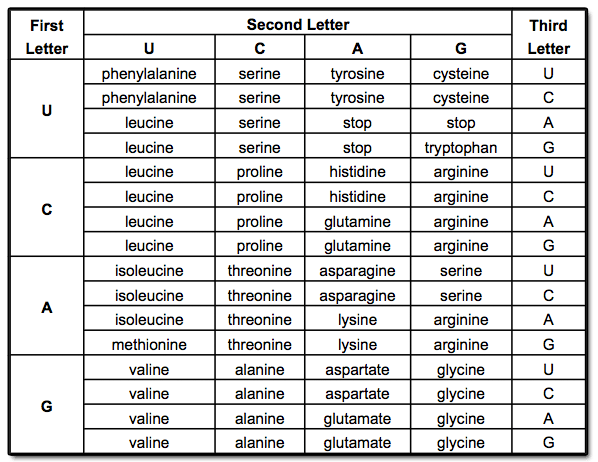
What is the correct amino acid sequence for the mRNA code AUGCCAGUAUGA
a)
Met-Pro-Ala-Val
b)
Met-Pro-Val
c)
Tyr-Gly-His
d)
Tyr-Gly-Arg-His
34.
Every three letters (example: ATC) in DNA codes for what??
a)
Amino Acid
b)
Nucleotide
c)
Lipid
d)
Carbohydrate
35.
One difference between DNA and RNA is that RNA....
a)
is double stranded 
b)
contains the base Thymine
c)
contains the base Uracil 
d)
contained the base Guanine
36.
Amino acids are joined together in order to form
a)
DNA
b)
ribosomes
c)
proteins 
d)
RNA
37.
What has DNA?
a)
animals
b)
plants
c)
bacteria
d)
all of the above
38.
What is the correct sequence?
a)
RNA --> DNA --> Protein
b)
Protein --> RNA --> DNA
c)
DNA --> RNA --> Protein
d)
DNA --> Protein --> RNA
39.
In eukaryotes, DNA is located in the
a)
cytoplasm
b)
nucleus
c)
cell membrane
d)
ribosome
40.
How many bases are in one codon?
a)
1
b)
2
c)
3
d)
4
41.
Translation takes place in the 
a)
ribosome
b)
chloroplast
c)
nucleus
d)
mitochondria
42.
What is the term for a three-nucleotide sequence that codes for an amino acid?
a)
base
b)
codon
c)
amine
d)
serine
43.
Which phrase best describes translation?
a)
converts mRNA into a polypeptide
b)
catalyzes bonds between amino acids
c)
produces RNA from DNA molecules
d)
recycles tRNA molecules for reuse
44.
Who is responsible for producing this image?
a)
Francis Crick
b)
James Watson
c)
Rosalind Franklin
d)
Watson and Crick
45.
What does this image show?
a)
Double helical structure of DNA
b)
Triple Helical Structure of DNA
c)
Double helical structure of RNA
d)
Triple Helical Structure of RNA