
 Worksheets
3.2 Vocabulary
Total questions: 13
Worksheet time: 7mins
Why are advantageous traits more likely to be passed onto offspring?
Because they are more likely to survive and reproduce.
Because they come from dominant alleles.
Because they come from recessive alleles.
Because the organism knew it needed that trait, survives, and passes it on.
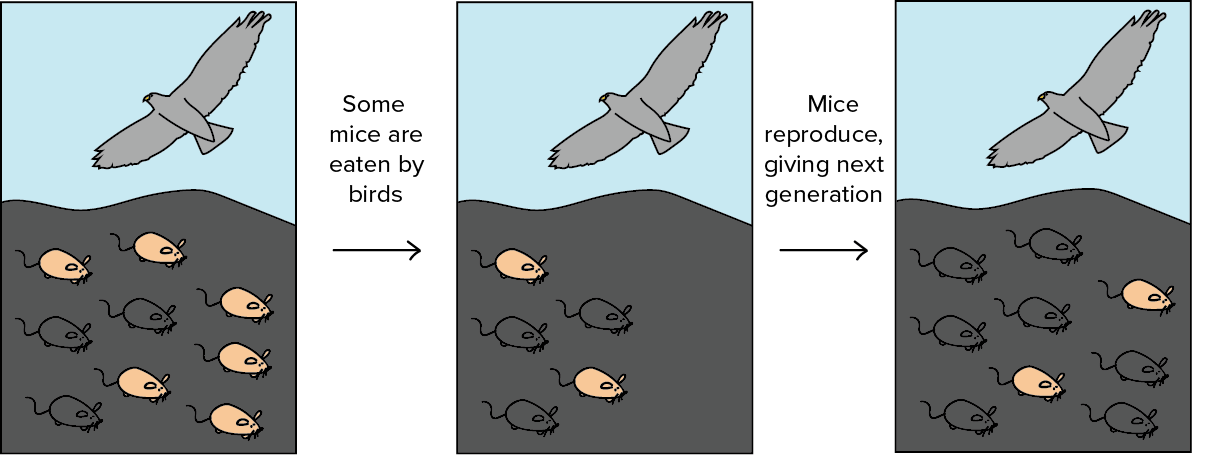

All rabbits of the same species living in a particular area would be an example of a(n)
population
species
community
ecosystem
Mutations sometimes result in an adaptive trait.
True
False
Mutations sometimes result in a non-adaptive trait.
True
False
Traits introduced by mutation will always become more common in a population.
True
False
Traits introduced by mutation will sometimes become more common in a population.
True
False

Blue jays with thinner beaks eat the seeds inside pinecones. Blue jays with thicker beaks eat seeds with hard shells.
Could there be thin beaks if there are only seeds with hard shells?
No blue jays could have been born with a thin-beaks.
No blue jays could have been born with a thick beak
A baby blue jay could have been born with a thin-beak mutation.
A thick beak bird could have changed to a thin beak.

If their environment changes to have only brown dirt, which of the following fox populations will most likely survive?
Populations 1 and 2 will most likely survive.
Populations 2 and 3 will most likely survive.
Only Population 2 will survive because it is the only population with variation.
All the populations will survive because the foxes will change the color of their fur if they need to.

